Somm's Table

Perfect pairings from the other side of the equation.

  • About
  • Front of the House
  • Back of the House
  • Contact Us
Powered by Blogger.

The day we landed in Rome on our trip to Italy last September, we ran into some annoying travel problems. We landed after our long flight to discover that there were issues with our car reservation. Bottom line, there was no car. Neither of us had slept much on the flight (I can never sleep much on planes), so we were in that zombie state where it’s both hard to make sense or make sense of the world around you. It took a very long time to get ourselves sorted and out of the airport.

When we finally got ourselves settled, we muscled up enough energy to take an introductory stroll around the city. Eventually, all we wanted was something tasty to eat (we were in Italy after all) and something cold and refreshing to drink. Nothing complicated; just delicious.


The solution was clear: pizza and Lambrusco. We found our way to one of the pizzerias on our long list of recommended restaurants – Pizzeria Baffetto – and sat down to a big pie loaded with toppings and a cold, fizzy bottle. It was still hot in Rome at this time of year, and a big red just did not seem appealing. Nor were we in any state to really analyze and revel in a complex wine. Lambrusco was just the thing.


This Cleto Chiarli Lambrusco Grasparossa di Castelvetro was just what we wanted with this pizza.

That said, don’t assume I’m talking about the sweet, schlocky fizz that Lambrusco became associated with a while back. I learned there was a lot more to this class of wines a long time ago. One of the very first pieces I wrote on wine years ago was called “Lauding Lambrusco” for the now-departed Food Arts Magazine. It covered a seminar and tasting celebrating the wide range of styles Lambrusco comes in, and paired different versions with many different bites prepared by celebrated Chefs like Michael White. My appreciation for these wines started there, and since Lambruscos don’t tend to be very pricey it’s been easy to continue the relationship over the years and will usually have a bottle of two around.


Lambrusco is actually the name of a group of related grape varieties originating in Emilia-Romagna in northern Italy, although these grapes are grown in a few other regions as well. These sparkling wines range in styles from sweet (dolce), to off-dry (amiable) to very dry (secco). There are even rosé and white Lambruscos (these make a delicious pairing for sushi!), but by far and away the most common versions are red.


We’re not going to get too far into the nitty gritty of each one, but there are a few different varieties and some of them have their own DOC’s in Emilia-Romagna which include: Lambrusco di Sorbara, Lambrusco Grasparossa di Castelvetro, and Lambrusco Salamino di Santa Croce. (There are 8 different Lambrusco DOC’s in total.) Across the board, in all of these cases the wine must be made up of at least 85 percent Lambrusco grapes, and in some cases it has to be a specific sub-variety.  (The remaining bit can be made of different grapes depending on the DOC.)


Today’s wine is a Lambrusco Grasparossa di Castelvetro, which comes from a the town of Castelvetro di Modena. Grasparossa is one of the most full-bodied of the Lambrusco varieties, and it is the most tannic. This all makes Grasparossa a really good option if you’re looking for an alternative to a still red wine that you can served chilled.


Most of Lambrusco is made through the charmat method (similar to Prosecco) for sparkling wine, but some is still made via the traditional method (similar to Champagne.) You do have to be careful about where you buy them, because there are a lot of mass-produced versions. However, if you go to a store you trust you can find really solid bottles that aren’t that pricey.


I’ve had the pleasure of trying some beautiful, complex versions, but I’m not going to lie to you, I tend to grab these bottles when, like on this occasion, I’m just looking for refreshment and enjoyment. We were beyond exhausted and worn down on that first night in Rome, and the pizza and Lambrusco combo was the perfect restorative, comforting, simple pleasure.


THE WINE & PAIRING


I recently decided to take inspiration from this experience for a homemade pizza night. We popped a bottle of Lambrusco and decided to let the wine inspire the toppings, then sipped away while the pizzas baked in the oven.


Our wine for the night was the Azienda Agricola Pezzuoli Lambrusco Grasparossa di Castelvetro NV, which comes from 4th generation winemaking family that has been in working since 1932. Their are wines are still 100% estate made.


The Pezzuoli Lambrusco Grasparossa di Castelvetro gave us notes of tart blackberries and sour cherry, a bit of meatiness, a touch of balsamic and medicinal herbs in the background. It was juicy, but dry with a savory finish and had lots of mouth puckering acidity.


We definitely wanted some charcuterie on this pizza, so opted for some Calabrese salami. Without overthinking it too much, the wine moved us to use roasted red pepper spread as our sauce over the usual tomato sauce. Given all the acidity, we though the wine could handle some marinated artichokes, and briny black olives seemed a good option to pair with the wine’s savory finish. Topped it all off with buffalo mozzarella for that melty, oozy, cheesy factor. I also sprinkled on a favorite herb mix just before serving, to tie in some of those light herbal notes in the wine and I really think it gave it a nice pop of flavor. Here’s the one I used, but feel free to use your favorite. The combination of ingredients reminded me of an antipasto platter served up on a pizza, hence the name.


I’m working on my pizza crust game. A friend recently gifted me some of her sourdough starter and I’ve been starting to make bread at home, as well experimenting with sourdough pizza crusts. This was only my second attempt at a homemade sourdough crust. The skill is definitely still in development, but this second run was already a big improvement from the first, and I’m more than happy to keep at it. I used this recipe from NYT Cooking, but the flour between the recommended and whole wheat flour. I used the entire quantity for one large pie, baked for 12 to 15 minutes at 550°F.  Feel free to use your favorite of buy storebought dough.


We really liked this combo and the Lambrusco was full on chuggable alongside it. So yummy!


I highly recommend this as a low-stress pairing experiment. Have a selection of pizza toppings available. Pop open and taste your bottle of wine, then just go with whatever you feel like having with it. Don’t stress, just go with your gut. It’s pizza and wine — the results are bound to be good!


OTHER POSSIBILITIES


Lambrusco is remarkably food friendly. Charcuterie, panini, pasta — of course! 100% I can tell you from experience that adry, savor version like this one is AMAZING with a mushroom burger. it’s a pretty ideal candidate for a summer cookout when you’ve got meat going on the grill on a hot sunny day. I’d guess this would be particularly good would vinegar based BBQ sauces. Don’t eat meat? I’m certain it would also be excellent with a portobello burger with a little balsamic vinegar or soy sauce glazed on top.


THE GEEKY DETAILS


I couldn’t find a tech sheet, but the estate vines are all grown through sustainable methods, with some organic practices in use. I believe it’s made through the charmat method.


MONEY TALK


I think I bought this wine for about $17ish (I can’t find the receipt) at Bay Grape. I that’s a really Solid Buy for a good representation of this style. 


*****

The rest of the Italian Food Wine Travel Group is exploring Lambrusco this month as well. If you see this early enough, you can join us for our Twitter Chat tomorrow morning at 8 am PT/ 11 am ET by following #ItalianFWT. Check out the group's offerings here:


  • Camilla from the Culinary Adventures with Camilla will be featuring "Every Wine Deserves a Second Look: Warmed Brie with Mulberry Chutney + Cleto Chiarli Lambrusco di Sorbara Vecchia Modena 2018"
  • Jill at L'Occasion shares "La Collina Biodynamic Bubbles -- Lambrusco!"
  • Wendy of A Day in the Life on the Farm highlights "Lambrusco? Really??"
  • Deanna from Asian Test Kitchen will showcase "Top 5 Fast Food Pairings with Lambrusco"
  • Jeff at Food Wine Click will share "Lambrusco Shines with Red Fizz and Fun"
  • Cindy of Grape Experiences will feature "Italian Old-School Classics: Easy Drinking Lambrusco with Spicy Vegetarian Pensa Romana"
  • Marcia of the Joy of Wine will be highlighting "Lambrusco - The Star of Emilia-Romagna" 
  • Linda from My Full Wine Glass will be sharing "Drinking Lambrusco in Strawberry Season"
  • Pinny of Chinese Food and Wine Pairings  is focused on "Picnicking with Scarpetta Frico Lambrusco"
  • Lauren at The Swirling Dervish will be sharing "Revisiting Lambrusco with Francesco Vezzelli Rive dei Ciliegi"
  • Nicole with Somm's Table shares "Cooking to the Wine: Pezzuoli Lambrusco Grasparossa di Castelvetro with Antipasto Pizza"
  • Gwendolyn of Wine Predator will be showcasing "Bugno Martino's Organic Lambrusco Defy Expectations"
  • Susannah of Avvinare will be featuring "Sparkling Lambrusco from Vitivinicola Rota"
  • Jennifer of Vino Travels shares "Over 150 Years of Dedication to Lambrusco with Cleto Chiarli"


This post contains affiliate links, including the following Amazon Associate links, from which I might receive a commission at no cost to you.
Passopisciaro Bottles.

In my last post we took a virtual trip to Sicily through a conversation with my friend Sarah H. Bray, who has spent a lot of time working in Sicily, among other places. Now we continue the exploration by narrowing in and looking more closely at Mount Etna. As Sarah is a US Brand Ambassador for Passopisciaro, we’ll get to know their winery, wines, and their relationship with the fascinating terroir on top of this volcano. 

Mt. Etna.
Mt. Etna.


Passopisciaro’s wines have always impressed me, so I was excited to talk to Sarah more about them and get know their backstory better. This winery is all about Nerello Mascalese, which is native to Mount Etna. This grape tends to show red fruit flavors with herbal and floral notes,as well as light hints of spice. It tends to be medium bodied with fresh acidity. Nerello Mascalese is also known for being really able to reflect its terroir. Passopisciaro really showcases this aspect of the grape with six different bottlings from different sites on Mount Etna.


Sarah told me that owner Andrea Franchetti seeks to show textural complexity in his wines. “He favors late picking in order to soften the phenolics of these highly tannic varieties,” creating polished wines. The wines are fermented in stainless steel vats, followed by malolactic fermentation and 18 months of aging in large neutral barrels. Since they use no new oak, that polish has to come from the quality of the fruit from the start. Andrea also believes in racking the wines when needed. Getting that oxygen in the wine allows for more expressive fruit and less rustic tannins when the wine are young. Other than this, intervention is kept to a minimum so as to allow the differences in the terroir to really shine through. 

Farming in Passopisciaro’s vineyards follows sustainable practices. They generally take a lutte raisonnée approach (basically only intervening when really necessary) and only use organic materials for treatments. They also borrow certain practices from biodynamic methods, following the moon cycles, but don’t the preparations.

In addition to the six Nerello Mascalese wines, Passopisciaro also makes a Passobianco from Chardonnay, and their top-end Franchetti cuvée which is a blend of  Petit Verdot and Cesanese d’Affile.

Now that we have this primer on the winery out of the way, let’s jump back into the conversation with Sarah.

*****
My understanding is that Andrea Franchetti did quite a lot both to revive the winery and the vineyards when he purchased the property. What was that process like and were there and surprises along the way?

He tells the story about how, after founding Tenuta di Trinoro, he was looking to start a new project in Sicily. Driving around the island, he thought it was too warm overall, but someone pointed up to the black mountain in the skyline, and he set off (I’m assuming at break-neck speed; he’s quite the fast driver!) Ascending, he stuck his arm out the window – this would have been around Easter time – and the air was substantially cooler. He then came upon these collapsed terraces across the volcano with these gnarly old vines planted on them. He ended up acquiring several parcels across the northern side of the volcano at different elevations, from 1,800-3,300 feet above sea level, and released his first vintage of Passopisciaro in 2001.
There really was no winery before him. There was a building with a caved in roof that he had to restore; the previous owner had abandoned the building when the lava flow of 1947 came within meters of it. In the vineyards, about 60 acres purchased in non-contiguous sites, there was much work to restore crumbling, overgrown terraces and bring these 70 to 100 year old-vines he’d purchased back to production. Meanwhile, he was experimenting with winemaking styles for this “vinello,” or little wine as he called the Nerello Mascalese grape; his winemaking experience previously had been with the Bordeaux varieties, so initially he used barriques to age the wines, but evolved to using neutral oak after the first several years when he saw that the wood overpowered the variety. As an outsider to Etna, he was also interested in trialling different varieties and what they could express about the terroir, so he planted additional vineyards of Chardonnay, Petit Verdot, and Cesanese d’Affile on the main estate in the contrada of Guardiola.

Passopisciaro's Winery at Guardiola.
I love that image of him racing up Mount Etna. It’s like he’s chasing the terroir!
There must be some real challenges to working on an active volcano. Give us some insight into what that’s like?

You think active volcano, and of course, there is the constant, very real threat of eruptions. Etna is a composite volcano, meaning that pressure can build and release at any point on its surface, not just from the summit craters that loom at 11,000 feet above. The aftershocks of eruptions are also a challenge; the eruption that occurred after Christmas last year caused more damage through the earthquakes (mostly on the eastern side) than any lava did.

Smoke in vineyards on Mount Etna.
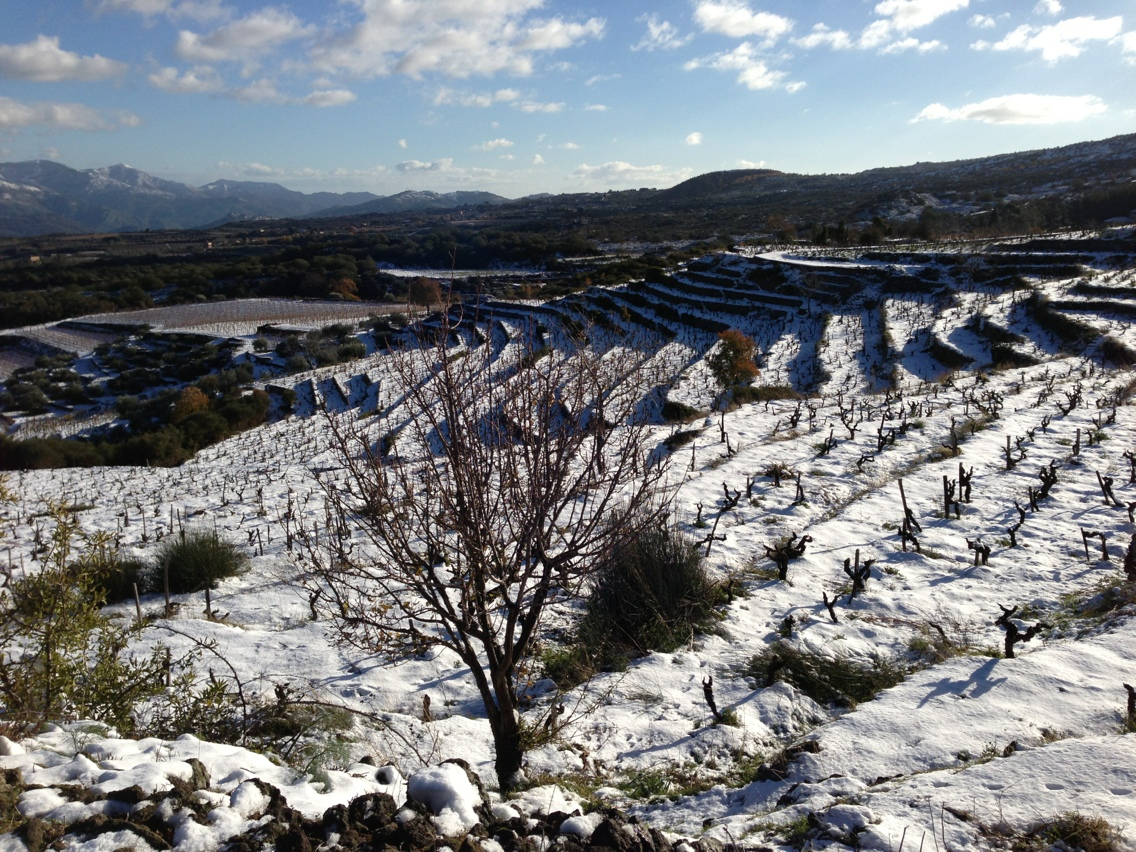
There is also the very fact of how hard these vineyards are to work. The traditional planting method is a bush-trained “alberello” (little tree) on terraces of varying widths that ascend in altitude very quickly, requiring manual labor at every stage of the growing cycle, but in soils that are like walking on the moon. It’s really laborious to move through the vineyard just walking – think about carrying equipment or crates of grapes!

Winter pruning on terraced vineyards of Mt.Etna.

For more on what it’s like to make wine on Mount Etna, see this detailed section on the Passopisciaro site.

Everything about this seems so precarious! However, the upside seems to be that the volcano creates really distinctive terroirs and these are now being classified. Passopisciaro has been at the front of establishing this cru system on Etna, known. Give us a brief overview of how it’s organized. How do you see that evolving?

The Contrada system on Etna leverages existing territorial names on the volcano. If you grew up there and told another local, meet me in Contrada Rovitello, that person would know instinctively where to go. In fact, Passopisciaro’s address just reads Contrada Guardiola -– mail and delivery guys know where to go, but it’s a bit more difficult for clients to find us the first time they visit!

These names roughly correspond with changes in elevation and lava spills and thus have been appropriated as names for the growing zones, which are quite distinct from one another. Some change as the lava flows occur: San Lorenzo was originally called Bocca Dolce, but the 1981 lava flow ate up several hectares, so the name was changed for the remaining territory; Sciaranuova, which literally means “new lava flow” in Sicilian dialect, is a small cru that corresponds to a flow from the 1600s that was planted in the 1800s (it takes about two hundred years for new lava to become friable enough to plant). 


Contrada map on Mt. Etna.

It’s also important to understand that every lava flow is made of a different mineral and soil composition, and over time, areas have been exposed to different elements. Sometimes, side by side sites are visibly different. In our Porcaria vineyard, which is part of the larger area Feudo di Mezzo, there once ran a river, so the pumice stones are much more worn down; Chiappemacine, instead, is at a lower elevation where a lava spill actually encountered limestone, and there’s a mix of these soils in parts of the vineyard making the soils lighter in color in some of the terraces. Elevation also has a huge impact, as ripening occurs at different times and climatic conditions can be quite different between 1,800 and 3,300 feet.

Passopisciaro vineyards in winter.
The real question about the evolution of this system lies in whether or not the DOC production zone will be expanded, which is not really on the front burner at the moment. Some Contrade lie within the DOC, some do not. Contrada Guardiola is split in half, with the upper confines of the DOC corresponding to the road that leads to our winery, which sits just above the road, as in just above the DOC line. Some of our vineyards are above, some below. Lots of the higher elevation sites on the northern face of the volcano are being used to make wines (really great ones, in fact), but they cannot be called Etna Rosso’s.
While Marco de Grazia was the first to put these names on his labels and begin to talk about the sites in terms of Grand and Premier Crus, Andrea had the idea to start an event called Le Contrade dell’Etna in 2008, where he invited other producers to his estate to bring samples of the most recent vintage and taste through these young nerellos from the different territories. He also invited some international trade and media, and that event really helped propel the region, and the concept of these cru sites, onto the world stage. The next edition of this event will take place on April 14 & 15.

For more info on Sicily’s terroir see this article Sarah wrote for SevenFifty Daily.


If I ever get to go to Sicily, I’ll have to plan my trip around Le Contrade dell’Etna. Seems like it’d be the perfect way to taste through and understand the terroir.

Now let’s add grapes into the mix. Passopisciaro focuses largely on Nerello Mascalese, with six of its eight wines coming from this grape. What’s is so captivating about it?  How does it transmit the various terroirs?

I could talk about Nerello Mascalese all day, every day. I think it is a grape that produces wines that are compelling, complex, and simply delicious. For someone encountering the grape for the first time, I talk about it like a lovechild of pinot noir and nebbiolo, since it has the tannic structure of the latter and the red fruit character of the former, with its own obvious distinct mineral and herbal characteristics (For the record, genetically, it’s not; according to Ian d’Agata’s Native Wine Grapes of Italy, it’s a natural crossing of Sangiovese and Mantonico Bianco).

In terms of transmission of terroir, Nerello Mascalese is an extremely transparent grape.


Images of Nerello Mascalese grapes and vines.
Images of Nerello Mascalese grapes and vines. Photo courtesy of Sarah H. Bray.


Here’s another detailed description of Nerello Mascalese from Andrea Franchetti on the Passopisciaro site :


The red wine of Etna is of nerello mascalese, an ancient grape, rare except on this volcano, where it is still splendidly cultivated like a mountain grape in old and ancient bush vines. It has little color, large bunches with strong, thick skins, and it ripens late – for the vines planted at 800 meters and above, as late as November. The light red color of the wine is from the variety, not from dilution; the berry is large, and instead of using the bitter skins, the wine is made from the juice, which is best when plants are not too stressed.

During fermentation, the nerello has notes of marzipan and a boorish, carnal quality, which are so pagan that the embarrassed winemakers let it fade; often, there’s a hint of nail polish when the yeasts are disturbed, but in every other sense, the fermentations on Etna happen easily because of the lack of pesticides, up to now, on the mountain. Notes of citrus and camphor come into the wine from the lava flows, and an aromatic acidity gives the impression of a sort of reddened white. When well made, nerello mascalese improves over eight years, then begins to age slowly, gaining hints of a sweet smokiness.


Now that we’ve learned so much about the wines, let’s turn to how to enjoy them. What are some of your favorite pairings for some of Passopisciaro’s wines?

Passobianco, the only white wine we make, is a delicious aperitivo wine, but I recently had it with a pasta dish over a fava cream, which was an absolutely delicious complement.

The Nerello Mascalese wines, from Passorosso to the five Contrada wines, can pair with fish as easily as pork both of which are readily available on a mountain that is located in the Mediterranean; they’re also great Thanksgiving wines, given that they can handle everything from the tartness of cranberry sauce to the richness of gravy. This glosses over the nuances of the five single vineyard wines, which generally are richer from the lower sites (Contrada C and P), structured from Contrada G, and lighter, more acidic, and almost ethereal from the higher elevation sites (S and R); when I have the option of showing them together, I course them according to body.

The Franchetti wine we make, made of Petit Verdot and Cesanese d’Affile, are great with meat dishes like barbecue and steak au poivre; I’ve also had them at the end of meals with simple desserts, given the richness of the black fruit that comes out in the wine with some bottle age.

Once again, you’ve given us some amazing suggestions. Fava cream, steak au poivre, and everything in between – it all sounds delicious. I’ll get my hands on a bottle soon to do some experimenting. Thanks for all the ideas and info Sarah!


Sarah H. Bray in Passopisciaro's vineyard on Mt Etna.
Sarah H. Bray in Passopisciaro's vineyard on Mt Etna. All photos courtesy of Vini Franchetti unless otherwise indicated.


*****

Sarah is one my collaborators on Bâtonnage Forum and will be here in Oakland at Bay Grape on 4/28/19 as part of our Women in Wine Discussion Series leading up to the event. Find more details here. All profits from ticket sales go to creating scholarships for minority women attending the Bâtonnage Forum!

You can also still get tickets to Bâtonnage as well. It's happening on 5/4 – just one month away! – in Napa.

Tickets and info here.


*****

The rest of the Italian Food Wine Travel (#ItalianFWT) is exploring Island Wines from Italy. Check out their posts here:

  • Steven from Steven's Wine and Food Blog features Sicilian Pasta con le Sarde Wine Pairing
  • Linda from My Full Wine Glass offers From Sardegna to Sicilia by Sea – Two Pairings
  • Pinny from Chinese Food and Wine Pairings explores Sicily’s Marsala Wine – A New Product (Wine) Life Cycle that Started in the 18th Century but Continues to Thrive Today!
  • Camilla from Culinary Adventures with Camilla recollects Island Memories, Slow-Roasted Lamb, and Cannonau Di Sardegna.
  • Lynn from Savor The Harvest is in the mood for Italian Island Wine Speak with Vinisola
  • Cindy from Grape Experiences reveals Discovering Liquid Gold from Sardinia and Sicily at Chicago’s Coda di Volpe.
  • Jennifer from Vino Travels tells the story of The Cultural Heritage of Mamuthone and Cannonau of Cantina Giuseppe Sedilesu.
  • Susannah from Avvinare invites readers to Discover Aleatico from the island of Elba.
  • Wendy from A Day In the Life on the Farm makes Oven Roasted Salmon with Tarragon Tartar Sauce paired with a Sicilian Grillo.
  • Lauren from The Swirling Dervish shares Island Wines of Italy: Alghero Torbato from Sardegna.
  • Gwen from Wine Predator features Island Wines of Italy: 3 from Sicily Paired with Pizza.
  • Jeff from FoodWineClick! is Dreaming of Italian Islands While We Wait for Spring.
  • Martin from ENOFYLZ Wine Blog tempts with Sardinian Vermentino di Gallura Paired With Shrimp and Asparagus Risotto.
  • Nicole from Somm's Table crafts A Passion for Sicily with Passopisciaro: An Interview with Sarah H. Bray, Part 1.
  • Jane from Always Ravenous is Tasting and Pairing Sicilian Wine From Mount Etna.
  • Cynthia and Pierre tell How a Wine Economists Conference Led Us to Wine from the Venice Lagoon.
  • Our hosts Jill and Jason at L'Occasion shares ‘300 Days of Sunshine’: The Vineyards of Sicilia DOC Interview with Alberto Tasca.


Passopisciaro Vineyards in Contrada Guardiola, on Mt. Etna, Sicily.
Passopisciaro Vineyards in Contrada Guardiola, on Mt. Etna, Sicily. Photo courtesy of Sarah H. Bray.

Over the past few years, I’ve developed increasing respect for the wines coming out of Sicily. The indigenous grapes of the island are intriguing and distinctive, while still striking me as being wonderfully food friendly. Moreover, the wines seem to have an ability to transmit their terroir that calls to me, drawing me in to pay closer attention. So I have been.


The timing is probably no coincidence since quality has been on a sharp upswing. The winemaking history here is quite ancient, going back more than 2,500 years, but it’s had checkered past. For a good part of the 20th century, it was largely known for making low-cost, mass-produced wines. However, it’s reputation has been doing a 180-degree turn in recent years. The warm, dry, breezy, climate is also pretty ideal for grape growing. This means that there isn’t much threat of vine diseases, so there isn’t much need for chemical sprays, which in turn means that it’s fairly easy to farm through sustainable methods.


The wines have definitely grabbed my interest and I’m trying to learn more, but I’m definitely no expert. . . Luckily, I have a friend who is. (I don’t know if she’d call herself that, but I will.) Sara H. Bray is a force. She’s one of my collaborators on Bâtonnage Forum for which she is “The Orchestrator,” doing a million and one different things for the event, often from half a world away while working in Europe. She’s part of the team at VinConnect, where she serves as Director of European Winery Relations, liaising with top estates in Europe to develop their direct-to-consumer marketing channels. (When Greg and I went to Italy last year, she was definitely one of the first people I hit up for info.) On top of everything else, Sarah recently began the journey towards becoming a Master of Wine.


Directly related to the subject at hand, Sarah is also US Brand Ambassador for Vini Franchetti, which includes Tenuta di Trinoro in Tuscany and Passopisciaro on Mt. Etna. Along with Arianna Occhipiniti (see my recent post here) and a small handful of others, Passopisciaro is definitley one of the wineries that’s grabbed my attention over the years. She also recently wrote a fascinating article on Etna’s terroir for SevenFityDaily. I knew she’d be the perfect person to talk to help get a better understanding of the wines from this island. She kindly let me virtually interview her for this blog about her experiences in Sicily. It turned into a longer conversation than anticipated, but her answers are so informative and evocative that I really didn’t want to cut anything. (She even included some tidbits from Andrea Franchetti, owner of Tenuta di Trinoro and Passopisciaro.)  Rather than lose any of that, I’ve decided to split the interview into two posts – this one will focus on Sicily in general, and my next post will be more specifically on Passopisciaro.

I found it all super interesting and hope you will too!


Photo courtesy of Vini Franchetti.


*****


I know you’re a big lover of Italy in general, but how did you come to fall in love with Sicily in particular?


In one word, travel. I had visited the island once in 2007 when I was living in Rome and had found its unique mix of architecture and history so fascinating – pretty much any civilization with a boat conquered the island at some point given its strategic location in the middle of the Mediterranean. So, when my mother and I planned a trip to a cooking school in Noto (in the southeastern corner of the island) in 2014, I extended the trip to visit other parts of the island, including Mt. Etna for the first time.

I call that trip my inspiration trip – we saw the ancient Greek theater Taormina; the sandstone temples at Agrigento; the palimpsest of religious history captured in the Duomo of Syracuse; the craggy, wild, lave-hewn slopes of the highest active volcano in Europe; the clear-blue color of the Ionian sea – and given where I was in my life at that moment, something about that unique mix of history, culture, food, wine, and sheer natural beauty inspired me to upend my life. I quit a job, booked a ticket, and found myself on the slopes of Mt. Etna testing sugar levels of the Chardonnay grape Passopisciaro grows for its Passobianco wine less than three months later. I’ve been representing the wines of Passopisciaro (and its sister winery in Tuscany Tenuta di Trinoro) in the US ever since that first harvest.

That may be the extreme version of what happens when you visit the island, but it really is one of the most phenomenally beautiful and interesting places in the world. And for me, Sicily will be forever tied to my own personal journey in the wine industry, and it’s a place that continues to inspire me every time I return.


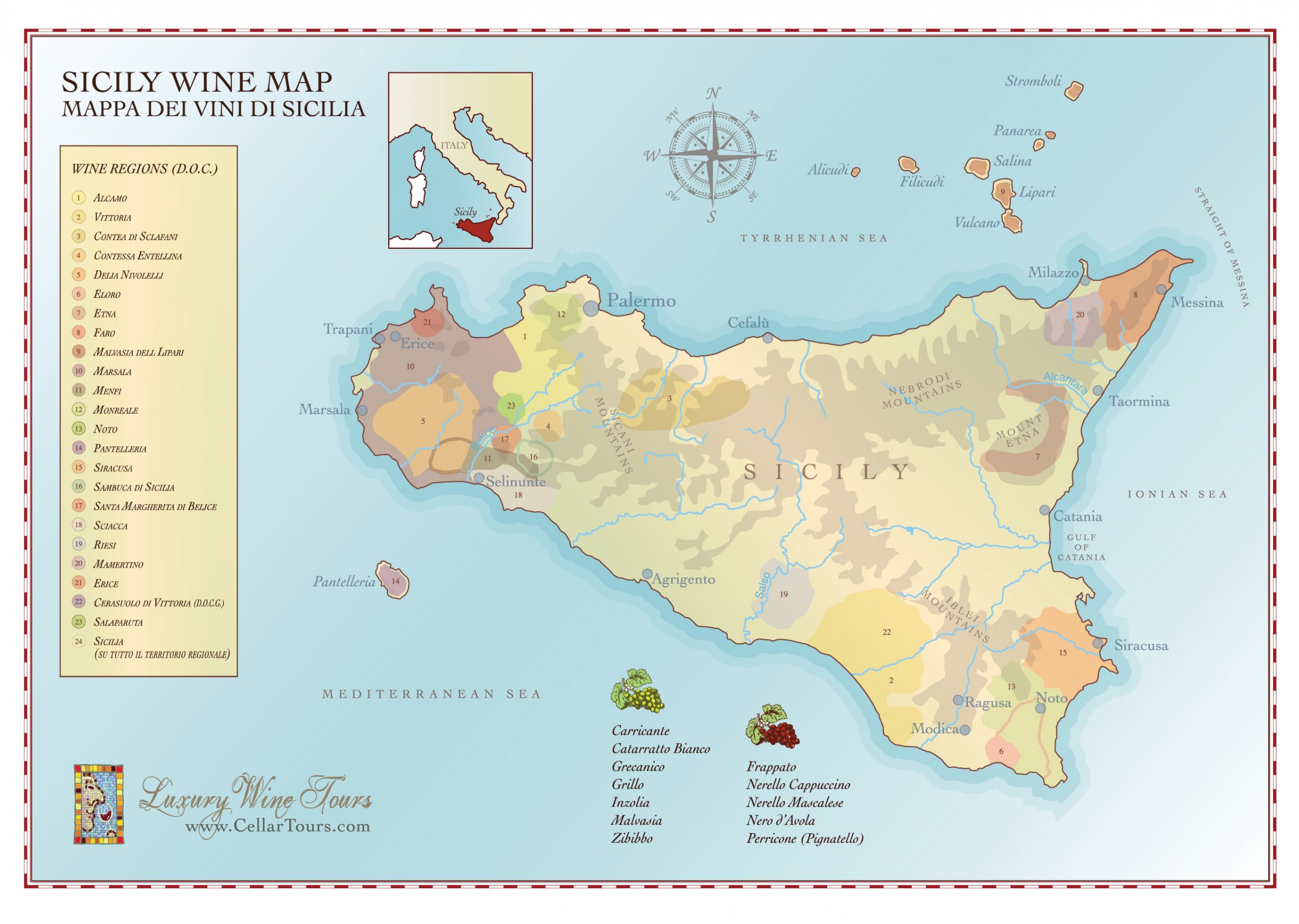
Sicily Wine Region Map
Map borrowed from CellarTours.com

Wow! Ok . . . I’m ready to move there as well now. You’ve painted such a beautiful picture here, I could practically picture myself there.  Love the history too. 


The only thing missing is something to sip while we take in the scenery, so let’s talk about the wines. What makes Sicilian wine special and unique to you, within the broader context of Italian wines? 

Well first, Sicily is a big place. According to winemaker Marilena Barbera, the distance from Marsala to Noto is roughly the same as Piedmont to Valpolicella. When you drive around the island, you can literally see how the tectonic shifts of the Eurasian and African plates have created distinctive terroirs (it lies on the fault line, which is why Etna is so active). In the southeast, around Vittoria, you have the chalky white limestone that clouds the air when you breathe at night, and this is where Frappato is grown; further west around Menfi, it’s windswept sand over the limestone and clay; and of course, on Etna, the earth is black as night, with large scars of pure black rock cutting through the landscape where there was a recent lava flow. And wine is made on the outer islands as well, from Pantelleria close to Africa to Lipari, which is nearer to mainland Italy. So there’s a huge diversity of grapes and styles being made given these vast differences in terroir, and that’s without even considering the nuances within these particular areas.

For me, beyond the diversity, what makes this moment in Sicilian wine history special is the focus for the first time on making really good quality wines. The island has a history of bulk wine production that dates back hundreds of years, with grapes grown to ship up to cooler climates in the north of Europe to round out those wines. That industry has dried up in the last century with the focus on appellation laws and winemakers’ increasingly focused on the transparency of terroir. It’s really been within the past decade or so that there’s been a real shift in mentality of growers here, later perhaps than in other parts of Italy. You’ve had a few key drivers of this change who have garnered international acclaim, and the subsequent interest has brought the money needed to produce wines of increasingly good quality more broadly.

Now you can find amazing expressions of once banal or unknown grapes made from a slew of exciting producers all over the island: oak-aged Catarratto from Porta al Vento, salty and refreshing Zibibbo from Marco de Bartoli, the unheard-of Corinto Nero from Tenuta di Castellaro; structured Inzolia from Cantine Barbera… the list goes on, and that’s without even touch my favorite production zone, Mt. Etna, and the myriad expressions of Nerello Mascalese, Nerello Cappuccio, and Carricante being produced there.


I’d love to see those landscapes! Your answer here regarding the increase in quality feeds into my next question.  
There’s a been a real boom in demand for Sicilian wines, and particularly for those from Mount Etna, as well as a boom in producers. What do you think is driving this renewed interest?  I know that Passopisciaro has been a driving force in this renaissance – how do you see its role in the evolution of winemaking on Mount Etna? Where do see things going?


Etna in particular has grown exponentially, both in terms of number of producers and demand in the US. It seems to correspond to the overall trend of the premiumization of wine across the US market. We’ve seen that both at Passopisciaro with our own wines holding consistent price points on the mid to higher tier, especially with the rise of the Contrada system of ‘cru-ification’ and correspondingly tight control of production, and across the region we’ve been able to observe similar trends with other producers putting ever more focus on specific delimited areas.

From an overall increase of production standpoint, we’ve been able to observe physically the growth in number of producers: since Andrea Franchetti started the Contrade dell’Etna event in 2008, the amount of producers across the mountain has exploded from a few handfuls that we could host at the winery for an Etna version of “en primeur" to over 160 producers that will be presenting at the event later this month at Castello Romeo, having completely outgrown the capacity of a single winery to host the producers and attendees. New producers crop up every year, often having worked for some of the original players, and new plantings are evident across the mountain. Just driving up to the contrada of Guardiola (an explanation on contradas soon) , you can see Cusumano’s new plantings alongside the old vines that Passopisciaro and Terre Nere own and cultivate.

It’s also been apparent in terms of how Etna is sold in the US. It’s been on the map for several years in the major wine drinking cities (e.g. New York and San Francisco), but we’re now increasingly seeing Etna producers entering other markets like Texas, making the landscape much more dynamic and competitive. It’s interesting anecdotally to see the Etna “brand” (both DOC and not) leveraged on wine lists to differentiate the region’s style from the rest of Sicily —a consumer that expects Nero d’Avola from Sicily needs to know that Nerello Mascalese is a different animal! 


Sarah also offered this response from Andrea to a similar question.
Q: How would you describe the recent history and progress you have witnessed in Etna? 

A: Viticulture and winemaking are on Mt. Etna have extremely ancient origins, but it was forgotten with the Second World War. There has always been as tradition of quality-oriented viticulture, which allows us to work with very old vines (even 130 years old) and, because of the sandy, ashy soil, in some cases with pre-phylloxera rootstock. On the other hand traditional winemaking was not of a high level. 

The last 20 years have seen the rise of a series of new wineries, including Passopisciaro, which has brought about a rebirth of Etna as a high quality winemaking region. The focus has gradually turned more to individuating each contradas, Etna’s own version of a cru, finds an almost exaggerated example due to the extreme variations in the lava flows and elevations of the vineyard sites. The names of these areas are appearing increasingly on the labels in this renaissance of Etna wine. 

There's this need to perceive Etna as a classic European wine territory, and if we all continue to push how the wine can vary, while at a high quality level, examining how different vintages and places show character, then Etna probably has the stuff to become like Burgundy or Piedmont. If good winemaking and obsessive interpretation grows.


I’m sure anyone reading this is now ready to book a flight. Any tips or highlights for anyone planning a trip to Sicily?


Sicily is big, and it’s rich in history, wine, food, art, architecture, beaches, and more. It’s important to home in on what you want to see and do on the trip, as well as to get a grip on distances (and also remember that driving at night on this island is not easy if you’re not from there!) There are several airports, so making one a point of entry and another the one for departure is a good strategy if you want to cover a lot of ground; or just pick a side and dive deep! On the east side alone, there’s a tremendous amount to see and do from Taormina and Etna in the north to Noto and Vittoria in the south.


That’s a really great practical tip to use two different airports and journey in between. 
Now moving on to my favorite topic: Wine + Food! Do you have any favorite food pairing memories from your trips to Sicily? 

Too many to count? I will never forget the meal I had at Roberta Corradin’s restaurant Il Consiglio di Sicilia in the town of Donnafugata in the southeastern part of the island. She’s a food writer whose name I knew from my time at SAVEUR, and she and her husband (the chef) faithfully source from local producers, press their own lemon-olive oil “condiment” (since they press the two together, they can’t legally call it olive oil), and regale you with stories about every ingredient’s origin. It was a magical four-hour lunch with the sea breezes coming off the Mediterranean, and the whole experience paired perfectly with Marco de Bartoli’s Grillo and Zibibbo blend from Pantelleria island that tasted faintly of sea salt and almonds.


Otherwise, a glass of bubbly Nerello or Carricante is also a perfect pairing with pesto al pistacchio – yes, you read that right; pistachio pesto is a real, wonderful thing, which makes sense when you realize that Bronte is on the western face of the volcano. I had a transformative experience of trying this pairing for the first time at Monaci delle Terre Nere’s restaurant on my first trip to the Etna with a glass of Murgo sparkling rosé and this rich, creamy sauce glistening over hand-rolled pasta, and I’ve revisited it many since times (and not just in my dreams!)


I’m absolutely going to try making a pistachio pesto. That experience sounds magical. I’m sooo hungry now!
*****
In my next post, we’ll get into discussing Passopisciaro specifically. Stay tuned!

Sarah will actually be here in Oakland at Bay Grape on 4/28/19 as part of our Women in Wine Discussion Series leading up to Bâtonnage Forum. Find more details here. All profits from ticket sales go to creating scholarships for minority women attending the Bâtonnage Forum!

You can also still get tickets to Bâtonnage as well. It's happening on 5/4 – just one month away! – in Napa.
Tickets and info here.
One more extra tidbit. Last year I interviewed Sarah over video for Bâtonnage Forum and she actually happened to be in Sicily at the time. Check it out here.

Here's Sarah leading her panel at last year's Bâtonnage Forum. Photo Credit: Rachel Hall


*****

The rest of the Italian Food Wine Travel (#ItalianFWT) is exploring Island Wines from Italy. Check out their posts here.

  • Steven from Steven's Wine and Food Blog features Sicilian Pasta con le Sarde Wine Pairing
  • Linda from My Full Wine Glass offers From Sardegna to Sicilia by Sea – Two Pairings
  • Pinny from Chinese Food and Wine Pairings explores Sicily’s Marsala Wine – A New Product (Wine) Life Cycle that Started in the 18th Century but Continues to Thrive Today!
  • Camilla from Culinary Adventures with Camilla recollects Island Memories, Slow-Roasted Lamb, and Cannonau Di Sardegna.
  • Lynn from Savor The Harvest is in the mood for Italian Island Wine Speak with Vinisola
  • Cindy from Grape Experiences reveals Discovering Liquid Gold from Sardinia and Sicily at Chicago’s Coda di Volpe.
  • Jennifer from Vino Travels tells the story of The Cultural Heritage of Mamuthone and Cannonau of Cantina Giuseppe Sedilesu.
  • Susannah from Avvinare invites readers to Discover Aleatico from the island of Elba.
  • Wendy from A Day In the Life on the Farm makes Oven Roasted Salmon with Tarragon Tartar Sauce paired with a Sicilian Grillo.
  • Lauren from The Swirling Dervish shares Island Wines of Italy: Alghero Torbato from Sardegna.
  • Gwen from Wine Predator features Island Wines of Italy: 3 from Sicily Paired with Pizza.
  • Jeff from FoodWineClick! is Dreaming of Italian Islands While We Wait for Spring.
  • Martin from ENOFYLZ Wine Blog tempts with Sardinian Vermentino di Gallura Paired With Shrimp and Asparagus Risotto.
  • Nicole from Somm's Table crafts A Passion for Sicily with Passopisciaro: An Interview with Sarah H. Bray, Part 2.
  • Jane from Always Ravenous is Tasting and Pairing Sicilian Wine From Mount Etna.
  • Cynthia and Pierre tell How a Wine Economists Conference Led Us to Wine from the Venice Lagoon.
  • Our hosts Jill and Jason at L'Occasion shares ‘300 Days of Sunshine’: The Vineyards of Sicilia DOC Interview with Alberto Tasca.


Older Posts Home
View mobile version

INSTAGRAM

Sign up for my mailing list!

Subscribe

* indicates required


Somm's Table 2017