Somm's Table

Perfect pairings from the other side of the equation.

  • About
  • Front of the House
  • Back of the House
  • Contact Us
Powered by Blogger.


In my last post, we got to know the Jura, a tiny region of France near the Swiss border that has become a wine geek favorite. Today we’re going to zero in and take a closer look at what is arguably its star grape – Savagnin.

Although it might not be that well-known in the wider wine-drinking world, Savagnin has quite a bit of range, as we saw last time. In the Jura, it’s used to make many styles of wine from playing a part in the blend for sparkling wines, to classic still wines, to the region’s dessert vin de pailles, and more. Its claim to fame though is that it’s the star of the region’s unique Vin Jaunes – a style of wine that is made in a way similar to fino sherry and with a lot of flavors in common. Wine casks are not filled all the way up to the top, and the bit of room that’s left open at the top allows for a layer of a local yeast to form on top. This thin layer is almost like a film, so it is referred to as voile, meaning veil. This wine is allowed to oxidize more than Fino Sherries, and so develop a lot of very deep nutty flavors. During this aging process, the wines develop a deep yellow color leading to the name Vin Jaune – literally “yellow wine.”

When not made in this oxidative way, Savagnin will show lots of citrus and delicate floral notes, and lots of acidity. It can also show fruit notes ranging from apples to stone fruits, and even heady tropical flavors. 

If you prefer the brighter, fresher style look for the term “Ouillé” on the bottle. It means ‘topped up,’ referring to the wine barrels being kept filled to the top so as to be closed off from air exposure and does not oxidize or develop voile. On the other hand, if you like the sherry-like notes of Vin Jaune, but can’t afford the hefty price tag those wines tend to have, look for the term “sous voile.” These are like baby Vin Jaunes, because the ‘veil’ is allowed to form, but the wines aren’t aged for as long.

Savagnin is an ancient variety and so has had a very long time to morph and propagate, and it’s been busy through the ages. It’s both a chameleon and rather promiscuous. It can show a lot of different clones and biotypes with variations in berry size, color, bunch shape, leaf shape, etc., which has led to many cases of mistaken identity when it comes to this grape. It has often been mistaken for Albariño, for example.

The combination of the grape being ancient, promiscuous, and with an ability to morph via different clones and biotypes, gives me an image crossing Galadriel from LOTR, with Number Six from Battlestar Gallactica, but perhaps a touch softer with an earth mother vibe, since this grape has also given birth to many others.

The grapes also has several aliases, the most common is Traminer, as it’s known in Germany. Gewürztaminer (“spicy Traminer”) is a mutation. This grape also has a long list of progeny including Sauvignon Blanc (don’t go confusing the two!) and Chenin Blanc, and I think you can see shades of both of these grapes in the flavors.

So, we have a grape that takes many forms and guises, showing a wide range of flavors, that can be made in a broad range of styles. I find that both maddening and incredibly exciting. 


DOMAIN DANIEL DUGOIS


I’d had a bottle of Domaine Daniel Dugois Arbois Auréoline 2011 in “my cellar” (i.e. our second bedroom) for a pretty long time. I’m not sure when I got it, or why hadn’t drunk it yet, but now seemed like the time! No more waiting. However, I was slightly worried that it wouldn’t be in the best state since I hadn’t stored it particularly well and it had moved from NYC with us.

I also thought it would be interesting to compare two Savagnins wines made in two different styles side by side, so I took my anxiety over the bottle (mild though it was) as an excuse to buy a second wine. Lucky for me, K&L  had the Domaine Daniel Dugois Savagnin Sous Voile Arbois  2015, giving me the chance to compare bottles from the same producer.

Image borrowed from the winery's website.


Daniel Dugois bought his estate in 1973 in the village of Les Asures, where he was born. The purchase included the house with wine cellars and 2 hectares of vineyards. Initially, he sold most of his grapes to Henri Marie, a prominent producer in the area at the time. In 1982 he decided to start making his own wines and selling them to consumers. Right off the bat, his Chardonnay won a gold medal in a Jura wine contest in his first vintage, gaining him quick recognition. He and his wife Monique continued to work on their wines, and were joined by their son Philippe in 2003. In 2012, he took charge of the vineyards.  

Their vineyards are farmed sustainably (via lutte raisonée) and all grapes are hand-harvested. They use native yeasts for their fermentations.


THE WINES


Arbois Auréoline 2011

SRP at Release: $30  | Alc: 13%

Savagnin is not listed on the bottle, but it is listed as the only grape on the winery’s website. They similarly note that its made in the fresher ouillé style, although it’s not on the bottle. It’s then aged for 8 months in casks, and it does undergo malolactic fermentation. The soils are composed of red clay with sandstone pebbles on red marl. (More details here. I couldn’t find a tech sheet for the current vintage, so it is possible that changes have been made to the winemaking in the interim.)

Tasting Notes: While I was mildly concerned about the fact that I had not stored this bottle very well, I need not have worried. Greg and I were both very pleasantly surprised as to how this wine was doing. It has a few years on it, but the wine had developed really nicely. It was delicious!

Salted almond and buttery notes greeted me on the nose, along with lemon cream, apples lightly dipped in caramel, and hints of sweet spices. On the palate, notes of sweet apricots that were a little dried and cady cap mushrooms joined the party, with a little extra squeeze on lemon on the finish. The wine’s texture was rounded, but there was still lovely acidity to keep it lifted. Altogether, it reminded me of a sunset in early fall.  

Savagnin Sous Voile Arbois 2015

Price at K&L: $24.99 | Alc: 13.5%


This is the “Baby Vin Jaune,” and I was happy to find it since I would’ve liked to have an example of a Vin Jaune, but alas, that was out of my price point at the moment. Like with Vin Jaune, voile is allowed to develop on this wine. It’s also aged for several years in oak barrels in an oxidative environment, though not for as long as with Vin Jaune.

Grapes for this wine come from two different terroirs. The vines in the first were planted in 1976, and the soils are made up of red marl and dolomitic rocks at the top of the parcel. The vines in the second parcel were planted in 1991 and has much deeper red marl covering a mass of fallen limestone mixed with silt. (More details here.)

Tasting Notes: The oxidative and sherry-like notes definitely differentiate this wine from the first. On the nose, there were notes of salted pecans, bruised apple, and chamomile. There was more zip on the palate, with some bright lemon and crisper apple notes mixed in with hints of dried pineapple, dried savory herbs, lemon verbena, Parmesan cheese rind, and even a pinch of curry. It’s complex and opens up with air.

Like other oxidative wines and wines aged under flor, this is an acquired taste. There are a lot of flavors that are pretty different from your average white wine if you don’t have experience with these styles. That said, this is a great way to dip a toe in and check it out at a fraction of the price of a bottle of Vin Jaune.


THE PAIRING


I wanted to create a dish to go with both of these wines, and after tasting them a picture started to form in my mind. I was thinking scallops, mushrooms, and cream . . . maybe with some cheese and nuts thrown in somehow. As I perused the interwebs for inspiration, I quickly realized that the dish I was starting to envision was actually a classic French dish: Coquille St. Jacques

I looked about a half a dozen recipes – many variations and presentations exist – but ultimately based mine on these two from Food Network and Epicurious. I also took a cue from Ina Garten and added a pinch of curry, since that seemed apropos. I made a few other minor tweaks to further tie the flavors together. This dish also seemed a perfect candidate to be adapted to sous vide cooking, since that completely takes the guesswork out of cooking them, and you don’t need to sear them to develop a caramelized exterior. You could even break this recipe out into phases to prepare when you have spurts of time: cooking the scallops, making the sauce and assembling the dishes, and then the final cooking under the broiler.

When cooked sous vide, it's easy to make sure the scallops turn out perfectly silky.

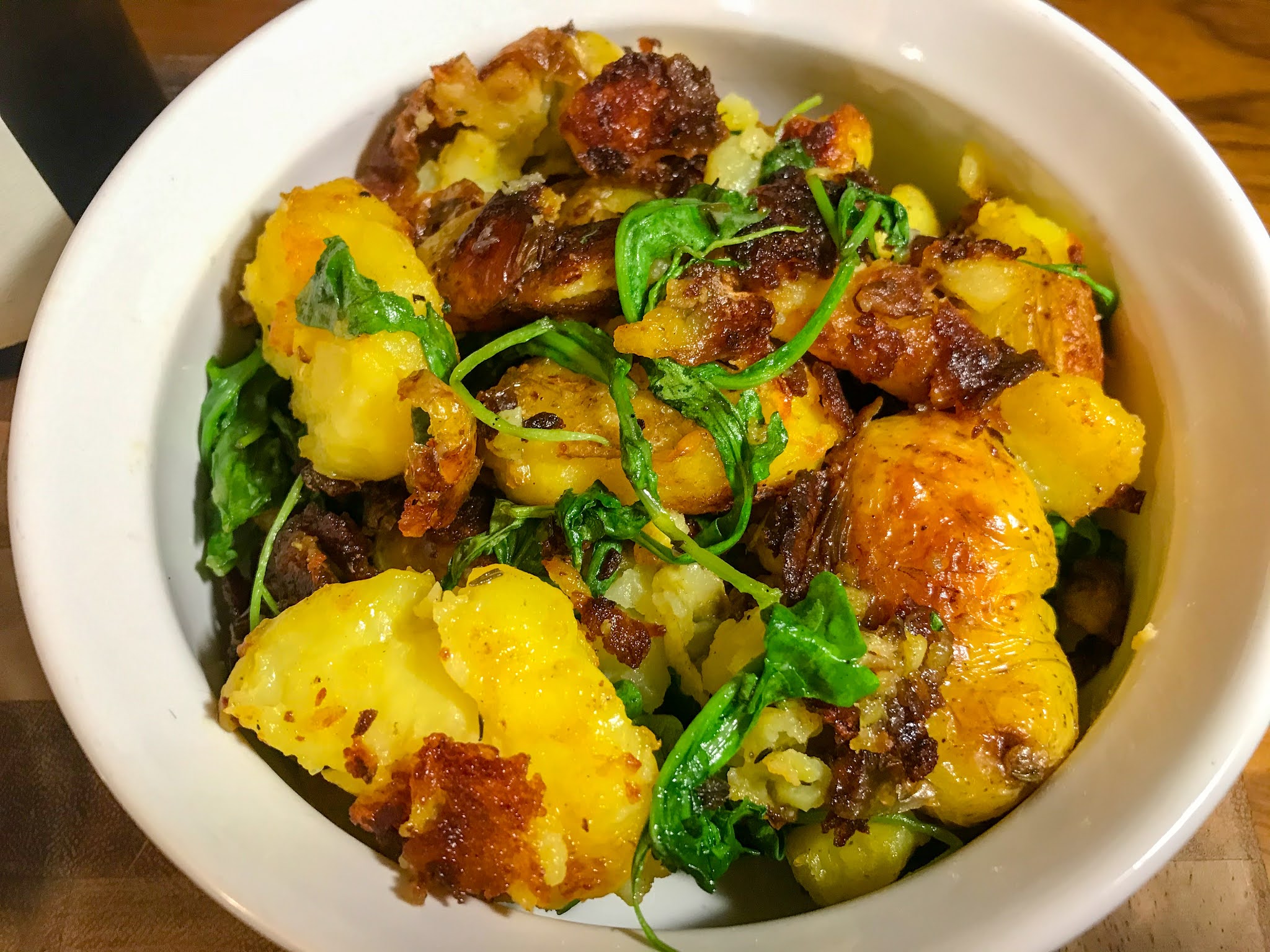
I also made a simple dish of smashed potatoes topped with herbs and wilted arugula as a side, which was perfect for mopping up the leftover sauce from the scallops. It really took things to the next level, although a big piece of crusty bread alongside the scallops would also be delightful.

Altogether, this meal was a showstopper! So freak’n delicious! It also paired really well with both wines, although it was particularly magical with the Auréoline. The flavors in that wine and the food just danced together in a beautifully decadent way. We were in heaven!


OTHER POSSIBILITIES


Since we had two bottles with this dinner, we had leftovers of each to try over the next couple of nights.

We had the rest of the Auréoline with salmon and roasted fall vegetables, and that combo also worked very well. The winery recommends this as wine aperitifs, crustaceans, and fish dishes.

The rest of the Savagnin Sous Voile was destined for a cheese night. I would have like to try it with a Comté, which is from the same region, but that was not to be. No worries though – I did get my hands on some Gruyère, which is the same cheese from the other side of the Swiss border. We also had some brie, nuts, and other accouterments like pear slices, confitures (jelly), speck, and a salad. The wine went pretty decently well across the board, surprisingly, even with pieces with confiture, as long as it wasn’t too heavy. Sweets and dry wines don’t tend to mix well.  As far as the cheese, maybe predictably, while it was fine with the brie, it was far better with the Gruyère. This wine and rosemary Marcona almonds were also complete besties.

The winery also recommends it as an aperitif, as well as with poultry or fish in a cream sauce, and with spicy or exotic dishes.

I also think these wines would work well with the crab gratin in this post.


Scallops
dinner, seafood
French
Servings: 4
By: Nicole Ruiz Hudson
Print
Sous Vide Coquilles St. Jaques

Sous Vide Coquilles St. Jaques

Prep Time: 10 MinCooking Time: 50 MinTotal Time: 1 Hour

Ingredients

  • 1 pound scallops (or 4 to 6 large scallops per person for a dinner portion)
  • 4 Tbsp butter, divided
  • 2 tsp lemon juice
  • 2 to 3 cloves of garlic, minced
  • 4 sprigs of thyme, divided, with the leaves picked from two of the sprigs
  • 3/4 cup dry white wine
  • 1 shallot, chopped
  • 8 to 12 ounces mushrooms, washed and sliced
  • 2 Tbsp flour
  • 1/2 cup milk
  • 1 cup heavy cream
  • ¼ tsp curry powder
  • Pinch of dried sage
  • Olive oil, as needed
  • Salt, to taste
  • Ground pepper, to taste
  • Flatleaf parsley, chopped, for garnish
  • Bread crumbs and/or ground almonds, for topping
  • Grated Swiss or Gruyère cheese, for topping

Instructions

  1. Heat water to 122ºF/50ºC using a sous vide immersion circulator.
  2. While the water heats up, place scallops into a zip-close plastic bag with 2 tablespoons of butter, lemon juice, garlic, 2 sprigs of thyme, and a pinch of salt and pepper. Seal the bag via water displacement method or vacuum sealing, then place the bag in the water and cook for 30 minutes
  3. Start the sauce while the scallops are cooking. Sweat the shallots in a saucepan over medium heat with a small amount of olive oil, wine, and a pinch of salt and pepper. Cook until the shallots are beginning to turn soft and translucent – about 5 minutes. Add the mushrooms to saucepan and continue to cook until softened – about 10 minutes. Once the scallops have finished cooking, pour the cooking liquid with the garlic in the with mushrooms, allow the liquid to reduce a bit, then set aside.
  4. Melt the remaining 2 tablespoons of butter in a medium saucepan and whisk in the flour to make a roux. Meanwhile, lightly warm the milk and cream in the microwave. Over medium-low to low heat, slowly whisk the milk and cream mixture into the roux. Allow the mixture to simmer and begin to thicken, then gently stir in the mushroom mixture. Add the picked thyme leaves, curry powder, and sage to the sauce, then season with salt and pepper. Continue to simmer gently until the sauce reaches a thick, creamy texture that can coat the back of the spoon. I sauce gets too thick, add a bit more milk, cream, or water. Taste and adjust seasoning. Keep sauce warm until ready to use
  5. Preheat the broiler. Lay out ramekins or other small oven-safe dishes (or if you have them, use scallop shells). Spoon a light layer of sauce into each dish. Divide the scallops evenly between each of the dishes, then distribute the remaining sauce on top of each portion of scallops. Sprinkle each serving with cheese, parsley, and breadcrumbs and/or ground almonds.
  6. (If you're not ready to serve the scallops, cover them with plastic wrap and refrigerate.)
  7. Broil the scallops until the mixture bubbles and the cheese melts and turns golden brown. Garnish with additional parsley if desired. Serve.
https://www.sommstable.com/2020/10/domaine-daniel-dugois-savagnin-with-coquilles-st-jacques.html
Did you make this recipe?
Tag @thesommstable on instagram and hashtag it #sommstable
Created using The Recipes Generator


potatoes,
sides
Servings: Varies
By: Nicole Ruiz Hudson
Print
Smashed Potatoes with Herbs and Arugula

Smashed Potatoes with Herbs and Arugula

This a non-recipe since it doesn't depend on specific quantities. You can also switch up the greens, herbs, and flavorings.

Ingredients

  • Small to medium potatoes (I particularly like Yukon Golds for this purpose )
  • Thyme sprigs
  • Dried sage
  • Salt
  • Pepper
  • Cooking oil
  • Parmesan, optional

Instructions

  1. Place potatoes in a large pot and fill with water and generously salt the water. Bring the pot to boil on the stove over medium-high heat, then reduce to a simmer. Cooking time will vary depending on the size of the potatoes. Smaller potatoes might be done after 5 minutes, and medium-sized potatoes will usually take around 15 to 20 minutes. The potatoes are done once they’re tender all the way through and a knife or fork slides in easily. Drain and let the potatoes dry for about 5 minutes.
  2. Preheat the oven to 425°F.
  3. Line the potatoes up on a greased baking sheet and lightly smash them using a potato masher or fork, until they’ve flattened and broken a bit, but are mostly still together. Sprinkle generously with olive oil, toss on the sprigs of thyme, and sprinkle on the dried sage, salt, and pepper.
  4. Place into oven and bake for 15-20 minutes, or until golden brown and crisp. Turn off the oven, toss on the arugula, and leave the pan in the oven for a couple of minutes while the arugula wilts. Transfer to a serving dish, add additional seasonings, and top with Parmesan if desired. Serve immediately.
https://www.sommstable.com/2020/10/domaine-daniel-dugois-savagnin-with-coquilles-st-jacques.html
Did you make this recipe?
Tag @thesommstable on instagram and hashtag it #sommstable
Created using The Recipes Generator


*****

The rest of the French Winophiles Blogging Group (#Winophiles) are exploring the Jura this month. Be sure to check out their posts:

  • Camilla from Culinary Adventures with Camilla will share "Seafood B'Stilla + Domaine Rolet Arbois Trousseau 2012"    
  • Pinny from Chinese Food and Wine Pairings is "Sipping Tissot-Marie Crémant Du Jura and Snacking Fried Pork Skin"  
  • Linda from My Full Wine Glass will be heading "Back to the Jura (virtually), for Crémant this time around"  
  • Robin from Crushed Grape Chronicles is "Channeling the Jura for a rooftop getaway with a bottle of Savagnin and Friends"   
  • Payal from Keep the Peas is sharing "Sherry? No, Jura"  
  • David from Cooking Chat will be sharing "Slow Cooker BBQ Chicken Thighs with Jura Wine"  
  • Terri from Our Good Life will tell us about "Sparkling Jura for Celebratory Moments"  
  • Wendy from A Day in the Life on the Farm will serve up "Bourride served with a Chardonnay from Jura"  
  • Christy from Confessions of a Culinary Diva is talking about "Jura in the Afternoon"  
  • Gwendolyn from Wine Predator will share "Exploring Flavors of Jura Food and Wine Take Two: Trousseau and Melon"  
  • Susannah from Avvinaire tells us about "Discovering Delights From Jura Region"  


Additional sources and extra reading :

  • Wine Grapes: A Complete Guide to 1,368 Vine Varieties, Including Their Origins and Flavours
  • Oz Clarke: Grapes & Wines: A Comprehensive Guide to Varieties and Flavours 
  • Wine-Searcher.com
  • Decanter: What is Savagnin? 
  • Frenchlibation.com
  • K&L On the Trail: In the Jura — Part I: Visiting with Domaine Dugois
  • The Real Review: Three sous-voile wines 
  • Punch: The Jura Wines Nobody’s Telling You About


This post contains Amazon Affiliate links, from which I might earn a commission at no cost to you.


Юра Франция, деревня в долине.jpg
The village of Baume-les-Messieurs, in the Jura department, France. Photo from Wikipedia.

Welcome to Wine Geeksville! 

Today we’re taking a looking at the Jura, a teeny tiny section of France that’s wedged between Burgundy and the Swiss border. (For the record, there also a Swiss Jura region). It’s just under 50 miles long, making it France’s smallest wine region. It’s got classic wine grapes, as well as obscure indigenous grapes. They have quirky wine styles made, as well as terroir-driven wines from fascinating, ancient soils. The tiny region also has its fair share of star natural wine producers. In addition, the wines tend to be fairly high in acid, which generally makes them food-friendly. Obscurity, quirkiness, crazy soils, food-friendliness – with this combination, is it any wonder this region is a wine geek darling?

Map courtesy of WineFolly.com

There are plenty of reasons why the rest of the wine-drinking world should also get to know this region too. For one thing, it’s got a lot in common with Burgundy, which isn’t surprising given that they’re fairly close together. Burgundy’s star grapes, Pinot Noir and Chardonnay reside here as well. The Jura also has similar soils and a continental climate similar to Burgundy’s, with dry, hot summer and long cold winters, although it rains a little more here than in Burgundy and the winters are more severe. There has also been quite a bit of investment going on from Burgundian producers, looking for places to expand and bringing additional development to the area. For all the similarities though, the price point for a lot of wines remains considerably less than in Burgundy, although they can be hard to find.

I was getting ready to put together a pairing post on a couple of wines from the region – which will be coming up next – when I realized that I had notes compiled from several Jura tastings from the last couple of years. I’m pulling them together here as a primer and round-up on the region.  

Let’s start with some basics. The name of this post isn’t just an excuse for a hip-hop reference – 5 is kind of the magic number in getting to know the region. 

5 MAIN GRAPES

The Jura is home to 40 different grape varieties, but there are five that dominate. In addition to the previously mentioned Pinot Noir and Chardonnay, which don’t really need much of an intro, there are also three major grapes of the region you might not know.

  • Savagnin (white) might be considered the star of the region since it’s the key grape in their famous Vin Jaunes. We’ll be getting to know it better in my next post, but it’s an ancient grape and typically has lots of citrus and floral notes. It can also show richer notes of stone fruits and even exotic tropical flavors.
  • Poulsard (or Ploussard) makes super light red wines thanks to really thin, delicate skins. It can show pretty aromatics and flavors of red cherries, berries, herbs, and white pepper. It’s often blended with the region’s other reds.
  • Trousseau (red) is another ancient grape. This one decided to use its long life to travel a bit though and it picked up various aliases along the way. In particular, you’ll find it in Spain and in Portugal, where it goes by Bastardo. Here it makes spiced, peppery, red-fruited wines.


5 KEY WINE STYLES TO KNOW

You will of course find classical still wines in red, white, and rosé. You’ll also find sparkling wines, predominantly crémants, but there are Pét-Nat examples as well.

Beyond the classics, there are three fairly obscure styles. Try them if you get the chance!

  • Vin Jaune, which literally translates to ‘yellow wine,’ might be the style the region is best known for. It’s made using a technique similar to that used for making Fino Sherry, but the wines aren’t fortified and no solera system is employed. Always made from Savagnin, the wines are put in casks with a little room left at the top so that a layer of yeast can form. It’s similar to the flor that forms on Fino, but here it’s called voile, or veil. As you might guess, you’ll find a lot of yeasty flavor notes in common between the two styles of wine, however, Vin Jaunes gain oxidative notes as well. These wines can get pretty expensive, but there are also some in-between styles that aren’t as pricey. We’ll see one of these in my next post, as well as in the wine notes below.
  • Macvin du Jura is a vin de liqueur made by blending hardly fermented grape juice with marc du Jura, and is usually drunk as an aperitif. Versions have been produced in the region since at least the 14th century, but the modern take is made from late-harvested grapes, then eau-de-vie added to stop the fermentation (a method known as mutage), and the wine is then aged in oak barrels for 12 months before release. Macvin can be made from anywhere in the region, and any of the region’s main grapes can be used in its production, although white versions are more common. It accounts for only 3% of Jura's total wine production.
  • Vin de Paille is a style of sweet wine that was traditionally made from grapes that were  been dried out on straw mats (paille is French for 'straw') to concentrate the sugars in their juice. The process is similar to that used for passito wines in Italy and stroweins in Germany.


5 MAIN APPELLATIONS

Map courtesy of Vins du Jura.
  • Arbois and Côtes du Jura are the most important in terms of quantity. Both cover red, whites, and rosés, but both make more red than white wines. Côtes du Jura is the larger appellation, basically covering the whole region, but second in terms of quantity. Arbois falls within those borders, centering around the town of the same name. Despite being a smaller area, more wines are produced under that appellation, since producers will generally choose to use the more specific classification unless they’re also using grapes from the wider area. 
  • Crémant de Jura is for the bubblies. Specifically, as with other crémants, these sparklers are made via the méthode traditionelle (i.e. in the style of Champagne, but not from Champagne.)  Whites have to be at least 50% Chard, and the rest can be Savagnin. Rosés must be made up of at least 50% Poulsard and/or Pinot Noir. You’ll find a Cremant de Jura featured in this post.
  • L'Etoile is a tiny appellation covering only 75 hectares (185 acres) surrounding the village of the same name. Given the area is so tiny, these wines are rare! Chardonnay is the star grape here, but Savagnin is also produced and used to make Vin Jaunes. They also make vin de paille, which can use both of these grapes, as well as Poulsard. No red is made under this AOC. The name means "the star," which supposedly comes from the star-shaped fossils that can be seen in the local limestone soils. (How cool is that?!) The village of L’Etolie is also surrounded by five hills which look a bit like the five points of a star.
  • Château-Chalon (name of the village, not a specific Chateau) is considered the Grand Cru of Vin Jaune. That’s all they make, so by default Savagnin is the only grape allowed. Grapes must be late-harvested but without botrytis. Interestingly, the borders are non-contiguous and based on if the vineyards are planted on grey marl soil.

In addition to these, there are also AOC’s to cover Macvin and Marc du Jura, the region’s eua-du-vie.

SOILS AND TERRAIN

Landscape of tree-clad valley stretching toward mountainous horizon
Picture borrowed from Wikipedia.

The key soil types are Jurassic limestone and marlstone. The Jurassic period was named after the Jura and not the other way around! The area has undergone many shifts during the eons. At one point it was covered by a vast sea – that's how those starfish fossils got here. It’s seen the rise and fall of mountains and has been covered by glaciers for the last 5 million years that have carved out peaks and valleys. The region's limestone mountains are representative of the geological developments which occurred during that period (between 145 million and 200 million years ago.)

The mountainous terrain twists and turns, and the hills are covered by woods. In this, it is similar to the nearby areas of Bugey and Savoie to the south, which are also crowded up against the Swiss border along with the Jura.

Creux-du-Van vertical.jpg
Creux du Van. Picture borrowed from Wikipedia.


WINES

Here are a few down and dirty tasting notes that were taken at tasting group sessions and at work. They were jotted down in varying degrees of detail depending on where they were tasted.  I’m sharing whatever I had here with some basic info, so as to give an idea of styles and flavor profiles.

Bubblies

Benoît Mulin Cremant du Jura NV

50% Chardonnay/50% Pinot Noir | Avg. price: $18

Benoît Mulin was a banker when he met his wife. Both were originally from the Jura and both were thinking about making the move back. As luck would have it, his wife was besties with the wife of then-rising winemaker (now regional superstar) Stéphane Tissot just as he was in the process of expanding the business to include a négociant arm. Benoît came on to help with the financial end of the business. He eventually went on to lease 7 hectares of land just next door to Tissot’s on which he is growing his own grapes. More info on Benoît Mulin here.

  • Biodynamic 
  • Bottles are aged for 15-18 months 

Tasting Notes: Really crisp, with notes of light brioche, apples, salted butter, and almonds.

Domaine Eric Thill Cremant du Jura Cuvée Adrian 2014

100% Chardonnay | Avg. price: $21

Eric was born in Alsace and prefers to work with single grape varieties. The family lives close to the village of Trenal, and they plant their vines close to the local forests to allows for greater diversity. More details on him here.

  • Certified Organic and committed to minimal-intervention. 
  • 1 year in tank, 3 years on lees.
  • Soils: Clay and marl.

Tasting Notes: Bruised apple, a little peach, melon, almond paste, rich baked bread. Rich creamy feel, almond paste, brioche, lemon, minerals on the finish. Yummy

Coup de Jus Caribulle Pét-Nat VDF 2017

100% Carignan (so atypical, hence the VdF) | Price: $26

Géraud and Pauline Fromont are natives of the Jura, but both came from farming rather than winemaking backgrounds. They started their domaine when they were in their mid-twenties. They share all vineyard, cellar, and sales duties, and are rising stars in the region. Coup de Jus is their newer négoiant project.

  • All fruit certified organic. 
  • Vinified in tank. Unfiltered.

Tasting Notes:  Glou-glou pomegranate kombucha.

Whites

Domaine du Pelican Arbois Savagnin Ouille 2015


100% Savagnin | Avg. price: $35

Guillaume d’Angerville decided to search for land to start a winery in the Jura after he blind tasted a glass of Stéphane Tissot’s Chardonnay Arbois Les Bruyères 2005 and was convinced that he was tasting Burgundy. He has built a very solid reputation in a very short amount of time.

  • Biodynamic. (He has 5 hectares of his own, but is set to take over more, and works with another biodynamic grower who has another 5.) 
  • The term “Ouillé” means “topped up”, referring to the wine being closed off from air exposure, a significant difference from traditional Jura Savagnins which are made with exposure to air. Without the traditional oxidation, the result is an aromatic, fresher style of wine, with zesty acidity.

Tasting Notes: Creamy in a way reminiscent of Chardonnay, but with much more screaming acidity. Gold apples, lemons, leesy, salted almonds. 


Peggy et Jean Pascal Buronfosse L’Hopital Savagnin 2015


100% Savagnin | Avg. price: $32

Peggy et Jean Pascal Buronfosse moved to La Combe de Rotalier to leave city life behind, with hope of having a farm. However, viticulture captured their curiosity. They'd ended up down the road from J.F. Ganevat, another of the area’s famed biodynamic producers, and with a little guidance from him, as well as their own trial error, they've found their way.

  • Organic. 
  • Native yeast fermentation in neutral oak. Wine is then aged for 18 months in neutral oak, sur lie. Additional details here.

Tasting Notes: Salty lemons, almonds, cheese rind, and oxidative (but much less than the next one) on the nose. Rich on the palate, but still makes the mouth water with notes of tangerine skin and lemons, with a tangy note.


Benoît Mulin Arbois Savagnin 2011


100% Savagnin | Avg. price: $35

See winemaker details above.

  • Soil: Blue and grey marl. 
  • Indigenous yeast followed by élevage for 30-36 months in barrels. Voile is allowed to form.

Tasting notes: Marigolds, yeast, tangerine skin, preserved lemon, and marzipan on the nose. Rich on the palate, with notes of salted almonds and pecans, butter, and apricot.


Reds

Domaine Valentin Morel Le Pieds sur Terre Poulsard Le Trouillots Cotes du Jura 2016

100% Poulsard | Avg. price: $39
 

Winemaker Valentin Morel had recently finished a degree in international law when he got interested in biodynamics. He studied winemaking in Alsace and decided to join the family domaine in 2014.

  • Organic, in process of certification.
  • Wine is fermented in stainless steel, then aged for 8 months in stainless tanks. Unfiltered and no sulfites. More info here and here.

Tasting notes:  Cranberry and oranges, dusty, drying flowers.  

Domaine Courbet Trousseau Cotes du Jura 2017

100% Trousseau | Avg. price: $28
 

The family-owned property is just south of Château-Chalon.

  • Indigenous yeast fermentation. Small portion whole cluster. Stainless steel fermentation, well as aging (10 months). Very low sulfur. More info here.
  • Certified organic and biodynamic. 
  • Soils: Marlstone, chalky limestone, clay.

Tasting notes: Dusty raspberry on the nose.  Brighter and fruitier on the palate, with raspberry and cranberry, cherry, pink flowers, light bramble, and a hint of white pepper. Pleasantly fleshy, good Pinot swap. Very pleasant despite light hints of brett (but not as much as the JaJa du Ben below). Reductive notes mostly blow off.

Domaine de la Renardière Arbois Pupillin Trousseau 2016

100% Trousseau | Avg. price: $30
 

Jean-Michel Petit decided to take over his family’s domaine in 1990 and also began expanding the holdings by buying vineyards. He’d ask all previous owners what the parcels expressed, but no one (not even his own parents) really knew because they all sold their grapes to the local co-op. He started vinifying each parcel separately to get to know each one. 

  • Organic 
  • Maceration and fermentation in stainless steel, then aged in barrel for 18 months. More details here.

Tasting Notes: Potting soil and dusty, bruised cherries on the nose. Red plums join in on the palate, with some bramble, white mushrooms, herbs, floral notes, and a hint of funk.

Domaine Valentin Morel Les Pieds Sur Terre Cotes du Jura Les Troullots Semain 16 2017

70% Trousseau,  20% Pinot, 10% Ploussard  | Avg. price: $39 

See winemaker details above.

  • Organic, in process of certification. 
  • This wine was made from the grapes that survived frosts in 2017.
  • Fermentation and aging in stainless steel vats. Unfiltered with no added sulfites. More info here.

Tasting notes: Bruised strawberry on the nose, with some of the strawberry stems included. Smells glou-glou. Brighter strawberries on palate, like some have just been recently crushed. A little spritzy, like dusty strawberry soda with some bramble and stems. Very easy to drink.
Really nice with goat cheese and preserves

Domaine Rolet Arbois  Rouge Tradition 2012

40% Poulsard, 30% Trousseau, 30% Pinot Noir | Avg. price: $17

Rolet is one of the larger domains in the Jura. Established in 1960, has been owned by three families throughout its history. Currently owned by the Burgundian wine family, the Devillards.

  • Varieties are fermented separately and blended after 18 months in large neutral barrels.

Tasting Notes: High toned on the nose, with a whisper of cured meat, bright red fruits, and a hint of mint.  Bright red fruits continue on the palate – dusty cranberry and slightly underripe strawberry – light herbs on the finish.

Les Dolomies Pinot Noir La Cabane VDF 2017


100% Pinot Noir | Avg. price: $18
 

The domaine was created Céline Gormally in 2008 with the help of her husband, Steve, who also helps to farm their 5 hectares of land. TCéline lives by the saying from Saint Exupery: “The earth is not ours; but lent to us by our children.”

  • Organically farmed, and also follow some biodynamic principles. 
  • Les Dolomies takes its name from the magnesium limestone found in the area. The iridescent marls and limestone outcrops can be found throughout the vineyards.  
  • Grapes are fully de-stemmed. Native yeast fermentation in stainless steel with use of very little sulfur, if any.

Tasting Notes: Very earthy, funky, cranberries, with dusty stones.

Anne and Jean-Francois Ganevat Le Jaja du Ben VdF NV

Gamay, plus a field blend of other obscure native varieties. | Avg. price: $39

One of the stars of the region and strongly associated with the natural wine movement. Jean-Francois Ganevat comes from a long line of winemakers, as far back as 1650. He is known for being quite meticulous in the vineyards and keeps things simple (although still detailed) in the cellar. (More info on him here.)

  • Certified biodynamic. 
  • Aged 9 months in conical wood tank. More details here.

Tasting Notes: There’s quite a bit of brett here, along with lots of red fruit notes. Reductive but it opens up. Juicier, fruitier, and friendlier on the palate. Really good with the funky cheese.

*****

The rest of the French Winophiles Blogging Group (#Winophiles) are exploring the Jura this month. Be sure to check out their posts:

  • Camilla from Culinary Adventures with Camilla will share "Seafood B'Stilla + Domaine Rolet Arbois Trousseau 2012"    
  • Pinny from Chinese Food and Wine Pairings is "Sipping Tissot-Marie Crémant Du Jura and Snacking Fried Pork Skin"  
  • Linda from My Full Wine Glass will be heading "Back to the Jura (virtually), for Crémant this time around"  
  • Robin from Crushed Grape Chronicles is "Channeling the Jura for a rooftop getaway with a bottle of Savagnin and Friends"   
  • Payal from Keep the Peas is sharing "Sherry? No, Jura"  
  • David from Cooking Chat will be sharing "Slow Cooker BBQ Chicken Thighs with Jura Wine"  
  • Terri from Our Good Life will tell us about "Sparkling Jura for Celebratory Moments"  
  • Wendy from A Day in the Life on the Farm will serve up "Bourride served with a Chardonnay from Jura"  
  • Nicole from Somm's Table will be "Cooking to the Wine: Two Savagnins from Domaine Daniel Dugois with Coquilles St. Jacques"  
  • Christy from Confessions of a Culinary Diva is talking about "Jura in the Afternoon"  
  • Gwendolyn from Wine Predator will share "Exploring Flavors of Jura Food and Wine Take Two: Trousseau and Melon"  
  • Susannah from Avvinaire tells us about "Discovering Delights From Jura Region"


This post contains Amazon Affiliate links, from which I might earn a commission at no cost to you.


Older Posts Home
View mobile version

INSTAGRAM

Sign up for my mailing list!

Subscribe

* indicates required


Somm's Table 2017