Somm's Table

Perfect pairings from the other side of the equation.

  • About
  • Front of the House
  • Back of the House
  • Contact Us
Powered by Blogger.


Time for more bubbly!

Today we’re exploring a small region of Italy not enough people know about – Franciacorta. It’s understandable that this is still a fairly undiscovered gem – the region’s sparkling wine history only dates back 50-60 years. However, in that fairly short period of time, Franciacorta has established a reputation (among those who know about it) for high-quality, traditional method sparkling wine. 

In addition, the area is rapidly pushing forward on the sustainability front as well. The first organic bottling of Franciacorta came out in 2002 (from Barone Pizzini), but since then they’ve progressed by leaps and bounds so that now nearly 70% of the region’s wineries are either certified organic or in the conversion process. This gives Franciacorta the highest percentage of organic producers of any region in the country.

Altogether, it’s a region well-worth getting to know.


Franciacorta Cheat Sheet 


Styles: The major defining characteristic of the region is, as mentioned, that it specializes in traditional method sparkling wines – i.e. the same style as Champagne in which the second fermentation that creates the bubbles occurs in the bottle. (For an in-depth look at the process, check out this post.) The wines come in rosé and white styles and are available in the full range of sweetness levels typical of sparkling wines, ranging from Zero Dosage wines at the driest end, and demi-sec at the sweetest end. Brut is the most common style, and while up to 12 grams of sugar per liter are permitted, most producers stay well below that.

One distinctive style of Franciacorta is Satèn, which is bottled at a lower bottle pressure than the usual – it must remain below 5 atmospheres instead of 6 – creating more subtle, creamy bubbles. Satèn wines are made with only white grapes are produced exclusively in the Brut style.


Aging Requirements: Non-Vintage Franciacorta wines must age on the lees for at least 18 months. The number goes up to 30 months for vintage wines, and that’s doubled to 60 months for wines labeled Riserva. Satèn and rosé wines must age for at least 24 months on the lees. 


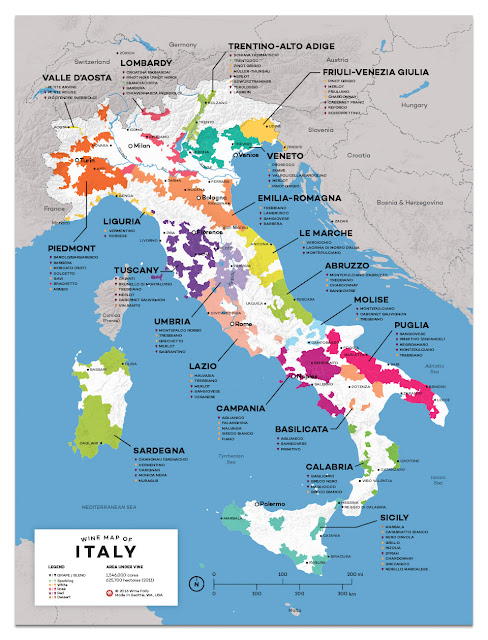
Location: Franciacorta is located in the region of Lombardy in northern Italy. It’s bordered by Lake Iseo to the north, which helps create a warm but moderate microclimate that gives the grapes plenty of time in the sun to ripen. Cooling breezes from the foothills of the Rhaetian Alps farther to the northeast help moderate the temperatures as they flow down through the area’s rolling hills, which also help to shelter the vineyards. The growing region is shaped like an amphitheater, which was carved out by retreating glaciers. The glaciers were also kind enough to leave behind lots of well-draining, mineral-rich gravel, and limestone soils. Put it all together and you get fairly ideal conditions for growing grapes that ripen well while maintaining acidity and can grow happy and healthy in the excellent soils.

Curtefranca DOC (formerly known as Terre di Franciacorta) covers the same area, but for still white and red wines made from international varieties.


Grapes: The key grapes are similar to those used in other traditional method regions. Chardonnay, Pinot Nero (Pinot Noir), and Pinot Bianco (Pinot Blanc) are the key grapes. Chardonnay is the leader both in plantings and usage, but Pinot Bianco can make up 50% of the blend. Rosé wines must contain at least 35% Pinot Nero. Erbamat, a white grape indigenous to the area that’s enjoying a resurgence thanks to its high acidity levels, is also permitted up to 10%.  


History: 

While the region’s winemaking history goes back to the 16th century, its modern chapter begins in 1961 when the house of Guido Berlucchiwith released the first traditional method sparkling wine ever to be produced in the region. The wines were in high demand right away, and as a result, a string of entrepreneurs was attracted to invest in the region. The style developed quickly, and Franciacorta was granted its DOC status in 1967 for sparkling and non-sparkling wines.

The region was conscientious in how it invented itself from the start. It modeled itself closely on Champagne, and the local Consorzio established a code of self-regulation for farming and production at least as strict as its example. Franciacorta has always set the bar high for itself in terms of quality, and its Consorzio (established in 1991) has generally campaigned over time for more and more rigorous standards. As a result of all of this hard work, as well as a good bit of lobbying, Franciacorta was promoted to DOCG status (Italy’s highest classification) in 1995. 

The region has established a reputation for high-quality wines that often have a good capacity for aging. (My example today had several years on it and was still quite delicious.) You’ll find a mix of large and small producers here, but they tend to share that focus on quality – which is heartening as a consumer. 


What makes it distinctive: 

Franciacorta might have modeled itself on Champagne, but it’s still its own region so there are distinctions. These two regions have very different climates and terroirs. Thanks to Franciacorta’s climate, they have a much easier time ripening their grapes. The fruit tends to have rounder and riper fruit notes, like golden apples and stone fruits, and even tropical fruits in warmer years. Personally, I often get a rich baked pear tart note from Franciacorta. 

Thanks as well to the ripeness of their fruit, Franciacorta can pretty reliably produce good zero dosage wines every year. This isn’t always the case in Champagne.

The next difference we already talked about – this is a much younger region. Champagne has about 300 years on Franciacorta. There’s also a huge difference in scale – Champagne produces about 100 times more wine per year. However, we’ve seen as well that in Franciacorta, that smaller scale goes with attention to detail and a focus on quality. 

The downside is that given the high focus on quality and smaller-scale production, bottles can definitely get pricey. However, at least you can be reasonably assured when spending the money that the wine you’re buying was conscientiously made, even if you know nothing about the producer as you're picking up the bottle. In addition, as mentioned at the top, there is an increasing focus in the region as a whole on organic and biodynamic viticulture. 


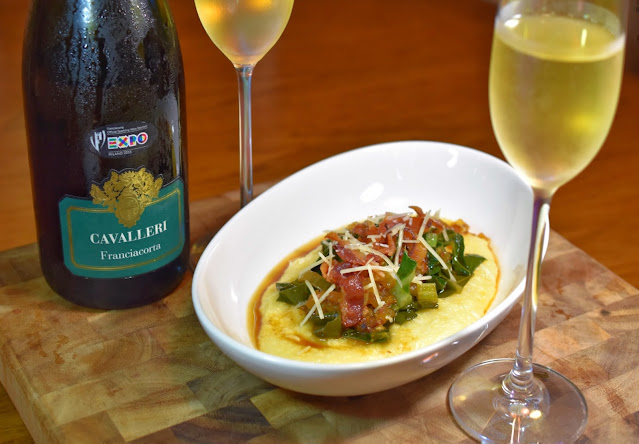
The Wine & Pairing: Cavalleri Satèn Brut Franciacorta with Braised Collard Greens and Polenta

Cavalleri is one of two biodynamic estates in Franciacorta. The family’s history in the region stretches back to 1450, but it was Gian Paolo and his son Giovanni Cavalleri that began to bottle wine for themselves and gave the company its current name in 1968, shortly after the Franciacorta DOC was established. (Prior to that, the family had sold their wines in bulk.) Giovanni Cavalleri was part of the group of winemakers that helped to establish the consorzio in 1990, and he even served as President. Giovanni’s daughters, Maria and Giulia, followed them into the business, and now his grandchildren, Francesco and Diletta, have also joined the company.

Cavalleri approaches farming in a holistic way, planting grass, cruciferous plants, and legumes in between the rows to increase the organic matter within the soil and increase its vitality by natural means. The house style is to produce wines that are ripe but dry, using low levels of pressed juice, sweet dosage, and sulfur.  They also partially ferment in large barrels of Slavonian oak, rather than barriques, which are more common.

I’d had the 2013 Satén in “my cellar” for a while, but it was still showing quite nicely. On the day we opened it, it showed notes of bruised golden apples and baked pears on the nose, along with dried flowers, yellow plums, and yellow peach. There were similar notes on the palate, although the fruit notes were a bit brighter and fresher. It also showed more leesy notes on the palate of pastry crust along with savory cheese rind and lots of toasty notes, perhaps coming from the age of the wine, well as the winemaking process. As it was a Satén, the bubbles were more subtle and had a creamier feel than your typical sparkler.
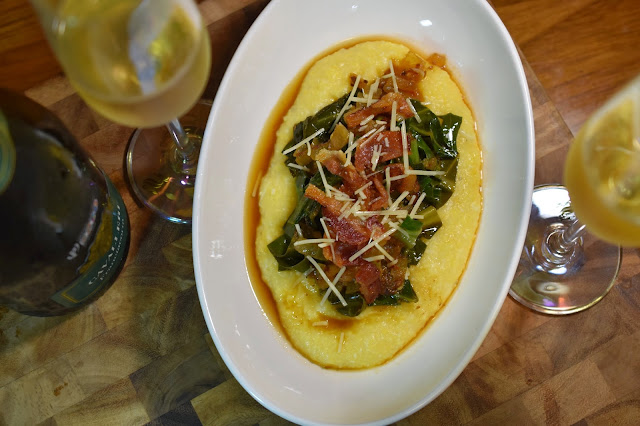
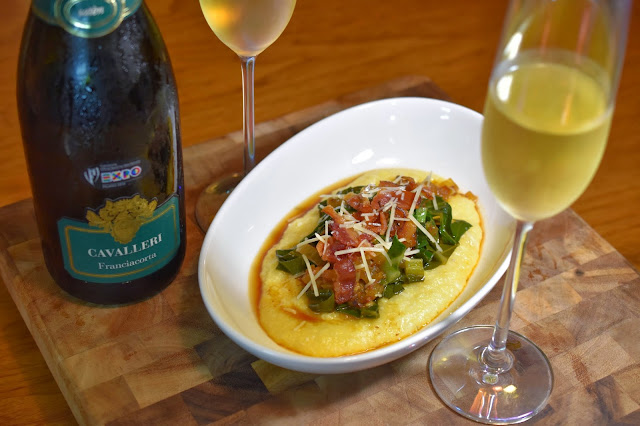
The pairing for this wine came out of a menu collaboration last Valentine’s Day with Dragonglass Glassware. (I’ve been meaning and trying to get this post up for A WHILE.) We paired this with a dish of braised collard greens topped with extra bacon and Parmesan. I love Serious Eats’ recipe – it’s rich and flavorful and has become my go-to method for preparing this Southern classic. 

I liked the idea of serving the collards with polenta, since polenta and grits are basically the same things, I saw it as creating a bridge between the Italian wine and the Southern dish. I use Marcella Hazan’s recipe for polenta as my template, although I tend to like to add cream and/or cheese at the end.

 These two made a delicious pairing. The wine became brighter and livelier with the food. The wine’s savory and umami notes, which were perhaps heightened from the wine’s age, mingled beautifully with the savory notes in the food. The wine also had a richness that matched the weight of the food but also refreshed the palate.


Geeky Details:

I couldn’t find a tech sheet for the 2013, but you can find the production details for the 2016 bottling of this wine here. The basic details for that vintage are as follows: 

Blend: 100% Chardonnay
Fermentation and aging: 75% in steel tanks, 25% in large oak barrels.
Aging:  3 years on the lees
ABV: 12.5%
Average price across all vintages: $28


For a rundown on the many styles of Italian sparkling wines, check out this post. 

And for a general overview on Italian wines, check out this post. 

*****

The Aura Champagne glasses were sent to me as samples, and since then I partnered with Dragon Glassware as an ambassador. Click here to get the glasses for yourself and use the code "NICOLE10" for 10% off. (I might receive a commission at no cost to you.)


*****

The Italian Food, Wine, Travel Blogging Group (#ItalianFWT) is exploring Italian Organic & Natural Wines of Italy. I'm very late to the party, but check out the rest of their posts:  

  • Wendy at A Day in the Life on the Farm will share “Discovering Ziobaffa Wines”.
  • Camilla at Culinary Adventures with Cam will share “With an Ethos of Quality and Sustainability: ZIOBAFFA Pinot Grigio Terre Siciliane IGT + Braised Celery Over Farro Couscous”
  • Susannah at Avvinare will share “Tuscany’s Querciabella Leads the Way on Vegan Wines”
  • Gwendolyn at Wine Predator will share “La Maliosa Saturnia Biodynamic Natural Wine: Red, White Native Grapes Paired with Pizza #ItalianFWT”
  • Jennifer at Vino Travels will share “The Sustainability Behind Sicily’s Principi di Butera”
  • Katarina at Grapevine Adventures will share “3 Wines Going From Organic To Natural”

Additional Sources and Extra Reading:
  • Franciacorta.net
  • Wine Enthusiast: Discover Franciacorta, Italy’s Hidden Gem
  • The Oxford Companion via JancisRobinson.com
  • Wine-searcher.com
  • Food & Wine: Meet Satèn, Italy's Silk Wine
  • The Italy Edit: A Guide To Franciacorta, Italy’s Best Sparkling Wine Region
  • Berry Bros & Rudd: Cavalleri, Lombardy
  • The Wine Chef: Four Great Reasons To Discover Italy's Franciacorta Sparkling Wines

Gorgeous and impressive doors at Podere Selva Capuzza.

Drive about 10 minutes away from the southern shore of Lake Garda, taking a couple of roundabouts inland, and you’ll start to see the beautiful vineyards of Lugana. Predominantly situated in Lombardy and crossing over into Veneto, it strikes me as odd that this region is not better known. It’s so close to the lake resort areas!

Greg and I recently spent a couple of weeks driving around northern Italy. (My first time in Italy!) We took a small detour as we made our way from Barolo to Verona to have a glimpse at Lake Garda and grab some food. After a lovely lunch, we made an afternoon stop at Podere Selva Capuzza. 


The truth is that this region is not all that well known even by wine geeks in the US. I’ve started to become familiar with it a bit over the last couple of years for two reasons. First, we often carry a bottling from Ottella Winery at Bay Grape that I’ve become partial to. Second, I caught a presentation on the region by Deborah Parker Wong at the 2017 Wine Bloggers Conference.


In a short time I’ve really come to appreciate the wines of this region–they’re incredibly versatile! The grape of Lugana is Turbiana, which must make up 90% of the blend. Turbiana is closely related to Verdicchio and Trebbiano di Soave, but the latest research shows it to be different from both. To me, Turbiana shows a deeper character with more stone fruits, ripe citrus, beeswax, and greater extraction than some of the versions of Verdicchio from the Marche, for example.


I was really interested to see the region since we’d be in the general vicinity. Sadly it was to be a very brief stay as we’d be only passing through. It was beautiful and I would certainly love to go back and explore it more completely. A little time relaxing by the lake wouldn’t be bad either! A recommendation from Deborah lead us to Podere Selva Capuzza.


We spent a couple of lovely hours tasting with Luca Formentini whose family established the estate. They’re in the middle of the family’s 101st harvest! He currently leads the team with the help of a cellarman, a winemaker and an agronomist. A musician in addition to being a vintner, he sees himself kind of like a music producer helping to bring all the pieces together to help realize the vision. He also is currently president of Conzorzio Lugana. Despite all of these myriad duties, there was something very calming and serene about his presence that made us feel quickly at ease. 


He graciously took some time out of harvest to meet with us and explained the terroir and history of the area. Lake Garda was cut by a glacier. The rolling Morainic hills of the region were created by the expanding and retreating of the melting of the glacier and caused the hills to form in an amphitheater shape around the lake. The soils on their vineyards are predominantly clay with a lot stones and are rich in mineral salts, thanks to that glacier. The minerality definitely shows up in the wines. 


Images borrowed from Podere Selva Capuzza's Website

The lake is key for the microclimate of the region as it greatly moderates the temperatures. To illustrate this point, Luca mentioned the many olive oil trees on the property, as well as the region as a whole. Typically, the latitude would be a bit far north and the area too far inland for growing olives. The moderating effects from the lake help make it possible. Additionally, cooling winds flow down from the Dolomites in the morning, while afternoon winds are warmer. Both help to keep the vineyards ventilated and the grapes healthy. 


While the winery is not certified organic, they have a deeply developed philosophy on sustainability. They prefer to take a more holistic approach that takes into account not only the soil (they use no herbicides), but other inputs and elements of sustainability as well. For example, they try to use electricity coming from renewable resources, work hard to reduce the CO2 emissions, use as little water as possible, and use recycled materials whenever they can. Their efforts go much deeper than this and are outlined in depth on their site You can read more on that here. (The approach reminds me of efforts such as Napa Green and Lodi Rules.)


The Formentini family works with all native varieties under three different overlapping DOC’s: Lugana, San Martino della Battaglia, and Garda Classico. Each DOC allows for different grapes. Selva Capuzza happens to be the only winery that produces wine under all three. 


Since we had a chance to taste through a variety of wines, I’ll quickly share my tasting notes on all the those we tried. (In addition, to these they make a sparkling wine we did not have the chance to sample on this occasion.)  We discussed pairing options as we tasted with both Luca and the somm at the winery. (Sadly, I forgot to write down her name. 
🤦🏻‍♀️ ) The winery also has a restaurant and rooms available for guests to stay at –– maybe next time!

They are currently between importers in the US, but I’m hoping they will find one soon as I found the QPR on the wines to be excellent. Happily, we brought back a couple of bottles with us. I’ll be cooking to them soon and will certainly share the recipes!


Lugana San Vigilio 2017


This is their lighter, fresher style of Lugana. They see it as their most traditional interpretation. It had notes of pear, green apples, a touches of white flowers. It also had a touch of pleasant herbal bitterness on the finish. It was a light and happy wine. 


This is a porch sipper. Completely lovely on its own to be paired with sunny days, salads, and light seafood.


Lugana Selva 2017 

 
They consider this their signature Lugana: “Produced from our oldest and highest vineyard the Selva is one of the first single vineyard Lugana ever produced.”  The vineyard is 40 yrs old.


This wine definitely goes deeper. Here the pears were more ripe, the apples were gold, but there were also green notes like green melon. White flowers and honeysuckle adorned the nose. The wine also showed greater minerality with a chalky feel.There was greater concentration on the palate with a touch of beeswax to the mouthfeel.


Greg liked the idea of this wine with anchovies. It certainly would be fabulous with all kinds of fish, shellfish, and chicken. The somm mentioned she’d even had it  work well with red meat.


Lugana Riserva Menasasso 2013


“Produced from a selected plot within the Selva Cru, the Menasasso grapes, that make up this rich and refined white wine, are harvested few days after the regular vintage to explore the full potential of the this wonderful vineyard.” This wine is aged 94% in stainless steel, with about 6% spending time in new French oak for a bit of added complexity.

This was a beautifully layered wine. On the nose it had notes of deep gold apples, baked pears, light herbs, a combination of dried and fresh flowers, with a hint of cheese rind. All of those notes continued on the palate and were joined by touch of saltiness, lots of minerality, green melon, almonds and beeswax. It had a luxurious creamy texture with a long, rich finish.


Anchovies continued to seem like a good idea, but now perhaps on buttery, golden toast points. We were told that there is also a local white truffle that pairs wonderfully with this wine. I think this could certainly stand up nicely to a roast chicken or pork, perhaps in a light cream sauce. We brought a bottle of this home, check out what we decided to pair it with here!


San Martino della Battaglia Campo del Soglio 2017

 
“Our family was instrumental to revive and save this small appellation from disappearing and is working hard to bring it to national and - subsequently - international attention.”  This is one of the smallest DOC’s in Italy and for a long time this was the only wine being made under it.


The grape here is Tuchì, which is actually the same as Friulano. They couldn’t use the former name, Tocai Friulano, anymore under EU rules as “Tocai” became reserved for the wines from the region in Hungary. The grape was subsequently left without a name in this region for 7 years. Selva Capuzza marks this by putting a “?” on the back label.  It was eventually agreed upon to re-adopt “Tuchì,” an older, local name for the grape.


This wine had a very compelling nose with notes of peaches, golden apples, and vanilla blossoms. On the palate, stones entered on the finish, but with a richness to the texture and lots of concentration of flavor.


While different in flavor to the Menasasso (different grapes of course), it had a similar weight and feel, so I think this would also go well with light meats and poultry. 


Garda Classico Chiaretto 2017


This rosé is made from four local varieties–Groppello, Marzemino, Sangiovese, and Barbera–and spends 12 hours on the skins to get it’s lovely pink color.


The wine showed a pretty floral note with light orange peel, and cherries. On the palate it was crisp, light and refreshing, with a touch of savory herbs and tomato water.


This would be wonderful with salads, panini, and charcuterie. The somm mentioned that she also finds this wine to work particularly well with asparagus, which can be so tricky to pair. 


Garda Classico Groppello San Biagio 2016 


Groppello is considered the most important of the local red wine grapes. It takes its name from the word for “knot” because it grows in very tight bunches.


Such a pretty nose on this wine! It showed pink flowers and lots of bright red fruits like cherries and pomegranate juice with a touch of the pith, and cranberries, all lightly spiced with a pinch of white pepper. On the palate it was light and very easy to drink with raspberries and lightly perfumed with roses.


If I had access to this wine on the regular, this would be a fantastic House Wine to drink on weeknights. Perfect for pizza, panini, and fresh tomato sauce. 


Garda Classico Rosso Dunant 2014 

 
Like the Chiaretto, this wine is a blend of the four local red grapes: Groppello, Marzemino, Sangiovese, and Barbera.


I got that hint of flowers here as well, along with darker, brambly red berries with a touch of spice. It was medium weight, fun and still easy to drink with a bit more structure.


They called this their “grill wine” and pairs with anything coming off the grates. We brought home the 2013 and am excited to check it out. 


Garda Classico Rosso Superiore Madér 2012 


A more concentrated version of the Dunant, the goal here is make a bigger and more complex style of Garda red. It’s made with the same grapes as the Dunant but from older vines with more restricted yields. It’s aged in small oak barrel for up to 18 months.


The berries here are deeper on the nose– steeped red cherries and spiced red plums. On the palate, it was fuller (while still medium bodied) with light tannins. It was quite flavorful with notes of raspberries, plum sauce, pomegranates, and spice.


This wine would pair well with red meats, particularly pastas topped with ragout and stewed meat dishes.


For me, the red wines kind of straddled Italian and Austrian styles, which makes a bit of sense since they’re fairly close to Austria. They certainly had the flavors of Italy but with the light, easy drinking quality I associate with a lot Austrian reds. 


Lume Benaco Bresciano Passito IGT

This wine is also made from Tuchì, but the grapes are dried out through the appassimento method to concentrate the flavors, and then it subsequently fermented in small barrels.

A beautiful dessert wine with lovely acidity and extraction. It showed orange and gold flowers, notes of hay, dried peaches, and honey.


I thought this was delicious and an excellent value in dessert wines, which tend to be very expensive. We really wanted to bring one back, but were running out of room.


Next time!


Swans and views at Lake Garda.


* * * * *

The rest of the Italian Food, Wine, Travel group is also exploring this wonderful region. Be sure to check out their posts:
  • Marcia at Joy of Wine: Lugana is Not just Another Italian Grape
  • Jane at Always Ravenous: Crab Herb Crusted Chilean Sea Bass and Lugana Wine
  • Wendy from A Day In The Life On The Farm: Seared shrimp and wild mushroom Risotto with Lugana wine
  • Camilla from Culinary Adventures With Camilla: Turbiana Grapes and Tuna Tacos
  • Jill at L’Occasion : Lugana: An Italian White Wine For All Seasons
  • Jen at Vino Travels: Love for the Wines of Lugana
  • Katarina at Grapevine Adventures: 3 Lugana DOC Producers in Comparison at #italianfwt
  • Lisa at The Wine Chef: Seafood Pasta With Tomatoes, Garlic And Lugana White Wine
  • Li of The Wining Hour: Lugana Loves Lake Garda
  • Rupal the Syrah Queen: A Journey to Lugana - Italy’s Elegant White Wines.
  • Lynn at Savor the Harvest: Change It Up With Lugana DOC and Turbiana
  • Susannah at Avvinare: Lugana Love
  • Gwendolyn at Wine Predator with Fall for Lugana and Chicken Piccata


  • Additional sources used for this post:
    Lugana’s Turbiana Isn’t Trebbiano 
    Wine Folly: Try This Wine Before It Disappears 
    The Oxford Companion to Wines via Jancis Robinson 
    Wine-Searcher 
    Native Wine Grapes of Italy
     

Older Posts Home
View mobile version

INSTAGRAM

Sign up for my mailing list!

Subscribe

* indicates required


Somm's Table 2017