Somm's Table

Perfect pairings from the other side of the equation.

  • About
  • Front of the House
  • Back of the House
  • Contact Us
Powered by Blogger.

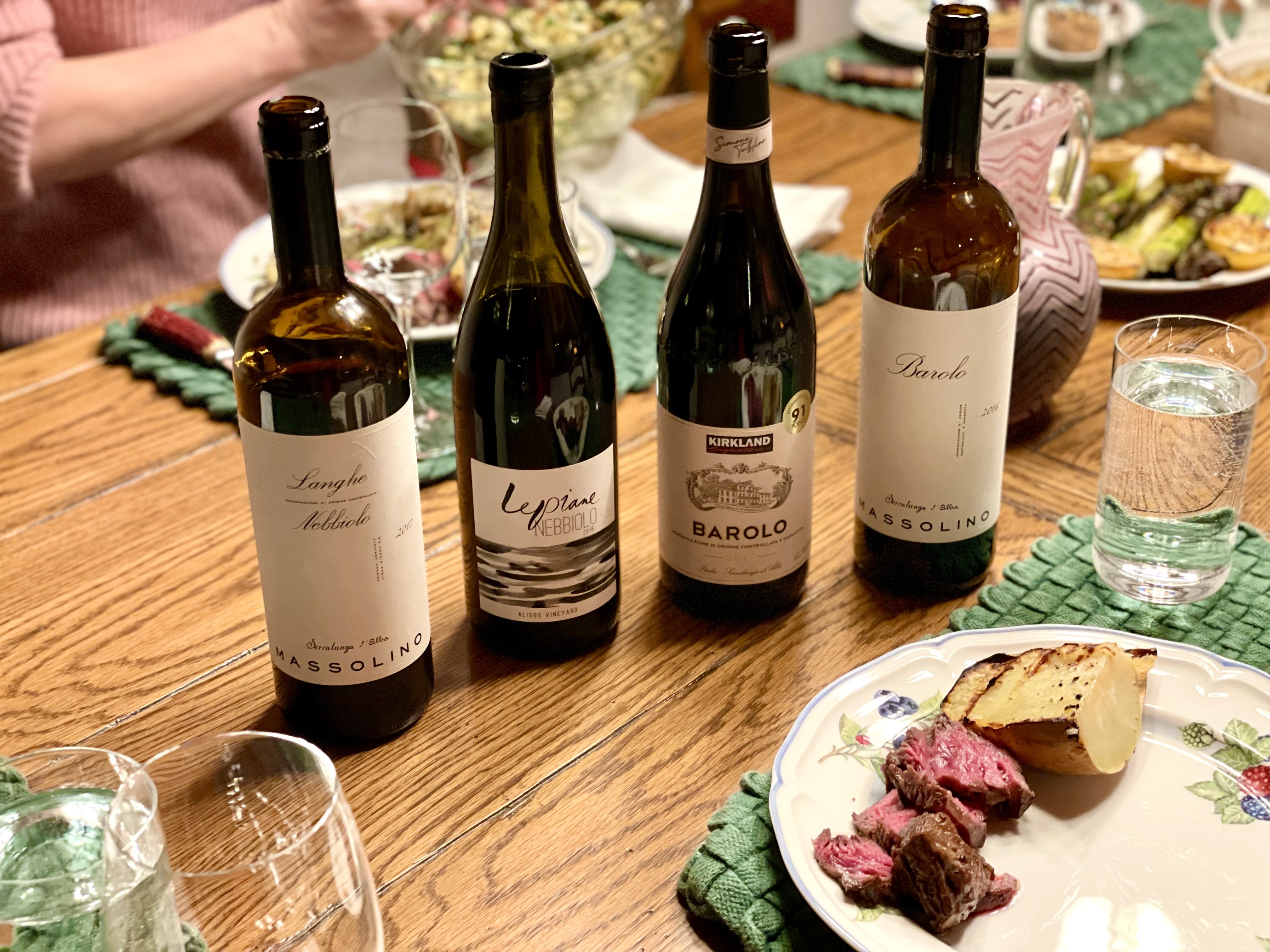
A steak dinner and a comparative tasting of four bottles of Nebbiolo – yes, please!

Please note, that some of the wines in this post were provided as media samples. No other compensation was received and all opinions are my own.


One of the great things about tasting with a group of friends is that you can open and taste a lot more bottles simultaneously without worrying that the wine will go to waste. If those friends are willing to go along with you on a wide-geeky ride, it’s also a perfect chance to do some comparative tastings. I admit that I often force friends to join me in conducting these types of experiments. Luckily, when we head off to the Culinary Cabin, only the lightest arm twisting is required. 

The Culinary Cabin is the loving name we’ve bestowed on our friends’ family vacation house in Tahoe, and the weekends we spend there tend to be all about food and wine experimentation. During our most recent trip, I “forced” my friends into a comparative tasting of four Nebbiolo-based wines “for science.” The guys in the group prepared a steak dinner to accompany the wines. Everyone was very upset.


NEBBIOLO 


Nebbiolo is Piedmont’s superstar red grape. It’s the grape behind this northern Italian region’s blockbuster wines, Barolo and Barbaresco. The grape’s trademark aromatic signature is notes of “tar and roses.” That tells you something about the combination of delicate and rustic elements this grape tends to bring together.  Tart cherries, leather, anise or licorice, earth, mushrooms, leather, and herbs are all also common flavor elements in Nebbiolo wines. I personally also often get a little orange peel in the mix. 

In addition, the grape tends the show super racy acidity and grippy tannins. While the wines tend to be deeply flavored and highly structured, the body of the wines is often sleek and can be anywhere from medium-bodied and translucent in a way that belies the punch the wines can pack in, to deep and full-bodied, depending on how it’s made and where it’s from. 

The wines often show orange color even when they’re young, but thanks to the mix of high acidity, alcohol, and tannin, the wines can easily age for decades in the bottle. In many cases, particularly in the case of Barolo and Barbaresco, the wines really need that time to chillax and can taste super tight otherwise. They’re kind of like a person that’s super anxious and wound-up in their youth, but learns to unwind and relax with age. If you don’t have the time to wait for your Barolos and Barbarescos to age in a cellar, you’ll at least want to decant them with plenty of lead time before dinner. I’ll often decant them hours in advance when I manage to think of it. The high levels of tannins and acidity also mean, in my mind anyway, that these wines are best served with a meal as these elements smooth out when enjoyed with a hearty meal. Enjoy these wines with foods that are meaty or have some fat, like creams or cheese, as these will help to calm the tannins.

We’ve taken a look at this grape several times before. Check out this post for more on the grape and this one for more on the history of Barolo. 

Nebbiolo can be a fussy grape to grow, a fact that contributes to the high prices some Nebbiolo- based wines tend to command. Nebbiolo is thought to take its name from the Italian nebbia (or nebia in Piedmontese), meaning "fog," and it really seems to relish the foggy conditions of its home region as it doesn’t seem to express itself with quite the same complexity anywhere else. (The name might also be a reference to the bloom that appears on ripe Nebbiolo berries.)

However, while it likes that fog, it also needs a good balance of sunshine as well to ripen fully, so it’s typically given the prime spots on hillsides that get the most sun exposure. It’s a diva. 

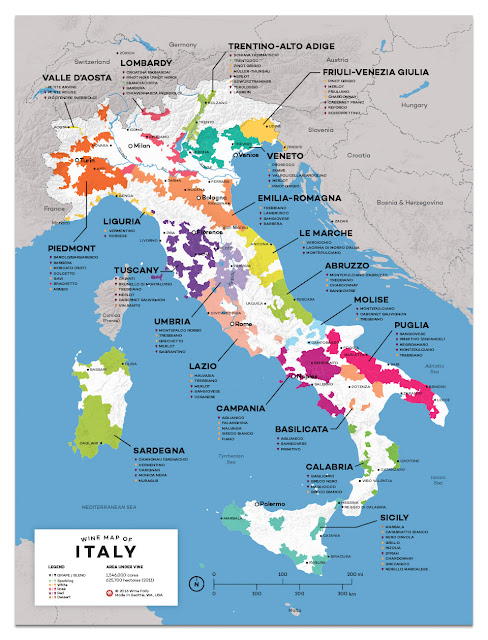
Map borrowed from Winefolly.com.

Barolo and Barbaresco might be the celebrity icons of Piedmont, however, they’re not the only show in town. It’s grown across Piedmont, as well as in Valle d’Aosta and Lombardy. While Barolo and Barbaresco tend to be pricey, thankfully, there are other Piemontese appellations making Nebbiolos that are both easier on the wallet and are approachable at a much earlier stage. Here are three: 

  • Roero DOCG – This region is just across the Tanaro river from Barolo and has sandier soil. It’s known for making high-quality Nebbiolos that tend to be lighter and a bit fruitier in style with less intense tannins.
  • Nebbiolo d’Alba DOC – This zone covers much of the territory of Roero but then extends further, crossing the Tanaro south of Alba to Diana d'Alba. It has similar characteristics to Roero.
  • Langhe Nebbiolo DOC – Langhe is the hilly subregion of Piedmont where Barolo and Barbaresco are located.  ("Langhe" is the plural form of langa, a local word for a long, low-lying hill.) Grapes that go into Langhe Nebbiolo might come from areas just outside the borders of Barolo and Barbaresco. The wines might also be made from grapes from younger vines or from less favored plots that lie within the two famed appellations. Wines not adhering to all of the requirements of the two prestige appellations might also fall into this classification. As such, these wines are sometimes thought of as “baby” Barolos and Barbarescos. Given this, prices on Langhe Nebbiolo can vary quite a bit.

Since we’re going to look at a bottle of Langhe Nebbiolo further down, we’re going to go a little deeper here. Production rules are meant to give winemakers more flexibility than they have in making Barolo and Barbaresco, so there are no minimum aging requirements and the wines will tend to spend less time in oak than in the other two. (Basic Barolo must be aged for at least three years with 18 months in oak, and basic  Barbaresco is aged for a minimum of two years with at least 9 months in oak.) Winemakers might also leave the juice less time macerating on the grapes than in the case of the other two, making a less extracted, easier-drinking style. Sometimes, winemakers use the Langhe Nebbiolo appellation simply to make declassified  Barbaresco and Barolo wines, allowing them to sell more wine without compromising their elite labels. Production rules also allow for up to 15 percent of other indigenous grape varieties, like  Barbera and Dolcetto, but most are also made entirely from Nebbiolo.


THE FOOD: A RIBEYE CAP STEAK DINNER

The guys did most of the cooking on this particular trip. One of our hosts, Northern Drew, was the head chef, Greg and Southern Drew were the sous chef. (Each Drew is so-called dependent on where in the state of California they live.) 


On this particular evening, they made a feast centered around Northern Drew’s favorite cut of beef: ribeye cap. This is the outer muscle of the ribeye roll, which is the source of ribeye. It’s richly marbled and also super tender, so it’s kind of like a ribeye crossed with a filet mignon. (For more on this cut, read J. Kenji López-Alt’s ode in its honor.)  The guys prepared it sous vide and finished it on the grill, seasoned with salt and pepper. 

In addition, they made a slew of veggie sides including grilled asparagus, roasted cauliflower topped with gremolata,  sautéed cabbage, and  roasted sweet potatoes. We also had horseradish sauce to enjoy with the beef.


It doesn’t directly relate, but there might’ve also been a Basque cheesecake prepared by my friend Dee for dessert. 


This meal did not suck. 


THE WINES


We had two Barolos (both were decanted), one Langhe Nebbiolo, and a bottle from California with this fabulous steak dinner. Here’s what was in the line-up. 


Massolino Barolo 2016
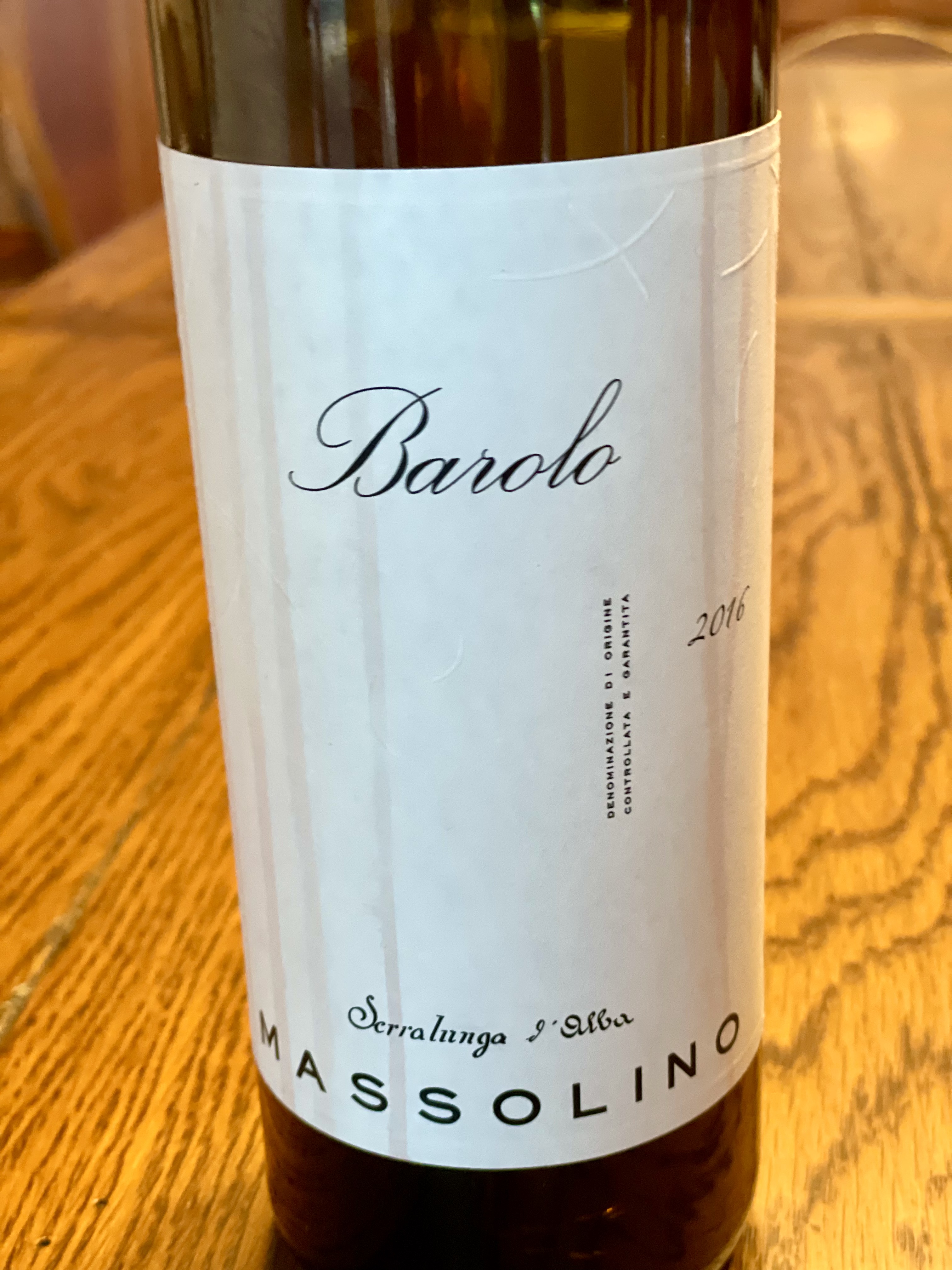

Average Price: $55 (sample)  | ABV: 14.%

The Massolino family’s history in the commune of Serralunga d’Alba dates back to 1896 when Giovanni Massolino founded the estate. Giovanni was the very first person to bring electricity to the village. His son, Giuseppe,  built their wine cellar, and he along with his sister Angela, extended the estate. Giuseppe was also one of the founders of the Consortium for the Defence of Barolo and Barbaresco in 1934. Giuseppe had six children and three of them – Giovanni, Camilla, and Renato – followed their father into the family business. They continued the estate’s expansion and purchased three of their cru vineyards: Margheria, Parafada, and Vigna Rionda. Franco, Roberto (both oenologists), and Paola represent the current generation. Their vineyards are farmed sustainably. 

Winemaking: Their Barolo DOCG represents a blend of their vineyards, each bringing different characteristics offered by each terroir. There is a blend of soils with a tendency toward limestone. This is traditional Barolo with long fermentation and maceration in oak fermenters (“tini”) at temperatures around 30°C; the wine is aged in large Slavonian oak casks for up to 30 months before being left to mature in bottle. Additional details can be found in the tech sheet here or here.

Tasting Notes: This is a classic Barolo showing the characteristic “tar and roses,” along with cherries, white pepper, and licorice. This wine showed an elegant and pretty side of Nebbiolo, showing a pleasant bright, tangy quality to the fruit, accompanied by the structure grippy tannins. One of the Drews noted that it tasted like his mental image of what he wants Barolo to taste like.  In comparison to Langhe Nebbiolo that we’ll see further down, the fruit quality was deeper, rounder, and plusher.

Pairings: This wine was generally friendly to the food on our table. No surprise, it was stellar with the steak, but it was also surprisingly ok with the asparagus, which is not a wine-friendly vegetable. 

The winery also offers the following recommendations: “It achieves its best expression when served with red meats, particularly game, and with dishes dressed with truffle. It is also excellent with fresh egg pasta and meat sauce, and with risotto, as well as medium-mature cow’s milk and goat’s milk cheeses.”


Kirkland Barolo 2017 


Price: $20 | ABV: 14%

Since Costco doesn’t share the details of the winery behind the wines, there’s no background info to share. However, as has been my general experience with their wines, this was a very solid representation of the style at a price point that can’t be beaten. The fact that it says “Kirkland” on the bottle might rule it out as an option to take to most dinner parties, but it should definitely not keep it from showing up on your dinner table. The price makes Barolo a possibility for a weeknight dinner. This is also a great option if you’d like to get an idea of what Barolo is all about without breaking the bank. 

Tasting Notes: This wine displayed the earthier side of Nebbiolo. It was the earthiest of the bunch. I picked up a little bit of brett when I first opened it up, but this quickly blew off, and then the nose became a bit shy. It showed notes of cherry, bay leaf, mushrooms, and thyme on both the nose and palate, all lifted by bright acidity. Unsurprisingly, this wine didn’t show the finesse of the Massolino Barolo, but it definitely delivers good value at $20. 

Pairings: Of course, this wine liked the steak, as they all did. However, I failed to take notes on how it went with the various veggies. This wine should also go with anything involving mushrooms.


Massolino Langhe Nebbiolo 2017


Average Price: $29 (sample) | ABV 14.5% 

The grapes for this wine come from several municipalities. As you might guess, it’s made for earlier consumption. 

Winemaking: The wine undergoes a medium period of fermentation and maceration (approximately 15 days). It ages in large Slavonian oak barrels for over a year. Additional details can be found in the tech sheet here and here.

Tasting Notes: A good representation of the fresher side of Nebbiolo. It showed notes of bright strawberries, cherries, and even a hint of cranberry on the nose and palate, along with floral notes and freshly tilled earth and stony minerality. While this was certainly a lighter expression in comparison to the Massolino Barolo, Nebbiolo’s structure wasn’t lacking and the wine still showed good density and grip.  

Pairings: Good with the steak of course, but this one paired quite well with bites involving horseradish as well. It was also quite good with many of the veggies. The wine became lighter and brighter alongside the roasted cauliflower with gremolata. 

Here are additional pairing recommendations from the winery: “Ideal throughout a meal but at its best when served with rich, tasty dishes, ranging from fresh-egg pasta with meat or vegetable sauces to grilled or roasted red meats. It is also excellent with soft and delicate blue cheeses.”


Lepiane Nebbiolo Alisos Vineyard 2015


Price: $49 (sample) 

I’ve shared a couple of wines from Alison Thomas’s Lepiane line in the past, so I’ll refer you here and here for more details on this one-woman operation in Santa Barbara, California. To be honest with you, I’m not typically the biggest fan of California Nebbiolos, but I thought it would be fun to have one in the line-up and this is usually one of the better examples, IMHO. Sadly, the wine wasn’t showing so well on this particular day, but I don’t really think it was its fault. I’d Coravin’d this bottle to AGES before and I think the gas cartridge had been running low because the fruit in the wine was a little flat, it was a touch oxidized, and overall, it lacked the vibrancy I’d previously experienced with it. 

Winemaking: Elevage occurred in a 600L neutral barrel for 33 months before being bottled without any fining or filtration. An additional 20 months of bottle aging allows this wine to show its beautifully complex nature. Organically farmed. Additional details here.

Tasting Notes: Since the wine wasn’t showing so well this evening, my tasting note is from my previous tasting of the wine. The wine reminds me of fall with notes of dried flowers, orange zest, and cranberries on the nose. The fruit is bright on the palate and joined by notes of black pepper, herbs, and the characteristic “tar and roses.”  

Pairings: It was good with the steak, of course. It was also good with the sweet potatoes, but it did not like the cauliflower. 


Go forth and explore the many sides of Nebbiolo!

*****

For more posts related to Nebbiolo, check out these posts:

  • Italian Wine 101 Cheat Sheet
  • Cooking to the Wine: Fontanafredda Barolo and Braised Short Ribs with Mushrooms
  • Touring & Dining at Marchesi di Barolo
  • An Anniversary Celebration with La Spinetta Vürsù Gallina Barbaresco and Braised Spatchcocked Duck
  • Cozy Date Night In with Gnocchi with Easy Pork Ragù


*****


The writers of the Italian Food, Wine, and Travel (#ItalianFWT) blogging group have been exploring the wines of Langhe this month. Check out their posts here:

  • Wendy Klik highlights Beef and Pork Ravioli, A Book Review and a Nebbiolo from Langhe on A Day in the Life on the Farm 
  • Camilla Mann pairs Spicy Mussels Chorizo + 2017 Villadoria Bricco Magno Langhe Nebbiolo at Culinary Adventures with Camilla 
  • Linda Whipple entices with Of Nebbiolo, Salami and a Langhe Farmer’s Dream at My Full Wine Glass
  •  Jen Martin gives us a glimpse with an Overview of the Langhe Wines at Vino Travels
  • Gwendolyn Alley introduces us to the “Queens of Langhe: Mother Daughter Duo Anna and Valentina Abbona of Marchesi di Barolo” on Wine Predator.
  • Host Cindy Rynning entices us to Explore a New-to-You Wine – Nas-Cëtta from the Langhe in Piemonte” at Grape Experiences.

Additional sources used for this post and extra reading: 

  • JancisRobinson.com
  • Wine-searcher.com
  • Winefolly.com - Nebbiolo: The Grape of Barolo and So Much More
  • NY Times.com - Your Next Lesson: Langhe Nebbiolo
  • Winefolly.com: Nebbiolo
  • Forbes.com: The Serralunga Style Guide - Barolo Power (Part One)
  • WineScholarGuild.org: Barolo Communes


Time for more bubbly!

Today we’re exploring a small region of Italy not enough people know about – Franciacorta. It’s understandable that this is still a fairly undiscovered gem – the region’s sparkling wine history only dates back 50-60 years. However, in that fairly short period of time, Franciacorta has established a reputation (among those who know about it) for high-quality, traditional method sparkling wine. 

In addition, the area is rapidly pushing forward on the sustainability front as well. The first organic bottling of Franciacorta came out in 2002 (from Barone Pizzini), but since then they’ve progressed by leaps and bounds so that now nearly 70% of the region’s wineries are either certified organic or in the conversion process. This gives Franciacorta the highest percentage of organic producers of any region in the country.

Altogether, it’s a region well-worth getting to know.


Franciacorta Cheat Sheet 


Styles: The major defining characteristic of the region is, as mentioned, that it specializes in traditional method sparkling wines – i.e. the same style as Champagne in which the second fermentation that creates the bubbles occurs in the bottle. (For an in-depth look at the process, check out this post.) The wines come in rosé and white styles and are available in the full range of sweetness levels typical of sparkling wines, ranging from Zero Dosage wines at the driest end, and demi-sec at the sweetest end. Brut is the most common style, and while up to 12 grams of sugar per liter are permitted, most producers stay well below that.

One distinctive style of Franciacorta is Satèn, which is bottled at a lower bottle pressure than the usual – it must remain below 5 atmospheres instead of 6 – creating more subtle, creamy bubbles. Satèn wines are made with only white grapes are produced exclusively in the Brut style.


Aging Requirements: Non-Vintage Franciacorta wines must age on the lees for at least 18 months. The number goes up to 30 months for vintage wines, and that’s doubled to 60 months for wines labeled Riserva. Satèn and rosé wines must age for at least 24 months on the lees. 


Location: Franciacorta is located in the region of Lombardy in northern Italy. It’s bordered by Lake Iseo to the north, which helps create a warm but moderate microclimate that gives the grapes plenty of time in the sun to ripen. Cooling breezes from the foothills of the Rhaetian Alps farther to the northeast help moderate the temperatures as they flow down through the area’s rolling hills, which also help to shelter the vineyards. The growing region is shaped like an amphitheater, which was carved out by retreating glaciers. The glaciers were also kind enough to leave behind lots of well-draining, mineral-rich gravel, and limestone soils. Put it all together and you get fairly ideal conditions for growing grapes that ripen well while maintaining acidity and can grow happy and healthy in the excellent soils.

Curtefranca DOC (formerly known as Terre di Franciacorta) covers the same area, but for still white and red wines made from international varieties.


Grapes: The key grapes are similar to those used in other traditional method regions. Chardonnay, Pinot Nero (Pinot Noir), and Pinot Bianco (Pinot Blanc) are the key grapes. Chardonnay is the leader both in plantings and usage, but Pinot Bianco can make up 50% of the blend. Rosé wines must contain at least 35% Pinot Nero. Erbamat, a white grape indigenous to the area that’s enjoying a resurgence thanks to its high acidity levels, is also permitted up to 10%.  


History: 

While the region’s winemaking history goes back to the 16th century, its modern chapter begins in 1961 when the house of Guido Berlucchiwith released the first traditional method sparkling wine ever to be produced in the region. The wines were in high demand right away, and as a result, a string of entrepreneurs was attracted to invest in the region. The style developed quickly, and Franciacorta was granted its DOC status in 1967 for sparkling and non-sparkling wines.

The region was conscientious in how it invented itself from the start. It modeled itself closely on Champagne, and the local Consorzio established a code of self-regulation for farming and production at least as strict as its example. Franciacorta has always set the bar high for itself in terms of quality, and its Consorzio (established in 1991) has generally campaigned over time for more and more rigorous standards. As a result of all of this hard work, as well as a good bit of lobbying, Franciacorta was promoted to DOCG status (Italy’s highest classification) in 1995. 

The region has established a reputation for high-quality wines that often have a good capacity for aging. (My example today had several years on it and was still quite delicious.) You’ll find a mix of large and small producers here, but they tend to share that focus on quality – which is heartening as a consumer. 


What makes it distinctive: 

Franciacorta might have modeled itself on Champagne, but it’s still its own region so there are distinctions. These two regions have very different climates and terroirs. Thanks to Franciacorta’s climate, they have a much easier time ripening their grapes. The fruit tends to have rounder and riper fruit notes, like golden apples and stone fruits, and even tropical fruits in warmer years. Personally, I often get a rich baked pear tart note from Franciacorta. 

Thanks as well to the ripeness of their fruit, Franciacorta can pretty reliably produce good zero dosage wines every year. This isn’t always the case in Champagne.

The next difference we already talked about – this is a much younger region. Champagne has about 300 years on Franciacorta. There’s also a huge difference in scale – Champagne produces about 100 times more wine per year. However, we’ve seen as well that in Franciacorta, that smaller scale goes with attention to detail and a focus on quality. 

The downside is that given the high focus on quality and smaller-scale production, bottles can definitely get pricey. However, at least you can be reasonably assured when spending the money that the wine you’re buying was conscientiously made, even if you know nothing about the producer as you're picking up the bottle. In addition, as mentioned at the top, there is an increasing focus in the region as a whole on organic and biodynamic viticulture. 


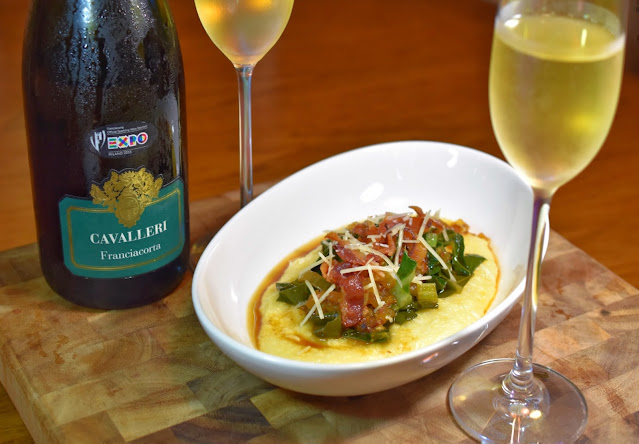
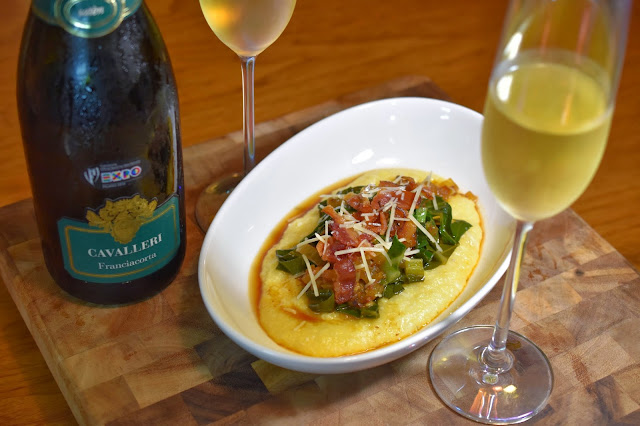
The Wine & Pairing: Cavalleri Satèn Brut Franciacorta with Braised Collard Greens and Polenta

Cavalleri is one of two biodynamic estates in Franciacorta. The family’s history in the region stretches back to 1450, but it was Gian Paolo and his son Giovanni Cavalleri that began to bottle wine for themselves and gave the company its current name in 1968, shortly after the Franciacorta DOC was established. (Prior to that, the family had sold their wines in bulk.) Giovanni Cavalleri was part of the group of winemakers that helped to establish the consorzio in 1990, and he even served as President. Giovanni’s daughters, Maria and Giulia, followed them into the business, and now his grandchildren, Francesco and Diletta, have also joined the company.

Cavalleri approaches farming in a holistic way, planting grass, cruciferous plants, and legumes in between the rows to increase the organic matter within the soil and increase its vitality by natural means. The house style is to produce wines that are ripe but dry, using low levels of pressed juice, sweet dosage, and sulfur.  They also partially ferment in large barrels of Slavonian oak, rather than barriques, which are more common.

I’d had the 2013 Satén in “my cellar” for a while, but it was still showing quite nicely. On the day we opened it, it showed notes of bruised golden apples and baked pears on the nose, along with dried flowers, yellow plums, and yellow peach. There were similar notes on the palate, although the fruit notes were a bit brighter and fresher. It also showed more leesy notes on the palate of pastry crust along with savory cheese rind and lots of toasty notes, perhaps coming from the age of the wine, well as the winemaking process. As it was a Satén, the bubbles were more subtle and had a creamier feel than your typical sparkler.

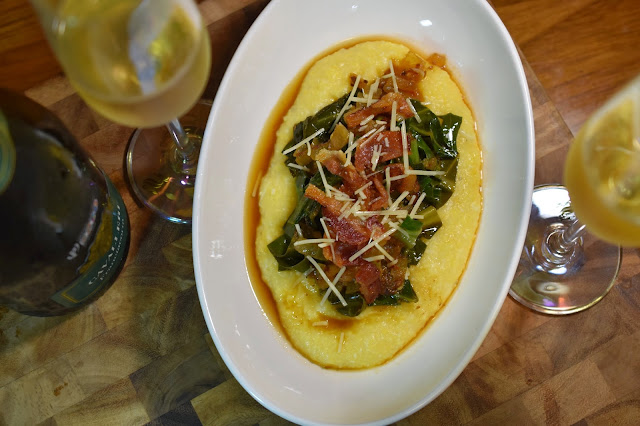
The pairing for this wine came out of a menu collaboration last Valentine’s Day with Dragonglass Glassware. (I’ve been meaning and trying to get this post up for A WHILE.) We paired this with a dish of braised collard greens topped with extra bacon and Parmesan. I love Serious Eats’ recipe – it’s rich and flavorful and has become my go-to method for preparing this Southern classic. 

I liked the idea of serving the collards with polenta, since polenta and grits are basically the same things, I saw it as creating a bridge between the Italian wine and the Southern dish. I use Marcella Hazan’s recipe for polenta as my template, although I tend to like to add cream and/or cheese at the end.

 These two made a delicious pairing. The wine became brighter and livelier with the food. The wine’s savory and umami notes, which were perhaps heightened from the wine’s age, mingled beautifully with the savory notes in the food. The wine also had a richness that matched the weight of the food but also refreshed the palate.


Geeky Details:

I couldn’t find a tech sheet for the 2013, but you can find the production details for the 2016 bottling of this wine here. The basic details for that vintage are as follows: 

Blend: 100% Chardonnay
Fermentation and aging: 75% in steel tanks, 25% in large oak barrels.
Aging:  3 years on the lees
ABV: 12.5%
Average price across all vintages: $28


For a rundown on the many styles of Italian sparkling wines, check out this post. 

And for a general overview on Italian wines, check out this post. 

*****

The Aura Champagne glasses were sent to me as samples, and since then I partnered with Dragon Glassware as an ambassador. Click here to get the glasses for yourself and use the code "NICOLE10" for 10% off. (I might receive a commission at no cost to you.)


*****

The Italian Food, Wine, Travel Blogging Group (#ItalianFWT) is exploring Italian Organic & Natural Wines of Italy. I'm very late to the party, but check out the rest of their posts:  

  • Wendy at A Day in the Life on the Farm will share “Discovering Ziobaffa Wines”.
  • Camilla at Culinary Adventures with Cam will share “With an Ethos of Quality and Sustainability: ZIOBAFFA Pinot Grigio Terre Siciliane IGT + Braised Celery Over Farro Couscous”
  • Susannah at Avvinare will share “Tuscany’s Querciabella Leads the Way on Vegan Wines”
  • Gwendolyn at Wine Predator will share “La Maliosa Saturnia Biodynamic Natural Wine: Red, White Native Grapes Paired with Pizza #ItalianFWT”
  • Jennifer at Vino Travels will share “The Sustainability Behind Sicily’s Principi di Butera”
  • Katarina at Grapevine Adventures will share “3 Wines Going From Organic To Natural”

Additional Sources and Extra Reading:
  • Franciacorta.net
  • Wine Enthusiast: Discover Franciacorta, Italy’s Hidden Gem
  • The Oxford Companion via JancisRobinson.com
  • Wine-searcher.com
  • Food & Wine: Meet Satèn, Italy's Silk Wine
  • The Italy Edit: A Guide To Franciacorta, Italy’s Best Sparkling Wine Region
  • Berry Bros & Rudd: Cavalleri, Lombardy
  • The Wine Chef: Four Great Reasons To Discover Italy's Franciacorta Sparkling Wines

Cava has been undergoing a makeover!  It's time to take a new look at Spain's sparkling wine. 


The wines in this post were provided as media samples. No other compensation was received and all opinions are my own. This post also contains affiliate links from which I might gain a commission at no cost to you.


Happy New Year! It seems appropriate to kick off the new year with some bubbly to celebrate.

I spent a lot of time last year reacquainting myself with Cava. The Spanish bubbly has been undergoing some changes, and it’s time to take another look. 

Drinking a bottle of Cava with dinner in Barcelona.

I have excellent memories of drinking glasses of Cava while eating tapas in Barcelona, as well as elsewhere around Spain. Nonetheless, I’m not going to lie, for a long time, Cava seemed to be a bit of a mess to me. Quality was very variable amongst bottles I’d try. Some were lovely, balancing citrus, smoky and toasty notes, in others, the smoky notes would come off as an unpleasant rubbery quality instead. Eventually, broadly speaking, I started to view Cava as cheap fizz – fine for mixing in a cocktail or mindless sipping, but not the bubbly I was going to grab if I was planning to pay attention to the wine at all. There were exceptions of course, but in general, it fell to the bottom of my personal hierarchy of bubbly regions. (I’m not talking about carbonated bubblies here – I’m talking about “should-be” quality sparkling wines.) I don’t think I’m alone here, as it would appear that many consumers had similarly begun to give the category the side-eye. 

As I started to learn a bit more about the D.O., it seemed to me that it was a region that was aware of its problems and its flagging reputation, but that the producers couldn’t agree on a solution. You didn’t have to dig too deeply to see that they were plagued by infighting since quite a few high-quality producers were choosing to leave the D.O. altogether. Raventos i Blanc is one famous example, as they opted to leave and to spearhead the creation of a whole new appellation: Conca del Riu Anoia. Then another group of nine quality-minded producers split off and formed Corpinnat in 2017, an association that adheres to their own stringent regulations and operates as a trademark rather than falling under the jurisdiction of a D.O.  

Basically, a lot of the best Cava wasn’t actually Cava anymore. 

I’m sure that many of the quality producers that were left were forced to do a lot of soul searching. It looks like it has paid off and that the D.O. has indeed figured out a plan and are moving forward with a renewed focus on quality and sustainability that is region-wide. In short, they’ve been giving themselves a makeover. Throughout 2021, I participated in a series of webinars to learn about the new developments in the region and was very impressed by the resolve and determination of the producers to re-establish the credibility of the region and to do it conscientiously and with care for the land. In the process, I also had the chance to taste a lot of Cava in order to reacquaint myself and got to play with many pairings!

Cava Basics

Image borrowed from D.O. Cava. 

Before we get into what’s new let’s look at the nuts and bolts of these wines.

It’s made in the traditional method, i.e. in the same way as Champagne with the second fermentation occurring in the bottle.

  • Where does it come from?  Penedès in Catalonia in northeastern Spain. . . mostly. Things get a little tricky because the region is non-contiguous. Cava production originally grew up around the town of Sant Sadurní d'Anoia, and it is still the center of production. However, there are delimited areas all around Spain in Aragon, Navarra, Rioja, and Paìs Vasco, Valencia, and Extremadura that are allowed to produce Cava. Nonetheless, this only accounts for about 10% of production. 
  • The Grapes. One of Cava’s most distinguishing features is the grapes used, as it’s made predominantly with indigenous grapes. The permitted white grapes include Xarel-lo (spelled many ways), Macabeo (aka Macabeu or Viura), Parellada, Malvasia (sometimes called Subirat), as well as Chardonnay. The red grapes, which are used for the rosés, include Trepat, Monastrell (aka Mourvèdre or Mataró), Grenache, and Pinot Noir. Here’s a bit more on the trio that makes up the most classic Cava blend:
    • Xarel-lo – Perhaps the region’s most emblematic variety. It adds acidity, citrus, and apple flavors, and is responsible for Cav’s distinctive earthiness.
    • Macabeo – It's fairly neutral in flavor, but it can also add notes of citrus and stone fruits. Its strengths lie in the fact that it adds body and texture to a blend, and it’s resistant to oxidation, so it allows the wines to age better. It also grows easily in Spain’s climate.
    • Parellada – This grape has green apple, quince, citrus, and floral notes. In addition to fruity character, it also adds structure and body, particularly to the mid-palate. Parellada ess and balance. It also has aging potential.
For more detailed info on the grapes of Cava, see this guide from D.O. Cava.

  • Styles: Cava comes in both white and rosado (rosé) styles. It is also made in the full range of sweetness levels typical of sparkling wines: 
    • Brut Nature: 0-3 grams per liter
    • Extra Brut: 0-6 g/l
    • Brut: 0-12 g/l
    • Extra Seco (Extra Dry): 12-17 g/l
    • Seco (Dry): 17-32 g/l
    • Semi-Seco (Semi-Dry): 32-50 g/l
    • Dolç/dulce (Sweet): 50+ g/l  
  • Aging Requirements: These have changed a bit recently, and we’ll get into additional details on recent changes a bit more further down. Like all traditional method sparkling wines, Cava is aged on its lees (the dead yeast cells left over from fermentation) in order to gain toasty/nutty/bready/pastry notes. Here are the minimum aging requirements by aging category – note that many producers will choose to exceed this: 
    • Cava (Cava de Guarda - basic level) - 9 months
    • Reserva - 18 months (increased from 15 months, starting with the 2020 vintage)
    • Gran Reserva - 30 months 
    • Cava de Paraje Calificado - 36 months. (This is a newer category introduced in 2016. We’ll get into it in a moment.)


A Bit of History 

Cava’s history goes back to 1872 when Josep Raventòs produced the first bottles of sparkling wines using the method he’d seen in Champagne while traveling around Europe promoting the still wine wines of Codorníu Winery. This had a few benefits. The vineyards of the Penedès were being devastated by phylloxera right around the same time, and where the vineyards had previously been dominated by red vines, they were now being replaced by larger numbers of white grapes. This dovetailed nicely with Cava production, as it relies more heavily on white wine grapes. Raventòs didn’t focus on the Champagne grape varieties  – he just imported the method of production and used the grapes of the Penedès.

Raventòs also had the aim of competing with the already fashionable Champagne. (Remember, Champagne as we know it today only came into being in the 19th century, so Cava wasn’t that far behind.) Trade wars with France also helped spur on the development of ‘Catalonian Champagne,’ and it didn’t hurt the Spanish monarchy also supported the endeavors. Altogether, Pendes’ sparkling wines were a pretty immediate success, although it would see some dips during hard times during the early half of the 20th century like the Spanish Civil War.  

The name ‘Cava’ didn’t come into being until 1959. Prior to that, the wines were known under other names like Champán and Xampany, but in 1972 Spain made an agreement with France to no longer use versions of ‘Champagne.’ The word ‘cava’ in Spanish means ‘cellar’ and is a reference to the long aging period the wines go through during and after the second fermentation, waiting around in the cellar until they’re read. Cava became an official appellation in 1986 when Spain entered the EU.

Gyropaletten Champagner.jpg
Image borrowed from Wikipedia.

Cava has also contributed to the greater sparkling wine world. Producers here developed the gyropallet, the machine that riddles bottles in large batches, collecting lees in the neck of the bottles, so that they can be disgorged (removed.) Prior to this, all bottles had to be riddled by hand, one at a time. 

Image borrowed from D.O. Cava. 

One more quick note on the industry here. It’s true that the production in the region is dominated by two major producers – Freixenet and Codorníu – you can probably picture the bottles right away. However, it's worth noting that there are also lots of medium-sized and small producers as well, and it’s well worth exploring and comparing the different styles, not to mention fun!


What’s New in Cava

Image borrowed from D.O. Cava. 

As I mentioned, there have been a lot of changes in Cava recently. Many of the complaints that were leveled by producers that left the appellation had to do with issues of quality standards and sustainability, as well as the fact that wines tended to lack a sense of place. The updates tend to speak to these issues. Even if they were too late to keep the producers from leaving, some of them are pretty impressive and ambitious. 

In addition to tightening up quality standards, a new hierarchy has been created. Starting this year, 2022, all Cava will fall under two overarching tiers: Cava de Guarda and Cava de Guarda Superior, which is then further subdivided. Cava de Guarda is basically your entry-level tier. As discussed above, it’s aged for the least amount of time and is intended to have a bright, fresh profile, ideal for early drinking.

Image borrowed from D.O. Cava. 

Great, but Cava de Guarda Superior is where things start to get interesting. This tier encompasses all Reserva, Gran Reserva, and Cava de Paraje Calificado wines. In addition to updating restrictions on vineyard yields, these wines must all now come from vines that are a minimum of 10 years old, and the wines will all be vintage-dated. Most interestingly, all grapes for Cava de Guarda Superior will be 100% organic. 

This is unique in a few ways. This is the first time I’ve heard of an appellation making the use of organic grapes a requirement in any tier. (Please leave a comment and let me know if you know of others.) It also ties the use of organic grapes to quality, as all of the higher-end wines of the region will be required to use them. It will be interesting to see how this plays out since the two things haven’t always necessarily gone together. (You can have crappy wine made with organic grapes, and good wine made with non-organic grapes.) 

It was pointed out on one of the webinars that this will hopefully have the added benefit of bringing up the sustainability factor of the Cava de Guarda wines as well. While they will not be required to use organic grapes, hopefully, as growers learn new sustainability techniques, they will start to implement them in all of their vineyards. The region already has the highest proportion of organic and biodynamic vineyards in all of Spain. As well, it might be reasonable to assume, that not all of the organic grapes grown in the region will get used for the Cava de Guarda Superior wines, so some of those grapes are likely to get used in the lower tier wines as well. (You can also read more on the region's sustainability efforts here.)

There is also a new focus on giving the wines a sense of place. Introduced in 2016, the Cava de Paraje Calificado designation is still pretty new and serves to designate that the vines the grapes came from are from a small area that is distinguished specific characteristics of location and terroir. As well, the D.O. has also approved the use of subzone labeling – so while the overwhelming amount comes from Penedès, you might soon be able to see if the wine you’re buying comes from one of the other permitted zones. Comparative tastings between Cavas from Penedès, Rioja, Extremadura, etc. might be on the horizon! As well, wineries that estate-produce all of their own wine (rather than buying base wine from another producer for use in their blends, for example – a common practice with larger producers) will also be able to indicate this on the label with the term “Integral Producer.” It’s kind of like a grower Champagne indicator, but for Cava.

Image borrowed from D.O. Cava. 

I think all of this is quite exciting and should serve to help consumers make better buying decisions by making it easier to understand what they’re getting and what wines will best suit their needs. What's even better is that many wines remain extremely accessible in price!


A Few Bottles & Pairings

As I mentioned, I’ve had the chance to drink a lot of Cava this past year and got the chance to play with a lot of pairings. For me, there are a couple of things that set Cavas apart in terms of flavor from other sparkling wines. First, Cava tends to be a little more earthy than other bubblies. I tend to get a smoky factor, particularly in the Reservas and Grand Reservas. Personally, I also often get an umami factor tied in with the minerality of the wines – and this I get across the board, with the entry-level wines, as well as with the higher-end wines. So it makes sense then that I particularly like Cavas with dishes with smoky flavors and a lot of umami notes, in particular savory Asian dishes. (For slightly sweet or spicy Asian dishes, I tend to prefer Prosecco.) Also, fried foods are the friends of all sparkling wines – there’s no exception here. 

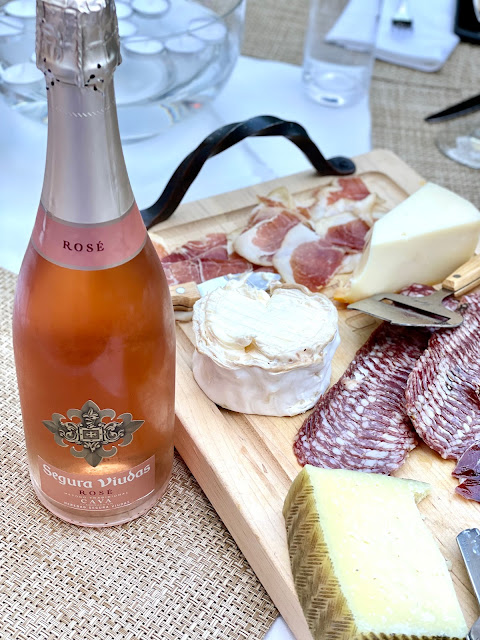
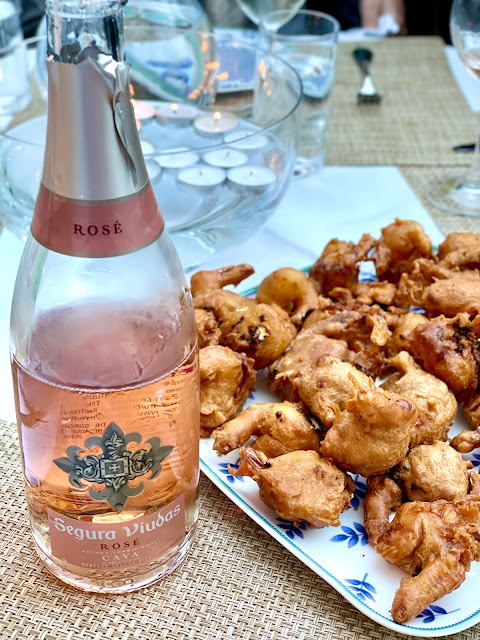
This bottle of Segura Viudas Brut Rosé was hit at a dinner party over the summer and worked equally well with cheese and charcuterie (as shown up at the top) as with fried shrimp puffs. 

You’ll see a lot of seafood pairings below, as well as a few chicken dishes, but they’d also definitely work with game birds and pork – in particular the rosados, Reservas, and Gran Reservas. We also can’t forget about cheese and charcuterie – bring on the jamón!

Here are some pairing examples. D.O. Cava also has a lot of good ideas and recipes.  Click on the name links for more info on the wines. 

Vilarnu Reserva Brut Nature Cava  2017 (Organic)

Avg price: $14  | Blend: 50% Macabeo, 35% Parellada, 15% Chardonnay | Aged more than 24 months

This wine had classic Cava nose with brioche, baked apple, pear, lemon, and a touch of smoke.

Similar notes appeared on the palate, but the fruits were more tart, rounded out by the brioche notes and creamy lees on mid-palate, leading into a crisp, stony finish

I paired this with Chilean sea bass with bok choy, in a savory broth and soba noodles. This combo surprised me by just how good it was – far above expectation! It turned out to be one of my favorite combos. The nuttiness of the soba noodles worked particularly well with the toasty notes in the wine, and the food out brought out umami notes in the wine.

Maria Rigol Ordi Mil·lenni Reserva Brut Nature Cava 2017 (Organic)  


SRP: $32, Avg Price: $19 | Blend: 45% Xarel-lo, 30% Macabeo, 10% Parellada, and 15% Chardonnay | Aging 24 to 36 months

This wine is certified organic. All of their wines tend to be long-aged. It showed notes of lemon, peach, and flowers, and stones on the nose. On the palate, similar notes continued with the peachy notes hitting at the front of the palate, leading into the stones and minerality on the finish. It was tart and crisp, balanced with a little texture. 

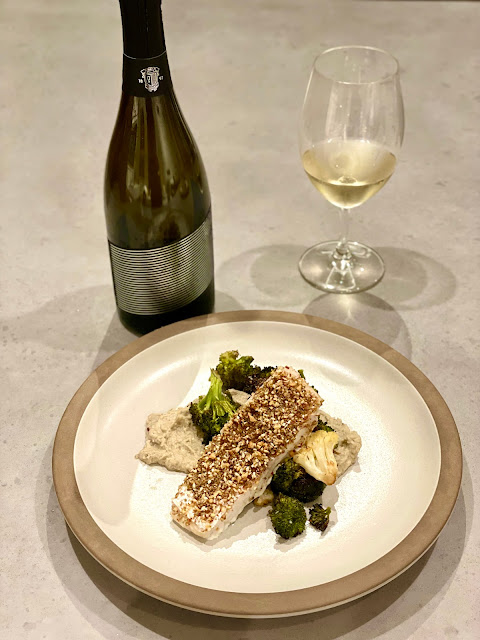
It paired nicely with cod encrusted with dukkah, roasted broccoli and cauliflower, with a little baba ghanoush.

Canal & Munné Reserva Dionysus Brut Nature Cava (Organic)

Avg Price: $15 | Blend: 60% Xarel-lo, 30% Chardonnay, and 10% Macabeo

This wine showed smoky notes on the nose, along with lemon and apple, just a hint of tar, and white flowers. There was lots of citrus and crisp apple on the palate, as well as an almost saline minerality mixed in with stones and touch of smoky tar on the finish.

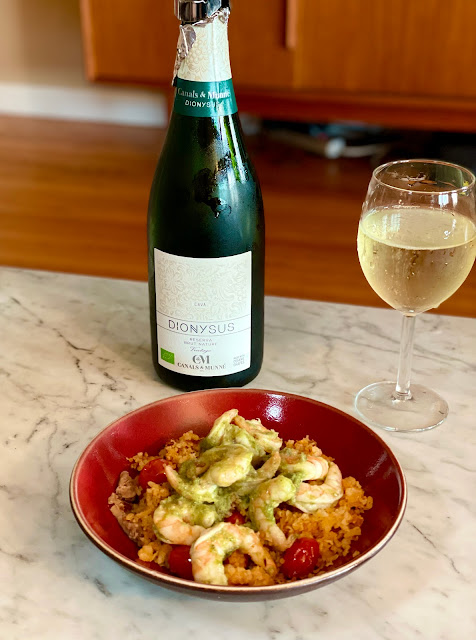
We paired this with shrimp in salsa verde on tomato rice – kind of mimicking some of the flavors of paella, but far more simple. The wine spoke nicely with the green notes of the sauce, as well as the richer flavors in the rice.

I also participated in a webinar with Ray Isle of Food & Wine called "Cava in the Kitchen." In it he recommended this wine with Mt. Tam cheese and chicken with mushroom sauce.  

Seguras Viudas Reserva Heredad Brut Cava 2017 


SRP $30  /Avg Price: $26 | Blend: 75% Macabeo 25% Chardonnay | Aged a minimum of 15 months

This cuvée is intended to be “democratic” in taste, to appeal to a wide set of palates. I also love that bottle seems like something out Game of Thrones. 

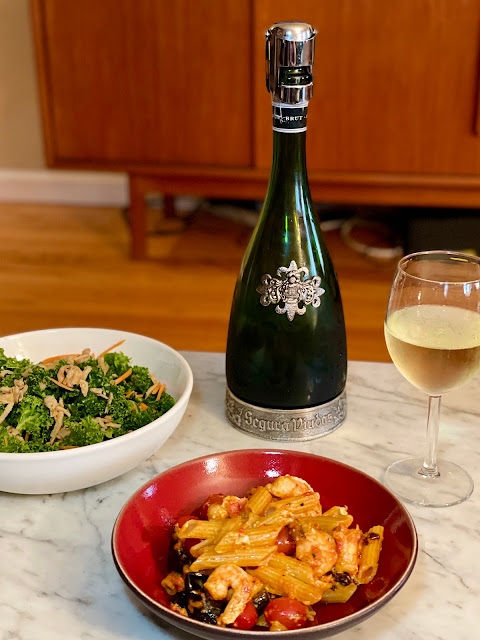
It had notes of green apple, Meyer lemon, and a touch of smoke balanced with a bit of honeysuckle on the nose. On the palate, the apples were more golden and a touch bruised, with a little mushroom, and a little char.  It also had some beeswax texture on the mid-palate. This is a wine that’s likely to work well with many things as it’s fresh but also has a bit of weight and round texture. It worked with this shrimp pasta dish with a slight smoky red pepper sauce, tomatoes, and olives and also made an appearance at Thanksgiving this year and also worked quite well. 

In the webinar, Ray Isle also suggested this would be good with mushroom pizza


Alta Alealla Mirgin Reserva Brut Nature Rose 2018 (Organic)

Avg Price: $24 | Blend: 100% Monastrell

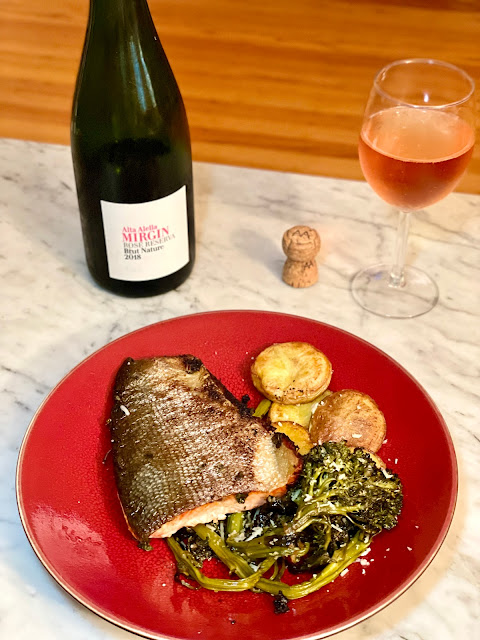
This wine had a great balance of fruit, toastiness, and minerality. It started with notes of brioche topped with strawberries, cherries and raspberries doused with lemon, with a hint of smoke. The fruit brought a rounded texture up front with a crisp, stony finish. It also showed a hint of tannin. The wine is also organic and vegan to boot

I paired  it with a simple seared salmon with roasted broccolini and potatoes. (I wish I’d done a better job of plating it, but it was all delicious nonetheless.) The wine and the food made a fabulous match.

Ray Isle also recommended this with prosciutto or jamón, or a day by the sea.

Bodegas Langa Reyes d'Aragon El Casto Brut Reserva 

Blend: 75% Macabeo, 25% Chardonnay | Aged 17 months | (I couldn't find a good price marker for this wine, but it appears to range between about $8 and $17.)

This showed notes on the nose of roasted golden apple, as well as crisp green apples slightly charred, peaches, vanilla, honeysuckle. On the palate, there were gold apples and peaches doused with lemon and limejuice. It had a round, creamy texture with notes of buttered biscuits, and touches of smoke and a hint of tar on the finish. Lovely!

I paired this with roasted chicken, cauliflower, potatoes and romesco sauce, with a side of greens. It held up nicely to this richer dish with more robust flavors. (You can find the recipe for the potatoes and romesco sauce in this post.)

Ray Isle also mentioned he liked this one with potato chips. 

Roger Goulart Brut Gran Reserva Cava 2015

Avg Price: $19 | Blend: 60% Xarel-lo, 20% Macabeo, 20% Parellada | Aged 72 months

The wine showed lots of toasty notes on the nose, along with apples (a mix of  green and gold)and a hint of flint. On the palate, there were yellow peaches as well as apples, toast, a hint of honey, herbal touches along the lines of a hint of fennel, then leesy finish with flinty minerality. (This winery is owned by CVNE, which we had the chance to visit.) 

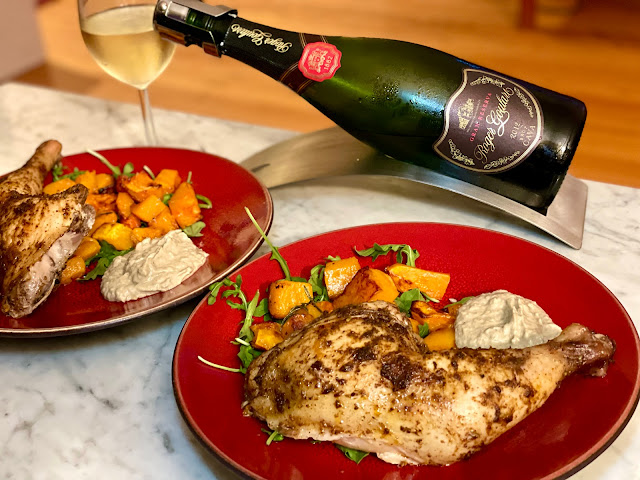
I paired this with shawarma-spiced chicken loosely based on a recipe from Olive Magazine, with butternut squash roasted alongside, with a side of baba ghanoush and pita bread. I’d made this baba ghanoush very lemony, and it also had a bit of smokiness, and the wine spoke to those elements beautifully. In fact, the wine worked beautifully with everything on the plate and acted as a unifier for the various elements.

Ray Isle also recommended this one with pizza, as well as nuts and aged cheese.


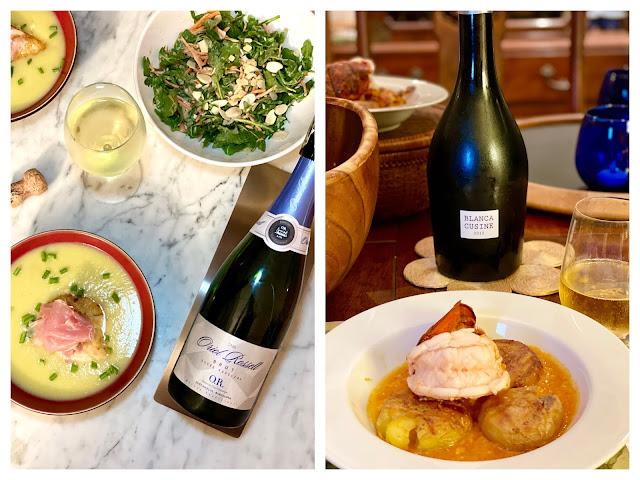
You’ll probably be seeing more Cava here soon. I have a few more samples to explore and a couple of recipes to share to pair with Oriol Rossell Cuvée Especial Brut Cava and Parés Baltà Blanca Cuisine Brut Cava 2012.

In the meantime, I’ll lead you with one last simple pairing I tend to like with Cava in general – popcorn tossed with butter or olive oil, smoked paprika, and a little salt.


Thanks to D.O. Cava and O'Donnell Lane for including me in the webinar series, as well as for the samples.

*****

The Wine Pairing Weekend (#WinePW) blogging group is kicking off the new year with an exploration of bubbles from around the world. Be sure to check out the rest of their posts:

  • Camilla from Culinary Adventures with Camilla sabers open Gelukkige Nuwe Jaar with Pannekoeke + Boschendal Brut Rosé
  • Wendy from A Day in the Life on the Farm is Celebrating Little Christmas in Michigan with a Local Bubbly
  • Linda from My Full Wine Glass cracks open Cava: Because everybody needs a go-to bubbly
  • Martin at ENOFYLZ Wine Blog pops the cork on Sparkling Wine from Chablis? Oui! Val de Mer Brut Nature Rosé
  • Anna Maria of Unraveling Wine toasts us with 10 Best Greek Sparkling Wines with Pairings 
  • David at Cooking Chat disgorges Baked Fiesta Dip with Mexican Bubbly
  • Robin of Crushed Grape Chronicles riddles with Bubbles by any other name…Sparkling wines from all over the globe
  • Jennifer of Vino Travels charms with Upcoming the Game with Asolo Prosecco
  • Lisa at The Wine Chef adds dosage with Dive Into the OG Bubbly With Blanquette de Limoux 
  • Terri from Our Good Life shares Favorite Bubbles from Around the World
  • Gwendolyn from Wine Predator...Gwendolyn Alley adds the crown with Sparkling Wine Secrets from Around the World
  • Susannah from Avvinare sparkles with Brazilian sparklers come of age
  • Andrea The Quirky Cork celebrates with A Vertical Tasting of Vinkara’s Yaşasın

  • Additional sources used for this post and extra reading: 

    • Decanter: Cava de Paraje Calificado: A new exciting age for premium Cava
    • Jancis Robinson: A Cava Compendium
    • SevenFifty Daily: Inside Cava’s Quest to Upgrade its Reputation
    • SevenFifty Daily: Corpinnat—an Emerging Category of Spanish Sparkling Wine
    • Winefolly.com: Cava Sparkling Wine: Outstanding Bubbly on the Cheap
    • Wine-searcher.com
    • Masterclass.com: The Complete Guide to Cava, Spain’s Sparkling Wine


    Older Posts Home
    View mobile version

    INSTAGRAM

    Sign up for my mailing list!

    Subscribe

    * indicates required


    Somm's Table 2017