Somm's Table

Perfect pairings from the other side of the equation.

  • About
  • Front of the House
  • Back of the House
  • Contact Us
Powered by Blogger.
  25 Anni Montefalco Sagrantino DOCG  2009.

Wine has the lovely side effect of sending me on frequent trips down memory lane. Drinking and researching Sagrantino for my last post got me reminiscing about a winemaker lunch I had the chance to attend a couple of years ago exploring the wines of Arnaldo Caprai at Oliveto, here in Oakland. Inspired by the topic, I thought I’d share a quick post now sharing a few details from that lunch. I always think it’s fun to see how others, particularly restaurants, decide to pair similar wines. 


This pic and the one above, courtesy of my friend Paige Carnwath.


The Caprai family were key figures in the modern history of Sagrantino. As I very briefly mentioned in my last post, despite its long history, Sagrantino was on its way to extinction in the middle of the last century. Luckily that’s right about when the Caprai’s got into the wine game. Arnaldo Caprai had been a textiles entrepreneur, but decided to buy a small parcel of about 12.5 acres in Montefalco in 1971. Right away they started reviving the grape, and the family was instrumental in establishing the DOC for the wine in 1979, followed by the DOCG in 1992.  


Arnaldo’s son Marco really made it his mission to improve and promote Sagrantino, so when Marco took over the management of the estate, he kicked things into high gear. He increased the winery’s premium wine production offerings and built recognition for their own brand and as well as for the grape. He built up their vineyard holdings in order to increase production. Nowadays the estate encompasses 370 acres, 220 of which are used for wine production. He also dedicated major resources to scientific research and technological innovation, looking at everything from clonal selections, to trellising systems, and experiments high-density plantings. All of which led to a better understanding of the grape and has resulted in major improvements in the quality of Sagrantino wine.


The winery has also put a major emphasis on environmental practices. Beginning in 2008, Marco began his “New Green Revolution” to improve agricultural techniques and encourage more sustainable farming practices (including organic and biodynamic methods). The project tries to use energy judiciously, limit carbon dioxide emissions, limit the use of pesticides in the soil, and looks to increase biodiversity, among other goals.


Caprai wines with skirt steak with Yukon gold potatoes and wax beans at Oliveto. Photo by Nicole Ruiz Hudson.Caprai wines with skirt steak with Yukon gold potatoes and wax beans at Oliveto. Photo by Nicole Ruiz Hudson.


I had the chance to try several of the wines during this lunch. You can see the insanity of what my notes look like below; however, I will do my best decipher them for you. (Of course, these were from a couple of years ago, so there will be more current vintages now available.) 


Grecante Grechetto Colli Martani DOC 2014
Nose: Orange blossoms, chamomile, peaches.
Palate: Pink grapefruit, floral notes, green apples, light hints of white peaches with cream, and hints of stone. More tart on palate than on the nose.

Worked really nicely with the salad and vegetables.


Montefalco Rosso 2012
Nose: Charcoal, black cherries, and pepper.
Palate: Tobacco, black pepper, black cherries, and red plums.
Smooths out as it sits in the glass and gets air.

This would be great with salumi, pizza, or Bolognese.  

Collepiano Montefalco Sagrantino DOCG 2009
Nose: Smoked meat, licorice, red plums, and tobacco.
Palate: Similar notes to the nose. Meaty. Tannic, but should smooth out nicely with time. 
Paired very nicely with the steak. 

25 Anni Montefalco Sagrantino DOCG  2009
Pictured up top.
Nose: Lilacs, licorice, berries, and dark plums.
Palate: Similar notes on the palate joined by hints of mocha, spice and olives. Refined and elegant with velvety tannins that were already quite smooth.  

Also delicious with the steak. Would also work well braised meats. 
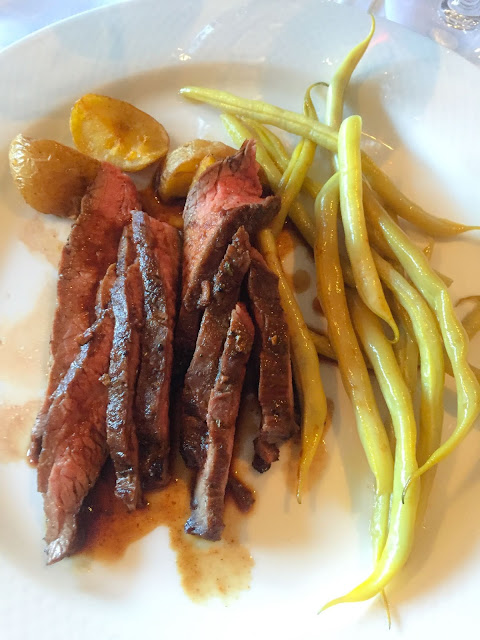
Skirt steak with Yukon gold potatoes and wax beans at Oliveto. Photo by Nicole Ruiz Hudson.

25 Anni Montefalco Sagrantino DOCG  2005
Nose: Licorice, dried flowers, mocha, and tobacco.
Palate: Tobacco, mocha, black cherry sauce, with spiced black fruits, both fresher and dried. Nicely structured and was still showing fairly youthful characteristics for its age.

This was surprisingly delicious with the chocolate cake. I tend to think matches between chocolate and red wines are overplayed, and don’t often actually work all that well together, but this was a magical match. 


Tech sheets for all of these wines available online on Wilson Daniel’s Website.


Còlpetrone Montefalco Sagrantino and Pasta with Red Pesto & Truffle Meat Sauce


Chilly and rainy weather keeps sending me in the direction of big Italian reds. They just seem to fit the season. There’s nothing like a big bowl of pasta and glass of something bold, red, and rich to warm you up when the weather is cold or dreary.

The Italian Food, Wine, Travel blogging group set Sagrantino from Umbria as this month’s theme and it really seemed like the perfect thing to reach for on a recent evening. It had been a while since I’d had one of these, and I’m happy to have had the excuse to reacquaint myself – it’s a pretty cool wine.

Map borrowed from WineFolly.com

It’s a really ancient grape that has been in Umbria around the town of Montefalco for centuries; it  was potentially described in the writing of Pliny the Elder. The name probably is derived from the Italian word sacro or ‘sacred’ thanks to the wine's use for sacred purposes. Alternatively, the name might have its origins in a word meaning ‘feast.’ Despite the pomp contained in the name, the grape went nearly extinct.

Thankfully,  in the 1960’s Marco Caprai and a few other local producers set about pulling the grape from its grave. It took a while, but they managed to get DOC status for the wine in 1979  and it was later promoted to DOCG in 1992. It’s still really only made by a few producers in the area and not really outside it, so it has an air mystery and rarity to it. Going even further, Sangrantino has “unique characteristics that bear no similarities with any other grape variety in Italy,” according to the website for Montefalco’s consorzio.

It was historically made as a sweet, passito wine (made from dried grapes); the dry style came about fairly recently given the grape's long history. As such, the DOC for the passito style was actually established earlier in 1977. This style is now the more rare of the two.

Sagrantino is SUPER  high in tannins. It actually potentially has the most of any grape–more than Cabernet Sauvignon, Nebbiolo or Tannat. These are good for a couple of things. Tannins act as preservatives in wine, which allows these wines to age a very long time. Tannins are also a type a polyphenol, which are antioxidants, and we know those are really good for us too. So, yeah, this wine is basically a health food.

The tannins do have to be managed so that they’re not super aggressive. For this reason, Sagrantinos are typically aged first in wood and then in the bottle. (DOCG wines are required to be aged for 37 month total, 12 months of which must be in wood.) The wines are really deeply colored, and you’ll tend to get darker fruit notes to match, so expect blackberries and plums, as well as some sweet spice notes coming from the wood, as well as some savory flavors. Given all their structure, Sagrantinos can usually can use a good decanting.


THE WINE & PAIRING


Còlpetrone Montefalco Sagrantino seems to be one of the easier to find options of Sagrantino in the U.S. The winery is owned by Tenuta de Cerro which belongs to the Unipol Insurance Group. I must admit that I’m sometimes a little skeptical when I find out a winery is in under the ownership of big company; however, Colpetrone is listed as a top example of Montefalco Sagrantino in pretty much every publication I looked at. I picked up the 2011 at Wines on Piedmont  in Oakland on the recommendation of one their sales associates that I know through a couple of my tasting groups. Boyd did not lead me astray.


Còlpetrone Montefalco Sagrantino 2011.

The day Greg and I opened this bottle we picked up notes of black cherries, licorice, tobacco, spice, savory herbs and a touch of tomato paste. There are also earthy leather notes that smooth out as the wine opens up. This is definitely a full-bodied wine with grippy tannins. The acidity was between medium to medium+,  but there’s enough to hold it together and the wine is well-structured.

When I looked up the foods of Umbria for inspiration, I found that truffles are common in the cuisine there. That certainly fit the earthy factors in the wine. I happened to have a can of  Red Pesto and Truffles from Urbani, a company that just happens to be based in Umbria. What luck! Almost perfect.


Almost. However, both Greg and I couldn’t knock the feeling that this wine really wanted something meaty alongside it. Boyd, who recommended the bottle, had mentioned he’d just had this wine with a pasta Bolognese and that it has been a delicious match. I decided to marry the two ideas into pasta with Red Pesto & Truffle Meat Sauce.

We’re trying to finally restart our healthy eating habits for the new year, so I opted to serve it on Brown Rice and Quinoa Fusilli Pasta, but even so, this was DELICIOUS! The sauce was awesome, easy, and will definitely now become a regular part of our repertoire. It also paired with the wine like gangbusters! The tomatoes in sauce resonated beautifully with the wine, and the wine also developed attractive smoke and pepper notes alongside the sauce. Super Yum!


OTHER POSSIBILITIES


Given that this is such a full-bodied and structured wine, you’re going to want to enjoy this with food that can stand up to it. A little bit of fattiness in the foods will be a good thing. The winery recommends this wine with “roasted red meats, rich and elaborate dishes, aged cheeses.”

Stay tuned for a look soon at Sagrantino pairings at a winemaker lunch.

Other earthy, structured Italian reds should work well with this dish as well. Here are a few other recipes matched with big Italian reds to consider mixing and matching with:


Cooking to the Wine: Fattoria del Cerro Vino Nobile and Spicy Salami Tomato Pasta
Cooking to the Wine: Borgo Scopeto Chianti Classico with Italian Meatloaf and Pasta Pomodoro
Cooking to the Wine: Vigneti del Vulture Aglianico del Vulture with Braised Oxtails
Cooking to the Wine: Fontanafredda Barolo and Braised Short Ribs with Mushrooms
8 & $20: Braised Chicken Thighs in Mushroom Sauce


THE GEEKY DETAILS


Taken from the tech sheet on the Vias Imports website:

Varietal composition: 100% Sagrantino
Soil composition: Limy, with clay deposits
Training method: Spurred cordon
Vines/hectare: 4,000- 5,000/Ha
Exposure: South east
Age: 14-17
Harvest time: Early October
First vintage: 1995
Production: 90,000 bottles
Fermentation container: Stainless steel tanks (18 days at 24-28 °C)
Maceration technique: Daily pumping over; delestages during alcoholic fermentation/20 days
Type of aging container: French oak barriques
Length of aging before bottle: 12 months
Length of bottle aging: 26 months
Alcohol: 14.5 %
Residual sugar: 1.8 g/l
Acidity: 5.6 g/L
Dry extract: 30.9 g/L

The winery suggests this wine can age for 10 to 15 years.


MONEY TALK


I picked up this bottle at Wines on Piedmont for about $25. I found that to be a completely Solid Value given the structured power of the wine.  I'd say it's even a Overachiver – It's a lot of wine for the money.

You can also find it on Wine-Searcher and Wine.com.

Older Posts Home
View mobile version

INSTAGRAM

Sign up for my mailing list!

Subscribe

* indicates required


Somm's Table 2017