Somm's Table

Perfect pairings from the other side of the equation.

  • About
  • Front of the House
  • Back of the House
  • Contact Us
Powered by Blogger.
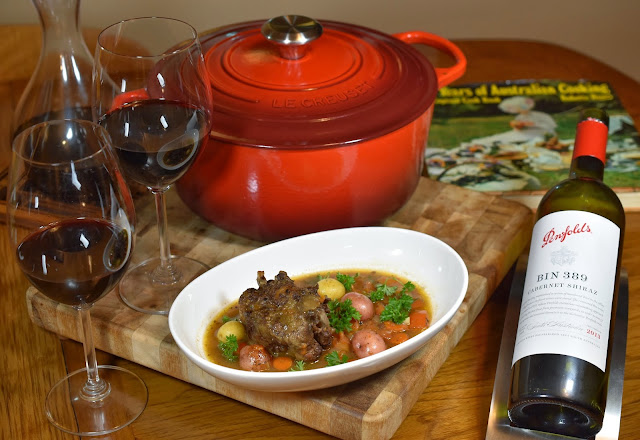
Sometimes you just have to go ahead and create a reason to enjoy a special bottle - or the bottle is reason enough on its own! Here we pair a bottle of Penfold's Bin 389 Cabernet - Shiraz with Braised Oxtail Stew.


We’ve been having one of those weeks, and sometimes when you’re having one of those weeks, it helps to make yourself something comforting and delicious and open up something good. 

Moreover, this weekend is ‘Open that Bottle Night.’ This is an annual occasion celebrated on the last Saturday in February created by Dorothy J. Gaiter and John Brecher in the year 2000. Gaiter and Brecher are a wife/husband journalist team, then working at the Wall Street Journal, who decided to create the day with the goal of motivating people to reconnect over a special bottle and create good memories. Many of us have bottles that are languishing away because we’ve been saving them for some special occasion. Their goal was to give us an occasion. 

I admit that I have a lot of these bottles. Earlier this week I was looking through my wine racks,  saw this bottle of Penfold’s Bin 389 Cabernet Shiraz South Australia 2013, and thought “WTF not?” A friend who used to work for the company gave us the bottle a few years ago, and I’ve been waiting for a reason to open it. In the spirit of OTBN, I decided to just go ahead and make the occasion. 


The Wine: Penfold’s Bin 389 Cabernet - Shiraz South Australia 2013

Penfold’s is one of Australia’s oldest wineries and potentially its most iconic. It was founded in 1844 by Dr. Christopher Penfold and his wife Mary, shortly after they arrived in Australia.  With the help of family, they purchased the Magill Estate at the foot of the Mount Lofty Ranges in South Australia, not far from Adelaide. As part of the development and cultivation of their estate, they planted vine cuttings that they’d acquired on their voyage from England on a stop-off in South Africa. Dr. Penfold believed in the medicinal benefits of wine, and the first wines were prescribed as tonics to patients and were seen as particularly beneficial in the treatment of anemia. The Penfolds started with fortified wines, they then went on to have success with Clarets and Rieslings, finding that they were both popular with customers and fairly easy to produce. 

Dr. Penfold’s reputation as a doctor grew, leaving him little time to work in the winery. Mary began to take on more responsibilities, gradually taking over the running of the winery. She continued to manage things even after her husband died in 1870, all the way until she decided to retire in 1884. At that point, she passed on management to her daughter Georgina and her husband Thomas Hyland. The winery remained in the family for many decades, and even after the company became public in 1962, the Penfold family retained a controlling interest until 1976. It is now owned by Treasury Wine Estates.

In 1948, Max Schubert became the company’s first Chief Winemaker and would take the winery in a new direction that put the focus of production on long-aging table wines. After World War II, Max was sent to Europe to learn about sherry production. However, he also spent time in Bordeaux and it left a major impression, inspiring him to experiment extensively. Through the next couple of decades, he would create many of the winery’s most famous wines, including Grange, their most iconic wine. 
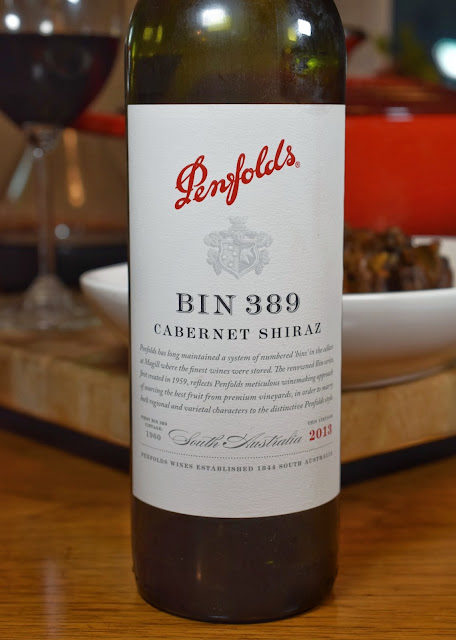
 

While I don’t have a bottle of Grange to share with you today, Bin 389 does also trace its origins to Max Schubert, who first created this wine in 1960. It’s been often been considered the “Baby Grange” in part because the various components of the wine are matured in barrels that held the previous vintage of Grange. The aim of this wine is to blend the structure of Cabernet Sauvignon with the richness of Shiraz. It has been very popular over time, and key in establishing the winery’s reputation for quality red wines.

The 2013 vintage of the Bin 389 was almost evenly split between its two component varieties – 51% Cabernet and 49% Shiraz. The grapes came from vineyards in Barossa Valley, McLaren Vale, Padthaway, Wrattonbully, and Coonawarra. In short, from many of the best areas of South Australia, the country’s most productive state when it comes to winemaking. 

I decanted this wine about an hour before we intended to drink it, so as to separate it from sediment, as well as to allow it to open up, and I do think it benefited from the time. On the day we opened this wine it showed notes of currants and blackberries on the nose, along with hints of eucalyptus, tobacco, and some light signs of age in notes of age forest floor and slightly dry/cooked fruits. These largely added interest and complexity to the wine. Black cherries and dark plums joined in on the palate. The fruit quality was rich and plush, with touches of dark chocolate, licorice, earth, and graphite. It’s a big wine, but well structured with good acidity to balance the strong, but fine dusty tannins. The wine was in a great place, but could still age for a few more years. 

I should mention that while this wine is a delicious and age-worthy splurge in the $70-$80 range, Penfold's makes good wines at every price point. We've often enjoyed the Koonunga Hills range and those wines tend to run in the $10-$15 price point and I've generally found them to be a good value.


The Pairing: Good Braised Oxtail Stew

Having decided to just do it, I took to my cookbooks in search of inspiration for what to pair with our bottle. Greg and I spent a few months living in Australia while he did a study abroad program during business school. While there, I picked up a book entitled 200 Years of Australian Cooking: The Captain Cook Book by Babette Hayes at a used book shop–– I love old cookbooks! Given the long history of the winery, I thought it an appropriate place to look for a pairing.

This book attempts to take the reader through the history of Australian cuisine from its colonial period through to more modern times while taking into account influences Aboriginal influences, as well as those of groups that migrated to Australia later on. Quite a lot to cover! 
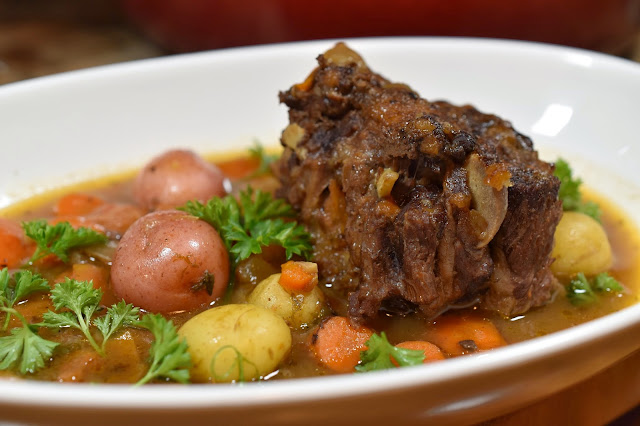
I found the recipe for “Good Braised Oxtail Stew” in a section entitled “Survival Cookery,” which looks at food from the early colonial period (from when the First Fleet landed in 1788 to the early 1800s) when settlers were struggling to figure out how to farm the land and feed the growing masses despite poor resources and lack of skilled farming labor among their population made up largely of transplanted convicts. Everyone was also missing a taste of home. The recipe that I’ve adapted feels very much in this vein – it’s a classic, comforting stew. (It’s also not all that different from the Braised Oxtails I shared in this post, but it’s amazing how just switching up a few things will change the character of the dish.) 

The stew and the wine paired beautifully together. The wine only grew more luxurious when paired with the food, and its intensity was an excellent match for the rich meatiness of the oxtails and broth. It was a soul-satisfying combo!


Geeky Details:

Average Price: $70 (across all vintages)
Blend: 51% Cabernet, 49% Shiraz
Vineyard regions:  Barossa Valley, McLaren Vale, Padthaway, Wrattonbully, Coonawarra
Maturation:  12 months in American oak hogsheads (28% new, 60% 1-year old, and 12% 2-years old)
ABV: 14.5%
Additional details here.

The winery also recommends pairing this wine with lamb with roasted vegetables. Their website shares a set of recipes, including that one, that can be found here. 

*****


*****

For additional wines from South Australia and pairings, check out these posts:

  • Cooking to the Wine: Dandelion Vineyards Shiraz and a Miso-Soy Strip Loin Feast
  • Cooking to the Wine: Clarendon Hills Grenache with Chicken Thighs with Spiced Saucy Eggplant and Tomatoes with Polenta


*****

The rest of the World Wine Travel (#WorldWineTravel) blogging group is exploring wines from South Australia. Check out the rest of their posts and join our Twitter chat on Sat. 2/26/28.

  • Allison on AdVINEtures pours "The Great Australian Red Wine: Cabernet-Shiraz"
  • Camilla goes "Beyond Shiraz in South Australia with Dagwood Dogs, Rissoles, and a Limestone Coast Cabernet Sauvignon" on Culinary Adventures with Camilla
  • Cindy has "Powerful, Prestigious Barossa Valley Shiraz" on grape-experiences.com
  • Jeff brings "Riverland Surprises in South Australia" on Food Wine Click!
  • Linda offers "Barossa Shiraz from ‘All the Land Around’ on My Full Wine Glass
  • Robin suggests "South Australia – Cabernet from Coonawarra & Fortified Shiraz from McClaren Vale" on Crushed Grape Chronicles
  • Susannah shares "Barossa Valley Memories" on Avvinare
  • Terri has "Penfold's Koonunga Hill Shiraz Cabernet and Busy Day Soup" on Our Good Life
  • Wendy is "Visiting South Australia; Home to one of Australia's Oldest Wineries" on A Day in the Life on the Farm
  • and on Wine Predator: "Celebrate Family Fun with Eight at the Gate: 2 Shiraz with Pie Floaters #WorldWineTravel "

Additional Sources:
  • Penfolds: The Rewards of Patience

This post contains Amazon Affiliate links, from which I might earn a commission at no cost to you. 

Vigneti del Vulture Aglianico del Vulture with Braised Oxtails by Greg Hudson

It’s been chilly out. Of course, I realize I have no cause to complain here in Northern California. The cold here has nothing to do with the cold we left back in New York, or in many other places in the northern parts of the US for that matter. We even had a mini-Spring as a break a few weeks ago when the temps suddenly rose for a week or two. It’s chilly again now to me, nonetheless. (I know, I know–How quickly we become spoiled!)

Aglianico is a perfect wine to turn to on such evenings. I definitely speaks of warmer places like it’s home in southern Italy. It’s exactly the type of wine that acts like a cuddly blanket, since it tends to be big, bold, and full of dark cherry, plum, chocolate, and spices. We recently decided to dig into our “cellar” stash to open just such a bottle for a comforting dinner in.

This grape is not for the faint of heart. It has richness, weight, structure, and longevity . . . but for all this you must have patience and wait for it to come together with age. It is typical of Campania and Basilicata (today’s wine is from the latter), and can be found elsewhere in southern Italy. (Click here to see a map.) It tends to be quite high in tannin, which can be really overpowering in the wine’s youth. Luckily, that tannin is also balanced by lots of acidity, which is really important when you’re dealing with a grape that makes such big wines, particularly from a hot region. With this structure, this is a grape that definitely lends itself to aging well when made by quality producers. Lighter, easy drinking styles are made as well and can be really lovely for more immediate consumption, but the higher end versions will continue to improve in the bottle for over a decade.

Some of the best examples come from the areas surrounding Monte Vulture in Basilicata under the DOC Aglianico del Vulture–the origin of today’s wine. (The region was elevated to DOCG status in 2010 under the label Aglianico del Vulture Superiore.) Monte Vulture is an extinct volcano and the volcanic soils help to produce wines of particular richness and concentration. Grapes are planted on the slopes at high altitudes (between 200 and 700 meters under DOC regulation) which provides a slightly cooler climate and helps better preserve acidity in the grapes. At the same time, the slopes help ensure that the grapes get plenty of sunshine–the grapes here actually get more sunshine hours than almost any others in the world


THE PAIRING


Vigneti del Vulture Aglianico del Vulture with Braised Oxtails by Greg Hudson

On this evening, we opened the Vigneti del Vulture Aglianico del Vulture Aglianico del Vulture Piano del Cerro 2009. I had this bottle hanging around in “the cellar” for some time. Nine years is actually still a little bit young for this wine, but I figured why not? Better too young, than too old. 

In fact, the wine was in a GREAT place on the day we opened it. Greg and I picked up  notes of warm black cherry compote on the nose, with a mix of black and red berries and smoked plums, a little black tea, licorice, spices, pepper, rosemary, and bramble. It was closed on the nose to start, but then it opened up nicely. It’s a modern style wine, and many of the same notes continued on the palate, along with notes of kirsch, stewed fruits, warm earth, and violets. In addition, there were hints of orange peel, sage, potpurri, blackberries, exotic spices, and smoke. There was a comforting warmth to this wine. It was generous and round even upon opening, but it just continued to open up and unfurl luxuriously with time–I would definitely recommend decanting. Even after the nine years the acid was very bright (medium+). It was full bodied with medium+ tannins that were dusty but smooth.  Frankly, this wine was bang’n! We enjoyed every last drop. That said, I think it could age much longer.

The chilly day and the wine both seemed to call for something meaty and comforting. A braised dish was decidedly in order. I decided on oxtails, which despite the name actually usually come from the  the tail of the cow. We also thought it would be nice to play up the fragrant notes of licorice, herbs, and spices, so I added tarragon, rosemary, and anise to the braise. These sent off beautiful smells from the kitchen while it all cooked in the oven. I added parsnips to the braise, but feel free to switch in other root vegetables.

To soak up all the delicious sauce, I decided to serve pearled barley as a side, which has a light nutty quality that I thought would be a good complement to the wine. I also added a little orange zest to play to the brightness in the wine, as well as a little tarragon to continue that thread from the braise.

It was a fabulous combo! It was all as comforting and luxurious as I’d hoped. The wine was smooth and velvety alongside the food. The notes of kirsch and licorice really came out int he wine, as did the bright note from the orange rind in the barley. Greg said that the wine and the food were "both  complex, warm, round hugs to the mouth." We ate it greedily ourselves and saved the extras for leftovers–as with most braises and stews, the sauce was better in the following days. Even though we kept this all to ourselves this time, it would be an ideal dish to make ahead of time and serve for a dinner party.


Vigneti del Vulture Aglianico del Vulture by Greg Hudson


GEEKY DETAILS

Admittedly, I could not find much of the history of the winery on their website. That said, they do provide plenty of details on the wine itself.  These are taken from the tech sheet:

Alcohol: 14.5%
Terroir: These grapes come from 1,300-1,800 feet (about 396-549 meters) above sea level. The vines are planted in volcanic soils rich in clay, calcium, nitrogen
and tuff.
Farming: Environmentally conscious farming practices
Vine Age: 70 to 80 years old
Vinification Process:  Pre-fermentative maceration takes place at 41°F for 10 days and is followed by fermentation carried out using natural yeasts for 60 days at a maximum temperature of 79°F.
Aging Process: The wine is put into new barriques for 24 months.
Recommended Cellaring: 10 to 15 years.


MONEY TALK

The SRP at the time of release of this wine was $37. At that price, this is an Attainable Indulgence and it fully delivered on every level. Of course, quite a bit of time has gone by–the average price on Wine Searcher  for this vintage is $44, which I still find quite reasonable for this wine.


OTHER POSSIBILITIES

The winery suggest that this wine pairs well with red meats, game, and mature
cheeses. Wine Folly also has more helpful recommendations for Aglianico pairings which you can find here. Altogether, this is a big wine and it should have robust fare to accompany it.

On the flip side, if you’re looking to pair another wine with this dish, don’t hold back and feel free to put your big, bold reds up against it. I would say that the earthiness of an old world wine works well with the light gaminess of the oxtails. Similarly, I think you’re more likely to find similar licorice spice notes in old world reds as well.

Older Posts Home

INSTAGRAM

Sign up for my mailing list!

Subscribe

* indicates required


Somm's Table 2017