Today we’re getting back to my roots via wine and food! And really, what better way is there to go?!
My background is made up of a crazy mix of components – I’m quite proud of this. My mother’s father was Lebanese, and I think I undoubtedly look the most like this part of my lineage. I think my genes show up in my food preferences too. If I could have a bottomless bowl of hummus next to me at all times, I’d be a very happy girl. I never met my grandfather –– he died when my mom was still a kid –– but we would visit my great aunt and great uncle every time we’d travel to Venezuela, where my grandfather and his family had immigrated to, when I was a kid.
Even when she was very old and could no longer hear well or move with ease, my great aunt would always have a big spread of Lebanese mezze ready and waiting when we’d come for a visit including kibbeh, falafel, hummus, baba ganoush, tabouli, stuffed grape leaves, stuffed cabbage leaves, tzatziki, pita bread, feta, and on and on. The flavors burrowed down into my blood and soul. Fun facts, my great aunt can also be credited with giving me my first sip of Champagne and, reportedly, for teaching me to cheat at cards. I no longer cheat at cards (or do I?), but the Champagne habit stuck. While she’s no longer with us, I think she’d be happy to know she left her mark. (Actually, she once accidentally cut me with her diamond ring, so she also literally left a mark – hah!)

Since one doesn’t immediately associate middle eastern countries with fine wine production, I was really excited when I was first introduced to Chateau Musar, the first Lebanese wine I ever tried. It helped me discover that were still continuing wine traditions in this part of the world I have ties to, even if I've never been there. Chances are that if you’ve heard of one Lebanese winery – or any middle eastern winery – it’s probably Chateau Musar. It’s not Lebanon’s oldest winery, and there are increasingly new players on the Lebanese wine scene, but for now, Chateau Musar remains the most famous Lebanese winery internationally.
A BRIEF HISTORY OF WINE IN LEBANON
Even if we don’t immediately associate wine with middle eastern countries today, Lebanon has a claim to being one of the earliest locations for wine production, dating back to about 7,000 BCE. The land of Canaan, and then Phoenicia, which followed it, were located in and around modern Lebanon. The Phoenicians were well-known for their viniculture, as well as for being traders, and the spread the doctrine of the vine far and wide, but modern Lebanon was really the heartland. At the end of last year, a 2,600-year-old Phoenician wine press was unearthed at Tell el-Burak that is particularly well preserved.
The Bekaa Valley is a pretty ideal spot for growing grapes, and it continues to be where the grand majority of Lebanon’s wine grapes come from today. Elevation has a major role to play here, and without it, conditions would likely be far too hot for quality grapes. Bekaa Valley is actually more of a plateau than a valley, with an average altitude of 1000 m above sea level. The surrounding mountains are key as they provide protection from deserts to the east and rains blowing in off the oceans to the west. Mount Lebanon creates a rain shadow and helps to keep the area dry and sunny, averaging 300 days of sunshine a year. These conditions make it pretty easy to farm via organic, sustainable methods. Without disease pressures, there’s no real need for chemicals. With such idyllic conditions, it’s really no wonder that the Romans decided to erect a temple to Bacchus right here in the Bekaa valley. It’s still well-preserved – yet another reason for me to want to visit someday!
 |
| Image courtesy of Wikipedia, Link. |
Despite their long history of winemaking, Ottoman rule pretty much brought it to a halt, just as it occurred in so many other countries in the region. Winemaking was allowed for religious purposes, so a few Lebanese Christian orders were permitted to continue to make wine. In 1857, Jesuit missionaries at Chateau Ksara planted Cinsault vines they brought in from French-governed Algeria. Other French wine grapes soon followed, along with newer production methods, starting the first flickers of the modern Lebanese wine industry.
This allowed Lebanon’s Christians, mainly Maronites and Greek and Armenian Orthodox, to produce wine and in 1857 the Jesuit missionaries of Ksara introduced new vine varieties and production methods from French-governed Algeria, laying the foundations of the modern Lebanese wine industry. Several more wineries began to pop up shortly afterward.
The Lebanese wine industry benefited from French connections again in the 20th century. The French governed Lebanon in between the World Wars after the fall of the Ottoman Empire, and this French presence created a huge demand for wine and brought further know-how for how to make it. The French withdrew their forces in 1946, but after World War II, Lebanon, in particular Beiruit, continued to be known and a cosmopolitan center of business in the region. The new wine culture thrived against this backdrop, and it continued until civil war broke out in 1975.
Interestingly, Chateau Musar was the only winery that managed to continue to thrive during this period, however, the rest of the wine industry began to flourish again when the fighting ended again in the 1990s. The French once again played a role as major French wine families took an interest in developing wineries in the Bekaa Valley. The industry has been developing quickly with the number of wineries growing from 40 to nearly 80 in the years between 1996 to 2020, despite numerous hurdles arising over the years.
The wine industry there has been facing another difficult moment, though –– 2020 was particularly rough in Lebanon. The country was already facing an economic crisis, protests, and revolution. Then on August 4th of last year, a major explosion in the Port of Beirut caused at least 207 deaths, 7,500 injuries, and left an estimated 300,000 people homeless. All the while, the COVID-19 Pandemic was raging, putting more strain on an already extremely strained medical system and economy.
The wine industry is a small ray of hope in the midst of a lot of turmoil.
For more on the current state of the Lebanese wine industry, see these articles from Wine Enthusiast and Bloomberg. A new documentary called Wine & War exploring the history of wine in the Middle East in general and in Lebanon in particular, premiered at the Sonoma International Film festival this year. I haven’t seen it yet, but I certainly, hope to soon.
CHATEAU MUSAR
Gaston Hochar founded Chateau Musar in 1930 when he was just 20 years old. He was inspired by his travels through Bordeaux, as well as Lebanon’s own ancient winemaking history. He set up his family’s 18th-century castle in Ghazir overlooking the Mediterranean, about 20km north of Beirut. (I mean, what else are you going to do with a spare castle on the coast?!) The majority of their vineyards are located in the Bekaa valley, about an hour away.
His wines impressed the Frenchies that were stationed in Lebanon in between the wars, and he became good friends with Major Ronald Barton, whose family owned (and still does) Châteaux Léoville-Barton and Langoa-Barton, creating further ties with Bordeaux.
Gaston set things off to a good start, but the next generation really put the winery on the map. Gaston encouraged his sons to participate in the winery from a very early age. Serge Hochar, Gaston’s eldest son would become the winery’s winemaker, and his brother Ronald would go on to take over the financial and commercial side of things. As Ronald put it (per the winery’s website), “My brother looked after the liquid, I look after the liquidity,” and each would play a crucial role in the winery’s longevity.
Serge Hochar trained as a civil engineer, then decided to study oenology at the University of Oenology in Bordeaux. He became the winemaker in 1959 after declaring to his father, “I want to make the wine my way, I want it to be known world-wide – and I want you to quit!” Gaston gave way and Serge created the house’s unique style. He spent 18 years perfecting the formula for Chateau Musar’s Red. He was charismatic, celebrated, and something of a philosopher winemaker, and he was mourned around the world when he passed away in 2014.
For his part, Ronald Hochar gets a lot of the credit for the winery’s business success, making savvy decisions during difficult times. He kept Musar’s trucks running during the war against all the odds, while Serge kept the wine production going. To say that harvesting the grapes was difficult during this time is a huge understatement – at times they could only be harvested during pauses between shellings. Getting the grapes to the winery was a whole other ordeal.
The family also had the foresight to develop foreign markets, another key reason Chateau Musar continued to do comparatively well during these difficult war years when no other Lebanese winery could really get a leg up. Ronald’s son Ralph worked with the on-trade sector in the United Kingdom until early 2017 and is now focusing on South East Asia from Chateau Musar’s UK office. His daughter Elsa produced a documentary film about the winery.
The style Serge created for Chateau Musar is extremely unique. They were making natural wines far before the term existed, and in many ways, they embody the good, the bad, and the ugly of the term. The wines intentionally show wide vintage variation, at times showing great elegance and depth, and a wild, feral, funkiness at others. I've experienced both ends of the spectrum, so it can be a bit of a gamble. That said, when they're good, they can be super good, very complex, and interesting.
They use native yeast fermentations and a bare minimum of sulfur. The wines are all unfined and unfiltered. They were also the first Lebanese producer to have their vineyards certified organic in 2006, and are also vegan.
They make three tiers of wines plus an Arack, an anise-flavored spirit made from grape alcohol. The top-tier Chateau Musar line is notable for the aging regime. Both the red (blends of Cab Sauv, Cinsault, and Carignan) and white wines (made with native grapes Obaideh and Merwah) are aged for a total of seven years before release, while the rosés (also predominantly Obaideh and Merwah, with a splash of Cinsault) are released three years after harvest. The wines develop interesting, savory flavors in the aging process with oxidative notes in the whites and rosés. This line is known for continuing to age well across all colors, and they greatly benefit from decanting. They’ve become coveted cult wines, and usually, run in the $50-$60 range at release.

The next tier is the Hochar Père et Fils Red is a single-vineyard blend (Cinsault, Grenache, and Cabernet Sauvignon) that is aged for 4 years and is typically in the mid the low to mid $30s. The Jeune line is their entry-level hovering around $20ish, and are unoaked, fruity wines, made from their younger vines, and the wines are intended for earlier drinking. I’m taking a look at the red in this line.
BRINGING THE FEAST & THE WINE TOGETHER
It occurred to me that I had never actually had a Lebanese wine with Lebanese food. As I mentioned, the Lebanese spread is one of my very favorite meals. When my mom asks me what I’d like her to make me when I go home to visit, it’s always either this or Venezuelan Pabellón. (Both over the course of the stay if possible.) I also buy myself middle eastern food pretty regularly, and I can make a pretty decent spread of mezze myself. I’ve also had the opportunity to have wines from Chateau Musar’s various tiers a fair number of times over the years. Still, the wine and the food had never met at my table. I figured it was about time to change that.

I opened a bottle of the Musar Jeune Bekaa Valley 2016 (click the link for additional details, average price: $21 13.5% abv), a blend of 50% Cinsault, 30% Syrah, and Cabernet Sauvignon 20%. This is from the entry-level line and intended for early drinking, and the winery's website suggested that it can be enjoyed right out of the bottle. Nonetheless, I decided to decant it anyways and I do think it helped the wine open up. I was greeted by aromas of warm raspberries, plums, and black cherries, warm earth, light herbs, and white pepper. Similar notes appeared on the palate, with dusty, candied raspberries, ripe red plums, as well as some dried fruit notes along the lines of strawberry leather. The generous fruit notes were mixed with savory hints of black olives, thyme, pencil lead, white pepper, and allspice (which had to be coming from the fruit, as this wine sees no oak aging). The wine was medium + to full in body, showed medium acidity, and medium + tannins that were smooth and supple. I found this bottle to be really delightful and excellent at the price point. As much as I've enjoyed Musar's high-end wines, this is definitely a much more accessible bottle that seems to be about direct pleasure, whereas I see the higher-end Musar wines as "thinky" wines.

Just to illustrate the point of the vintage variation with these wines, the last time I have a relatively clear memory of trying this wine was a bottle of the 2013, and that one left me with the impression of being rustic, earthy, with grippy tannins, and had mostly black fruits (in my memory anyways). This one gave an overall feeling of warmth with generous spiced fruits falling mostly into the red camp.
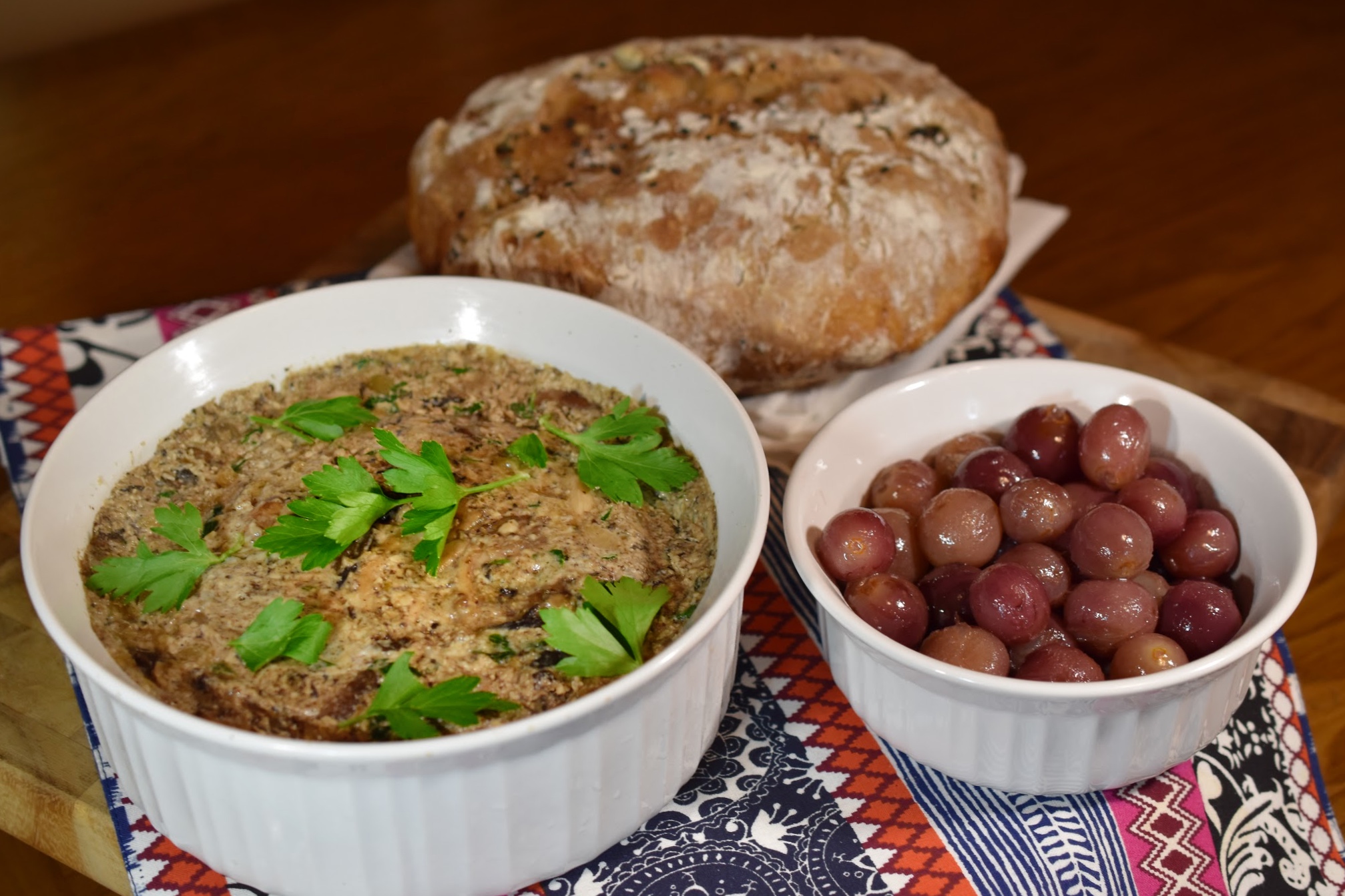
Coming back to the present, I treated myself to a Lebanese feast. I decided to make about half the spread to pair with this wine and purchased the rest to have a feast for two at home. I made kibbeh, spiced meat croquettes, made in this case with a combo of beef and lamb, along with hummus, and buckwheat tabouli. I’m not allowed to share my mom’s kibbeh and hummus recipes, however, so I used this one from The Mediterranean Dish for the kibbeh. I make the hummus to taste at the point, using a lot of garlic and lemon, but Ina Garten’s recipe is pretty close to my mom's (although we make it without the hot sauce). I first made this Buckwheat Tabouli when my MIL came for a visit while she was avoiding gluten a while back, but I find I like the toothsome texture or the buckwheat and its nutty flavor, so I opted to make it this way, rather than using the usual bulgur wheat. I purchased tzatziki and baba ganoush, as well feta and pita bread.
Normally, when I’m making a mezze spread for company, I divide the work out over a few days. It had been a while since I’d tried to make everything (although this was only a partial spread) on the same day. I’d forgotten how much work it is when you do it all at once! Most of this isn’t difficult, but many things involve quite a few steps. If making a spread like this for friends, I'd recommend distributing the work across a few days, as it makes it much more manageable. It might look something like this:
- 2 to 3 days before – Make hummus and/or baba ganoush
- 1 day before – Prep and form kibbeh and/or falafel. You can also spread the work of making kibbeh over 2 to 3 days as well by splitting the work into 3 phases: making/prepping the meat components, forming the kibbeh, and frying the kibbeh.
- Day of – Make tabouli and/or tzatziki, and fry kibbeh or falafel.
Of course, you can also buy some or all of the components as well!
The wine was soooooo good with the kibbeh. The allspice notes in the food and the wine really sang together. The baba ganoush I bought turned out to be mediocre at best, but it got a lot better with the wine, as the smoky note in this dip really resonated with the wine as well. Everything else worked ok, but having either the kibbeh or baba ganoush involved in a bite really helped tie things together.

*****
To read more about wines from places with ancient wine traditions that are now reemerging, check out these posts:
- Cooking to the Wine: Recanati Marawi with Black Cod and Papaya-Cucumber Salad, Part 1
- Cooking to the Wine: Recanati Marawi with Black Cod and Papaya-Cucumber Salad, Part 2
- An Armenian Feast with Friends Paired with Armenian Wines: Modern Wines from an Ancient Place
- You're Invited to Sip the Wines of the Ancient World
- A Sneak Peek at the Wines of the Ancient World with the #WinePW Crew
- Memories of Golan Heights Winery with a Side of Meatball Shakshuka Part 1
- Memories of Golan Heights Winery with a Side of Meatball Shakshuka Part 2
- Tasty Moldovan Food & Wine Explorations
- Celebrating Moldova National Wine Day with More Food and Wine Explorations
- An Ode to Godforsaken Grapes
- Stranger Grapes with Eric Danch of Danch & Granger Selections
*****
The rest of the Wine Pairing Weekend blogging group (#WinePW) is exploring Middle Eastern Wine and Food Pairings this month, hosted by Wendy of A Day in the Life on the Farm.
- Robin of Crushed Grape Chronicles is Celebrating Sauvignon Blanc Day at the table with St. Supéry and easy Middle Eastern Dishes
- Pinny of Chinese Food and Wine Pairing is Drinking Serious Wine from Israel's Domaine du Castel and Eating Causal Israeli Food
- Nicole of Somm’s Table is "Indulging My Lebanese Cravings with Chateau Musar Jeune Rouge"
- Susannah of Avvinare shares Israeli Wine From the Judean Hills and Tabbouleh Salad
- Terri of Our Good Life talks about Kofte Kebabs and Ben Ami Cabernet Sauvignon: a BBQer’s Bliss.
- Andrea of The Quirky Cork visits Lebanon and Syria, a Crossroads of Wines and Flavors
- Cam of Culinary Adventures with Camilla is sharing Man'oushe + Château Musar Lebanon Jeune Red 2017
- Wendy of A Day in the Life on the Farm made up a Mezze Platter with Middle Eastern Wines
- Jane of Always Ravenous is "Pairing Middle Eastern Flavors with Wine"
- David of Cooking Chat is serving Sesame Free Hummus with Wine from the Middle East
- Gwendolyn of Wine Predator shares So Africa’s Organic Reyneke Syrah and Chenin Blanc with Instant Pot
Additional sources used for this post and extra reading:
- Broadbent: Chateau Musar
- Vinepair.com: Why Wine Insiders Are Obsessed with Lebanon’s Château Musar
- The Oxford Companion via Jancisrobinson.com
- Wine of Lebanon
- Wine-searcher.com
- The Business Year: Chateau Musar
- Eater: We Should All Be Drinking More Lebanese Wine
- Whetstone Magazine: Wild Yeast and Native Grapes in Lebanon
- The World Atlas of Wine
- The Wine Bible
This post contains Amazon Affiliate links, from which I might earn a commission at no cost to you.