
Côtes du Rhônes are among my most regular everyday go-to’s. They’re kind of the quintessential bistro wine since they tend to not be expensive, are pretty food-friendly, and just generally easy-going. For the same reasons, they fall into a sweet spot for what I’m usually looking for in a weeknight wine. Similarly, if I’m having a party (when parties were a thing) and need to supply wine for lots of people, I’m bound to serve a few bottles of CdR because they tend to be crowd-pleasers, in addition to having those wallet-friendly prices. The Rhône also happens to be one of my very favorite wine regions, so I get to please my own palate as well.

Côtes du Rhône is actually quite a large AOP/AOC with 86,000 acres, and as is usually the case in large regions, there is a lot of variety and quite a bit more to know than one might expect. Here are the basics:
- It covers the whole region. The Côtes du Rhône AOC was established in 1937 and covers the entire Rhône Valley, both north and south. That said, the grand majority of CdR comes from the Southern Rhône.
- Most Rhône wine is Côtes du Rhône. This is the entry-level appellation for the region, and the majority of the wines released from the Rhône fall under it – over ⅔ according to GuildSomm.com, although I've seen figures of around 50% elsewhere.
- CdR’s come in Red, White, and Rosé. The overwhelming amount of wine is red as over 95% of the region’s vineyards are planted with red grapes, which of course can be used for rosé as well. However, you will find white wines too. Today we’re going to look at an example of each color.
- It’s all about the blends. Generally, speaking most wines from the Southern Rhône are blends, and that’s also typically the case for CdR’s. Moreover, there are 21 permitted grape varieties to choose from.
- That said, Grenache, Syrah, and Mourvèdre (aka GSM) are the star players for the reds, with Grenache usually making up the base of the blend, as it is the most planted grape in Southern Rhône. Cinsault and Carignan also make frequent appearances.
- Marsanne, Roussane, Viognier, and Grenache Blanc are common players among the whites.
- There are levels. While Côtes du Rhône is the entry point and the base of the region’s quality pyramid, there are few more levels. With each rung you move up the ladder, the quality restrictions get tighter and there is more regulation of how the wine is made.
- In 1966 the Côtes du Rhône Villages AOC was added for villages deemed to be producing wines of consistently higher quality.
- Next up are the named Côtes du Rhône Villages. These communes get to attach their name on the label. Currently, there are 21, but more are occasionally added.
- The Crus sit at the top of the pyramid above all the CdR's. This tier includes all of the Rhône’s most famous appellations like Châteauneuf-du-Pape and Côte-Rôtie. There are 8 in the north and 9 in the south. I hope to eventually get to them all, but so far we’ve explored:
- Crozes-Hermitage (Northern Rhône)
- Gigondas (Southern Rhône)
- Ventoux (Southern Rhône)
- Rasteau (Southern Rhône)
- Crozes-Hermitage (Northern Rhône)
I recently received a set of samples of Famille Perrin’s Côtes du Rhône wines and I thought this would be a great opportunity to explore the range of CdR colors together.
The Perrin stepped into the wine world in 1909, Pierre Traminer bought the famous Château de Beaucastel and then transferred it to his son-in-law Pierre Perrin, a scientist who further developed the property. His son, Jacques, then continued his father’s work and continued expanding the family’s holdings. His sons Jean-Pierre and François now head up the business with the fifth and 6th generations involved in the company as well. They now have a wide range of holdings and wines spanning the entire Rhône pyramid, as well as participation in ventures around the world.
The family is also a leading organic grape grower in the Southern Rhône. The began working with organic farming techniques in 1950, and later biodynamic farming in 1974. They are trying many different techniques at their properties, which now span much further than the Southern Rhône. Initiatives include an innovative renovation at Château de Beaucastel, as described in the article by Jill Barth on Forbes.com, and Regenerative Farming at Tablas Creek here in California, as described in this post by Robin of Crushed Grape Chronicles. Their organically certified Nature Côtes du Rhône line, the red of which is described below, is another example.
THE WINES
For this post, I’m looking at three of their Côtes du Rhône, all of which are pretty classic examples of their respective CdR color and all very good values.
 |
| These wines were provided as media samples. Please note that no other compensation was received and all opinions are my own. |
Côtes du Rhône Reserve Blanc 2019
Blend: Grenache Blanc, Marsanne, Roussanne, Viognier
Alc: 13%
Nose: White flowers, sweet honeysuckle, melon, white peach, and apples jump out of the glass.
Palate: All came back on the palate, and were joined by almonds, lemon cream, and stony minerals. It showed medium acid and medium body.
Find more details on the wine here.
Côtes du Rhône Reserve Rosé 2019
Blend: Cinsault, Grenache, Mourvèdre, Syrah
Alc: 13%
Nose: Cherry blossoms, tart cherries and strawberries.
Palate: The flowers and juicy red fruits were rounded out by a lightly creamy texture. Medium acidity and medium body.
Find more details on the wine here.
Côtes du Rhône Nature Rouge 2018
Blend: Grenache, Syrah
Alc: 14.1%
Nose: A bouquet of herbs and flowers, with berries and rosehips.
Palate: Crushed berries, pepper, and pencil lead. It reminded me of brambly raspberry and blackberry bushes at the edge of a forest. Medium body, medium + acidity, and medium/medium + tannins.
The grapes for this wine are certified organic by Ecocert.
Find more details on the wine here.
THE PAIRINGS & HOW THEY WORKED


 |
| I asked Dee to send me some pics of their adventures. These pics are of Cornas in Northern Rhône, where the landscape is more mountainous, and the weather and soils are bit different, but it still gives a bit of an idea of the rugged, rocky terrain. |
Dee picked up this little recipe booklet for me put out by Inter-Rhône and I thought it would be fun to pick a couple of recipes to try and then see how each of the wines worked with them.

I chose a mushroom terrine with grape compote and a braised pork dish flavored with preserved lemon and rosemary. I made a meal out each and served the dishes with the wines over two nights, however, these were originally intended to be an appetizer and a main dish respectively. I’ve adapted each bit from the original. Here’s a little about each and how they worked with the wines.
Mushroom Terrine with Grape Compote and Cheese

While this is written as a terrine, which is certain to be the more elegant presentation, I kind of prefer the creamier texture of pâté, and you can easily go either way with this recipe. For the pâté-like texture (which is the direction I went), just use an immersion blender on the mushrooms, or run them through the blender.
While the grape preparation is referred to as a compote, the grapes actually retained their shape fairly well, so they're more like glazed grapes. To turn this into a complete meal, I served it with a salad and sourdough bread I’d baked. I also had some Moses Sleeper cheese – a creamy, bloomy rind cheese that’s just a little funkier than a basic brie-style IMHO – so I included it in the spread.
- Greg and I agreed that the rosé was the MVP in this spread. Regardless of the composition of the bite, it seemed to work quite well.
- The red was the runner up. It worked with the mushrooms and wasn’t too bad with bites involving the cheese or even the compote, which could be tricky at times due to its sweetness.
- The white version worked solidly well with bites that had mushrooms and cheese, as well as with the salad. It definitely did not work with the grape compote.
Braised Pork with Preserved Lemon, Rosemary, and Fennel

- The overall winner was the white CdR. It was refreshing with the pork and the food resonated well with the lemon and herb flavors in the wine.
- Greg and I were split on the other two wines. I preferred the rosé, which I thought was refreshing, and matched the weight of the food. Greg felt it brought out a melon note in the wine that he didn’t care for.
- He preferred the red as a close runner up, and the choice was particularly close for bites that were predominantly pork. I have to say that I was surprised – I didn’t expect the red to work with the flavors in the dish at all, and I had to agree that it wasn’t half bad.
To me, there is a floral note in fennel, and in turn, the dish brought out the floral notes in each of the wines.

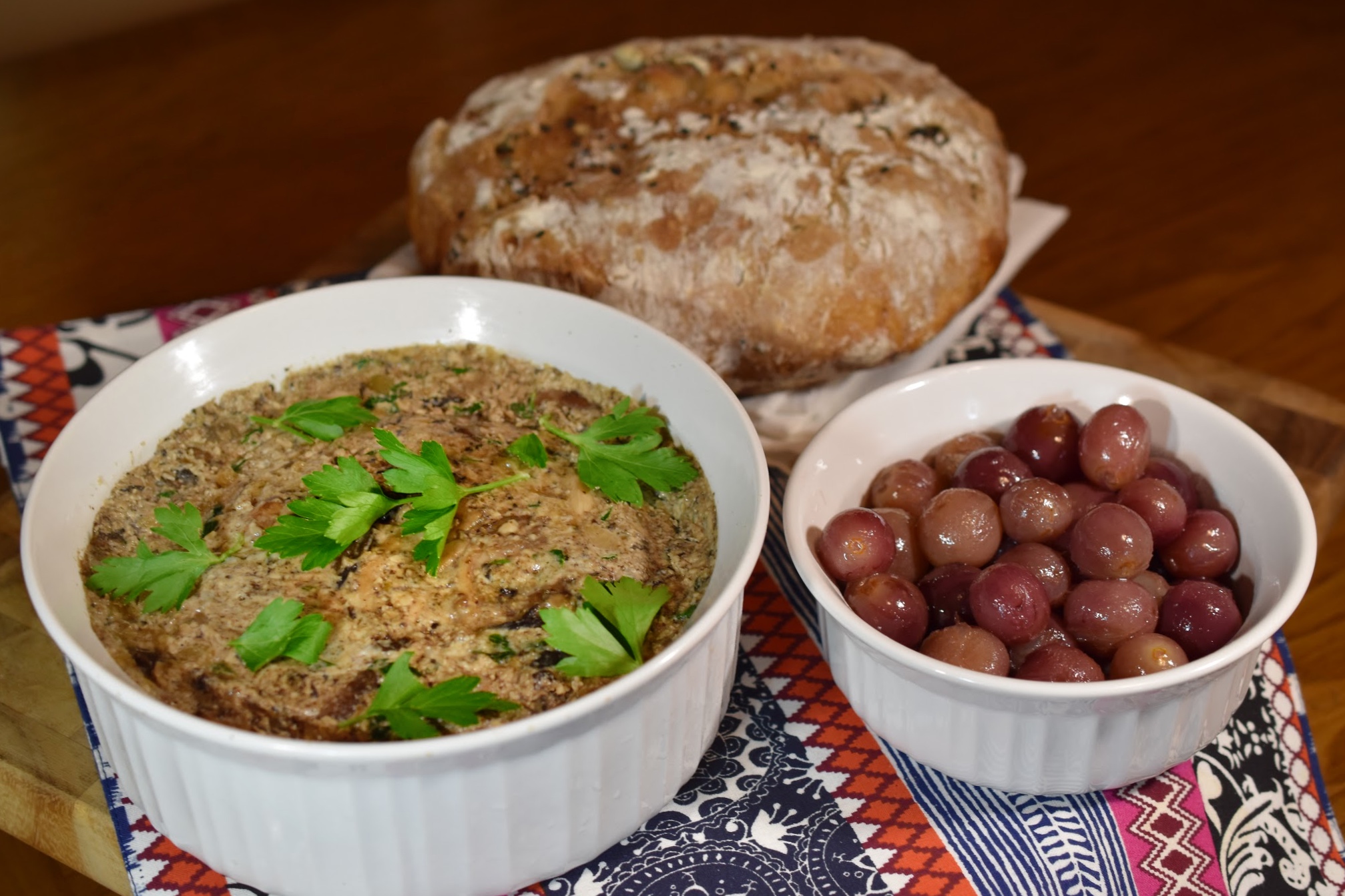
Mushroom Terrine with Grape Compote
By: Nicole Ruiz Hudson, Adapted from recipe by Inter-Rhône
Prep Time: 15 MinCooking Time: 45 Mininactive time: 8 HourTotal Time: 9 Hour
Ingredients:
For the Mushroom Terrine
- 1.5 to 1.75 lbs of mixed mushrooms (The original recipe recommends porcini and a couple of different types of chanterelles. I used a mix of various kinds including a high percentage of cremini.)
- ¼ cup olive oil
- 3 shallots, finely diced
- 3 to 4 garlic, finely diced
- 1 bunch of parsley, chervil, or half a bunch of each, chopped
- 5 sprigs tarragon (or substitute in 1 tsp dried), chopped
- 1 cup cream
- 1 packet of gelatin
- Salt, to taste
- Pepper, to taste
For the Grape Compote
- 2 Tbsp butter
- 1 Tbsp vinegar
- 1 Tbsp sugar
- 1 lb grapes, rinsed and dried (The original recipe recommends Muscat or Chasselas, but I used regular red table grapes here.)
Instructions:
For the Mushrooms
- Rinse mushrooms, trim off the woody ends of any mushrooms that have them, then slice up mushrooms.
- Sweat shallots in the olive oil in a large pan over medium/medium-high heat until beginning to turn translucent, then add in the garlic and continue to cook for about 30 seconds. Add in the mushrooms and season with salt and pepper. As the mushrooms begin to release cooking juices, spoon out about ¼ cup of the juices, and set aside. Cook the mushrooms until they’ve softened and the majority of the remaining liquid has been cooked off.
- Optional: For a terrine with a creamier, paté-like texture, blend the mushroom with an immersion blender (or regular blender).
- Sprinkle the gelatine in the reserved mushroom liquid and let stand for 1 minute. Add the mushroom-gelatine mix to a small saucepan along with the cream, whisking until the gelatin is fully dissolved, then reduce the liquid by about ⅓ over medium-high heat.
- Add the mushroom-cream sauce to the mushroom mixture, along with the chopped herbs. Taste and adjust seasoning. Pour the mixture into a terrine dish or small casserole dish. Weigh the terrine down with a board or a plate. Store in the fridge and allow to set for at least 8 hours.
For the Grape Compote
- Melt butter in a deep pan, then add in the vinegar, sugar, and grapes. Toss everything to dissolve the sugar and coat the grapes well. Cook for about 5 minutes, then set aside to cool.
- Serve the terrine and with the grape compote.
mushrooms, terrine, pate
appetizer
French
Did you make this recipe?
Tag @thesommstable on instagram and hashtag it #sommstable
Created using The Recipes Generator

pork, braise, fennel
dinner
French

Braised Pork with Preserved Lemon, Rosemary, and Fennel
Prep Time: 10 MinCooking Time: 60 MinTotal Time: 1 H & 10 M
Serve with a side of Israeli couscous as shown here, potatoes, or rice.
Ingredients:
- 2 to 2.5 boned pork loin or tenderloin (however, note the two will require different cooking times)
- 1 to 2 Tbsp butter
- 2 Tbsp olive oil
- Juice of 1 to 2 lemons
- 4 garlic cloves, minced
- 2 Tbsp honey
- 6 sprigs rosemary
- 6 bulbs fennel, quartered
- 1 preserved lemons, sliced
- Salt, to taste
- Ground pepper, to taste
Instructions:
- Heat butter and oil in a large saucepan or Dutch oven over medium-high heat, add the pork and brown on all sides, then place on a separate plate and set aside.
- Reduce the heat in the pan to low, then add garlic and cook until it’s beginning to turn fragrant and lightly golden (1 to 2 minutes), then add in the honey, lemon juice, sprigs of rosemary, and 6 oz of water. Stir to combine, allow the mixture to come to a boil, then immediately reduce to a simmer. Add in the fennel and the preserved lemons, along with a generous pinch of salt and pepper.
- If you’re working with a pork loin, add it back to the pot now, cover, and cook over very gentle heat for 50 mintues to 1 hour 15 minutes (the final internal temperature should be between 145° F medium-rare) and 165°F for medium to medium well). If you’re working with pork tenderloin, the cooking time will be at the lower range of this, about 50 minutes.
- When the pork is cooked through to the desired temperature and the fennel is tender, remove from the pot. Taste and adjust seasoning. Allow the pork to rest for about 5 minutes, then slice and serve with the fennel and lemons and a little jus spooned on top.
Did you make this recipe?
Tag @thesommstable on instagram and hashtag it #sommstable
Created using The Recipes Generator


*****
Check out these previous posts and recipes related to the Rhône:
- A Simple Spring Lamb Feast with Maison Nicolas Perrin Crozes-Hermitage
- Cooking to the Wine: Les Vins de Vienne Gigondas with Gratinéed Shepherd's Pie
- Cooking to the Wine: Clos de Trias Ventoux with Bacon-Cheddar-Teriyaki Burgers
- 5 Nights of Rasteau
- 8 & $20: Braised Lamb Shanks and Lentil Stew
- 8 & $20: Ham Steaks with Peach-Tomato Succotash
- A Wine & Cheese Night #MadeinFrance
- French Wine 101 Cheat Sheet
View this post on InstagramA post shared by Nicole Ruiz Hudson, DipWSET (@nibblinggypsy) on
*****
The rest of the French Winophiles blogging group are exploring various aspects of Côtes du Rhône, hosted by Camilla of Culinary Adventures with Camilla. If you happen to see this post early enough, join our twitter chat at 8am Pacific Saturday 9/19/20 by following the hashtag #Winophiles.
- A Côtes du Rhône from Franck Balthazar and A Deconstructed Pairing by Robin on Crushed Grape Chronicles
- A Côtes du Rhône Tasting by Payal on Keep the Peas
- All the Colors of Côtes du Rhône with Famille Perrin by Nicole on Somm's Table
- A Trio of Côtes du Rhône Pairings by Cam on Culinary Adventures with Camilla
- A Window Into Chateau-Neuf-Du-Pape Through Maison M. Chapoutier by Susannah on Avvinare
- Back on the Rhône Again by Cristy.
- Beef Tongue Stew with a Côtes du Rhône Gigondas by Wendy on A Day in the Life on the Farm
-
Côtes du Rhône and Clearwater Camping: Charcuterie in God’s Country by Terri on Our Good Life
- Côtes du Rhône: Essential French Wines by Jill Barth on L’Occassion
-
Lamb Meatballs Paired with Côtes du Rhône by Jane Niemeyer on Always Ravenous
- Leaning Savory with a 2016 Alain Jaume Côtes du Rhône by Linda Whipple on My Full Wine Glass
- Rhone Roam #3: Crozes-Hermitage Is Syrah, Condrieu Equals Viognier Paired with Fall Fish #Winophiles by Gwendolyn Alley at Wine Predator
- Rhône Wine with Brisket by David Crowley at Cooking Chat
- Turkey Does the Côtes du Rhône by Andrea Lemiux at The Quirky Cork
- What the Heck is Côtes du Rhône Villages? by Mel at Wining with Mel
Additional sources used for this post and further reading:
Wine Enthusiast: What is Côtes du Rhône?
This post contains Amazon Affiliate links, from which I might earn a commission at no cost to you.


