Somm's Table

Perfect pairings from the other side of the equation.

  • About
  • Front of the House
  • Back of the House
  • Contact Us
Powered by Blogger.
Umani Ronchi Vineyards in Conero. Picture courtesy of Vineyard Brands.
 

Living in California, I’ve been surrounded by smoke on and off for several weeks now. Over the last month or so, Greg and I have been driving to various destinations around the state – first to see his parents in Southern California, back to the Bay, then to see our quaran-team in Lake Tahoe – and the air’s been smoky pretty much everywhere we’ve gone. Fire season seems to start earlier and earlier every year.

Even putting the very real, and now yearly, threat of fires aside, I think you’d be hard-pressed to find climate change deniers among winemakers and vineyard owners. Pretty much all the vignerons I’ve spoken with over the years say they see the changes in their vineyards due to the climate in little and big ways.

I’m not dogmatic about what specific philosophies/practices are used to make the wine I choose, but I do try to pick wines from wineries that are trying to environmentally responsible. Wineries working responsibly come in all shapes and sizes, and I think there are lots of valid farming and winemaking practices to consider (see this previous post for a rundown on some of those practices), but having an eye on sustainability is important to me. Moreover, more often than not, conscientious practices in the vineyards and winery tend to show up in the quality of the wines. This month, the entire Italian Food Wine Travel Blogging Group (#ItalianFWT) is turning their attention to issues of sustainability. (Although this is the highlighted topic of the month, I must say that the group as whole tends to pretty tuned in to these issues year-round.)

For my part, this week we’re going to head back to central Italy to the Marche and Abruzzo (where we have been spending a good amount of blog time recently). These two regions are on Italy’s Adriatic coast, and both are quite hilly thanks to the verdant Apennine Mountains. The mountainous aspect of the regions has also made them somewhat remote, which has positives and negatives. On the one hand, they might’ve been slower to modernize than other wine regions. On the other hand, (from my understanding anyways, as I haven’t yet traveled to either), this remoteness also seems to have been a benefit when it comes to land preservation. For example, 30% of Abruzzo’s land is protected by four parks (three national and one regional) and a dozen nature reserves and protected areas.

Map courtesy of WineFolly.com


Specifically, today we’re getting to know the wines of Umani Ronchi, which has properties in both of these regions. I received a selection of media samples of the winery’s offerings (no other compensation was received and all opinions are my own),  and while I was previously familiar with several of their wines, I was not familiar with the extent of their sustainability practices. 

Umani Ronchi Vineyards in Castelli di Jesi. Picture courtesy of Vineyard Brands.

Umani Ronchi’s story began in 1950’s in Cupramontana, in Marche, with Gino Umani Ronchi. He formed a partnership with the Bianchi-Benetti family, who eventually became the sole owners. The family has made sustainability a focus of their practices, reflected even in their choice of packaging materials, opting to use light glass bottles which has a lower impact of CO2 emissions and recyclable cane sugar stoppers. 

Umani Ronchi vineyards in Abruzzo. Picture courtesy of Vineyard Brands.

The company also puts a strong emphasis on biodiversity and all of their vineyards are farmed organically. Currently approximately about 45% of their holdings are certified organic by Suolo e Salute, and another 15 hectares were set to be certified this year, which will bring the total to around 105 out of the company’s 210 total hectares under vine.

Earlier this year Grape Collective published an interview with Michele Bernetti, the third generation of the family to head the company, in which he discusses the goal to eventually have all of their vineyards be certified and some of the considerations and challenges that go into farming this way
:

"At the end I think of it in terms of quality. We started organic farming as a responsibility, to have a lower impact of our agriculture in the local territory. And also for the people working in the vineyard because I think it's better for them to work with organic products. So, it's been a choice that has been related mostly to the local territory and people, not for marketing. And in Abruzzo, in Conero, we have lesser percentages of organic vineyards. Why is the percentage lower? We've been a bit more cautious because Conero is an operation that is very close to the sea. And Montepulciano is a late maturing varietal. We harvest in the second part of October. It's a combination that can be a bit dangerous because of the humidity, because the fogs that you get in October, because of the sea. And the fog is very corrosive on the grape, on the skins. So, we've been more cautious. "

I received three bottles of their wines, all from organically farmed, hand-harvested grapes, and  I have been trying them over the last few months. Here’s what we tasted and how we paired each wine


Casal di Serra Verdicchio dei Castelli di Jesi Classico Superiore DOC 2018 with Crabby, Cheesy, Garlic Bread


SRP: $19
Blend: 100% Verdicchio
Alc: 13%

Marche is the home of Verdicchio, and Castelli di Jessi is one Marche’s two DOC’s dedicated to it. The grapes for this wine are farmed on hillsides on opposites sides of the Esino valley at a height of 200 to 350 meters above sea level, on opposite sides of the Esino valley. The deep, calcareous clay loam soils date back to Pleiocene‐Pleistocene formations. The wine undergoes natural fermentation in stainless steel tanks, does not undergo malo, and the wine stays in contact with the lees for 5 months for added texture. (Additional details here.)

Tasting Notes: Blanched almonds, herbs, lemon, white peach, green apple, and a little grapefruit zest, while light floral notes hang out int the background. Stony notes are smoothed out by the lightly creamy texture. It's medium-bodied and quite refreshing.

Pairing: Cheesy garlic bread with crab and a side salad. (You can find the recipe on Nibbling Gypsy.) It worked beautifully as it was textured enough to stand up to the decadent dish, but also remained refreshing. It also helped bring out herbal notes in the food. The winery also recommends it with oven‐cooked or grilled fish dishes, roasted white meats, and fresh cheeses.


Centovie Pecorino Colli Aprutini IGT 2017 with Roasted Shrimp and Veggies on Pesto Pasta

Average Price: $20, across all vintages. (Wine Enthusiast lists the 2017 SRP at $32.)
Blend: 100% Pecorino
Alc: 13.5%

The Roseto degli Abruzzi estate near Centovie village is planted mainly to Montepulciano grapes, but has a small amount of Pecorino. The estate has been farmed organically from the start. The vineyards are at an elevation of 150 to 200 meters above sea level and the soils are mainly clay and sand, with some alluvial pebbles. The wine is fermented in stainless steel, doesn’t undergo malo, is aged in concrete tanks for 12 months, after which it ages in bottle for at least 5 months. (Additional details here.)

Tasting Notes: Lemon and a salty cheese rind note hit on the nose, and are joined by savory herbs on the palate, leading into a minerally finish. It was medium-bodied with lots of freshness.

Pairing: We paired this with shrimp that I roasted simply in the oven with cherry tomatoes and cauliflower then served over pasta with pesto made with basil we’d just picked from my mother-in-law’s plants on the patio outside. I thought this was an ideal pairing as the cheesy and herby flavors in the wine reflected back the same notes in the food perfectly. The winery also recommends it with stuffed pasta, roast white meat, and roasted fish.


Montipagano Montepulciano d'Abruzzo DOC 2018 with Conchiglie with Eggplant, Tomatoes and ‘Ndjua
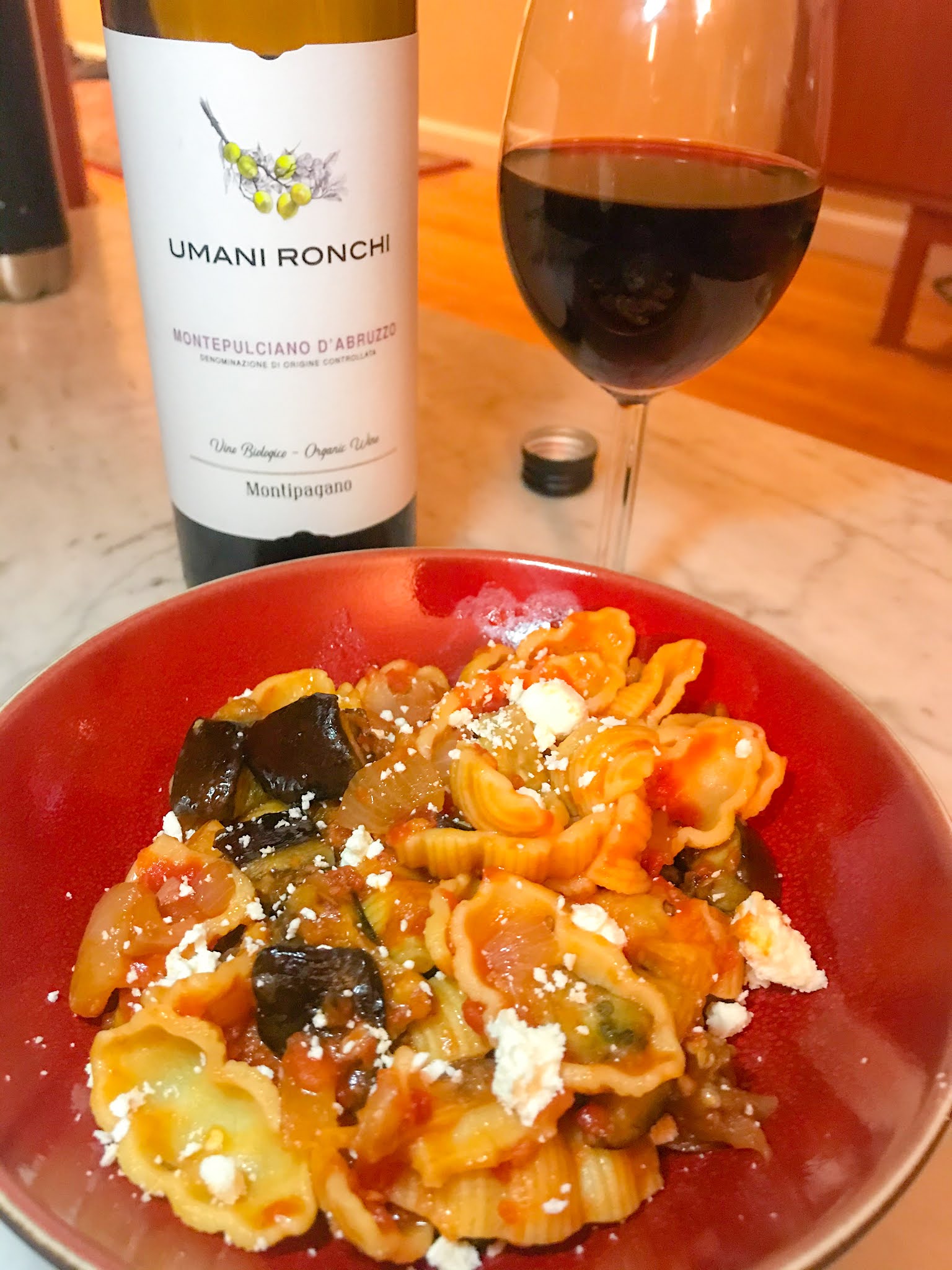
SRP: $15
Blend: 100% Montepulciano
Alc: 13%

This comes from the same vineyards in Abruzzo as the Pecorino above. Grapes are gently pressed and are fermented in steel tanks. After alcoholic fermentation is completed, wine undergoes malolactic fermentation, after which part of the wine goes through a short refining period in oak barrels.

Tasting Notes: Spiced red berries with plums and smoke hit on the nose. On the palate, the fruit quality is juicy, almost saucy, with warm berry notes of raspberries and cherries, accompanied by hints of fennel spice, herbs, and pepper. This is a simple, easy-going wine, but it’s worth giving it a little time to open up as the oak integrate and the wine becomes fruitier with a little air. It was medium-bodied with medium tannins and acid.
(Additional details here.)

Pairing: We had this wine with a simple pasta dish (recipe below) tossed with eggplant, tomatoes, and spicy ‘ndjua sausage. I was a little worried that the spicy sausage would be a problem, but the wine’s fruitiness stood up to the heat well and made for a very nice pairing. The winery also recommends pairing this wine with roasted lamb. 


eggplant, ndjua
dinner, pasta
Italian
Servings: 4
By: Nicole Ruiz Hudson
Print
Pasta with Eggplant, Tomatoes, and ‘Ndjua

Pasta with Eggplant, Tomatoes, and ‘Ndjua

Prep Time: 40 MinCooking Time: 35 MinTotal Time: 1 H & 15 M

Ingredients:

  • 2 small to medium eggplant, cubed
  • 12 oz pasta (in this case I used conchiglie)
  • 1 onion, diced
  • 1 Tbsp tomato paste
  • 6 oz ‘Ndjua
  • 12 to 15 oz tomato purée (you can also substitute in canned diced tomatoes)
  • 3 to 4 qarlic cloves, minced
  • 1 to 2 sprigs of rosemary
  • Olive oil
  • Salt
  • Pepper
  • Ricotta salata, for serving (or other salty, fresh white cheese, like feta)

Instructions:

  1. Salt the eggplant. (Optional – see note.) Place the eggplant in a colander and sprinkle liberally with salt, then toss to combine. Let the eggplant sit for 20 to 30 minutes. Arrange the colander over the sink or a bowl, so that moisture can drain off. Rinse the eggplant cubes well under cool water, then pat dry with paper towels.
  2. Meanwhile, bring a large pot of liberally salted water to a boil and cook pasta according to pasta instructions, or until pasta is al dente. Reserve a cup of the pasta water, then drain.
  3. Sauté the onions in a large pan with a generous pour of olive oil (about 2 Tbsps) over medium heat. Season with salt and pepper and cook until soft and translucent – about 8 to 10 minutes.
  4. Stir in the tomato paste and allow it to cook for a few minutes until it’s beginning to brown, then add in the ‘ndjua, tomato purée, the garlic cloves, and the rosemary sprigs. Stir in a splash of the pasta water, then reserve the rest to use as needed. Add in the eggplant, bring the mixture to a boil, then reduce heat and allow everything to cook over medium heat for about 15 to 20 minutes, or until the eggplant has softened and the sauce has thickened. Taste and adjust seasoning with salt and pepper as needed.
  5. Gently toss in the pasta to coat with the sauce. Serve topped with the ricotta salata.

Notes:

People pre-salt eggplant to draw out bitterness, but most versions in stores today aren't all that bitter, so I usually only notice a mild difference in flavor once sauces are added on top. Given that, if you're in a rush, skipping the salting step shouldn't make a drastic difference.
https://www.sommstable.com/2020/09/sustainable-sampler-pack-with-umani-ronchi.html
Did you make this recipe?
Tag @thesommstable on instagram and hashtag it #sommstable
Created using The Recipes Generator


If you’re interested in learning more about Abruzzo, please see these previous posts:

  • Cooking to the Wine: Lammidia Anfora Rosso from Abruzzo & Pot Roast with Tomatoes and Chickpeas 
  • Passion and Authenticity in Abruzzo: A Conversation with Cristiana Tiberio of Az. Agr. Tiberio 
  • Cooking to the Wine: Tiberio Pecorino & Saffron Chickpea Stew with Seafood


And for another Verdicchio from the Marche's Castelli di Jesi check out: 

  • Cooking to the Wine: Azienda Santa Barbara Verdicchio and Tuna Melts


 *****

As I mentioned, the rest of the Italian Food Wine Travel (#ItalianFWT) bloggers are exploring issues of sustainability in Italian wines this month, hosted by Katarina of Grapevine Adventures.

Be sure to check out the rest of the group's posts here:

  • Camilla from Culinary Adventures with Camilla takes inspiration from Sicily in Pasta alla Norma + Tasca d’Almerita Lamuri Nero d’Avola Sicilia 2016.
  • Terri from Our Good Life shares the article Che Fico: A Wine that Supports Sustainability in Italy.
  • Linda from My Full Wine Glass heads to Alto Adige with Alois Lageder – Driven to Create Wines in Harmony with Nature.
  • Gwendolyn from Wine Predator posts her Interview: Antonella Manuli’s and Lorenzo Corino’s Patented Method + Wines, Lasagna, and Dogs.
  • Lynn from Savor the Harvest answers How the Ricci Curbastro Estate In Franciacorta Tackles the Sustainability Question.
  • Robin from Crushed Grape Chronicles explores the question Climate Change, Finding Sustainable Italian Wines and Why You should Care.
  • Susannah from Avvinare tells us more about Sicily with Tasca d’Amerita, A Longstanding Focus on Sustainability.
  • Jennifer from Vino Travels shares VIVA Sustainability at the Forefront with Michele Chiarlo.
  • Deanna from Asian Test Kitchen shares Italy’s First Vegan Certified Winery.
  • Then our host Katarina at Grapevine Adventures will talk about Torre Bisenzio where Authenticity And Quality Is All About Sustainability.


Additional sources used for this post:

Vineyard Brands

 The Oxford Companion via JancisRobinson.com

Wine-Searcher.com 

Vini d' Abruzzo

Umani Ronchi Jorio Montepulciano d'Abruzzo 2016 


This post contains affiliate links, including these Amazon Associate links, from which I might receive a commission at no cost to you.


In my last post, I shared an interview with Cristiana Tiberio, the badass winemaker of Azienda Agricola Tiberio. Today we’re going to take a closer look at one of her wines –the Tiberio Pecorino Colline Pescaresi 2016 – and we’re bringing it home to the table.

Pecorino is one of those white wine grapes that I realize most people don’t know, but it’s very much in line with what many people are looking for in a bottle of white wine. It’s crisp, it’s minerally, it’s refreshing. It also has the ability to be really interesting. . . and it has a great comeback story.

It’s not surprising that it’s not that well known. Let’s be honest, I know a lot of you are thinking ‘Pecorino? I thought that was a cheese.’ I’m pretty sure I had that same thought the first time I heard of it. You’d also be right, there is a cheese called Pecorino – and I couldn’t resist including it in today’s recipe. However, it is also a wine grape that is grown predominantly in Italy’s Marche and Abruzzo regions. According to Ian D’Agata in Native Wine Grapes of Italy, the grape got its name from sheepherders who ate them off the vines as snacks while accompanying their flocks around the countryside. Other sources suggest that the sheep themselves ate the grapes. Either way, it seems there is at least a thin thread linking the wine with the cheese. (Sorry guys, it’s hard for me to resist a cheesy tangent.)

The grape’s obscurity has largely to do with the fact that it nearly went extinct. It’s an ancient grape that had been grown for hundreds of years. However, it’s not a very productive grape and many growers replaced it with far crappier varieties that gave higher yields. However, Pecorino’s weakness is also its strength. The fact that its vines don’t produce that many grapes also means that the grapes that are produced tend to have higher flavor concentration.

All the same, growers ripped up most of these vines and Pecorino was commonly thought to be completely gone by the middle of the 20th century. Then a few remaining vines were discovered in the 1980s and the grape made a pretty remarkable comeback. The grape can largely thank two producers as its heroes for bringing it back from the brink of death – Guido Cocci Grifoni of Cocci Griffoni in the Marche and Luigi Cataldi Madonna of Cataldi Madonna in Abruzzo.

The Tiberio family happened to be good friends with Cataldi Madonna. In 1999, Cristiana and Antonio Tiberio discovered a few rogue vines mixed in with others on their property. Once they figured out what they actually had on their hands, Cristiana went to Cataldi Madonna and learned everything she could from him about the grape. The Tiberios began cultivating the grape and Cristiana eventually developed her own style with the wine.


Cristiana with her Abruzzese Shepherds Quarmari and Frida in the vineyards. Photo courtesy of Cristiana.


In my conversation with Cristiana for my last post, I asked her what customers could expect from a bottle of  Pecorino.  She noted it’s often likened to a fuller-bodied Sauvignon Blanc, but it’s also very much its own grape and very evocative of the Mediterranean. She shared, “I love its energy, with beautiful depth balanced by the minerality. An authentic Pecorino has herbal flavours of sage, thyme, rosemary, and always a little zest of lemon.” You might also find apple and pear flavor, as well as light floral notes, and lots of minerality. Pecorino will also tend to be high in alcohol, and it is also high in glycerol, both of which add to the body of the wines, but all of this is balanced by high acidity as well.


Tiberio vineyards. Photo courtesy of Cristiana Tiberio.


THE WINE & PAIRING


Cristiana noted the Pecorino is generally a very food-friendly wine, but when I asked for her pairing recommendations to go with the 2016 bottling of her wine, she had a great recommendation: “My favorite food pairing for my Pecorino, especially for an aged vintage is a chickpea soup with saffron. Pecorino has a long creamy texture able to support and to match the flavour of saffron and the legumes expanding the length of these flavours and at the same time to add lift with its minerality.”

On the day we opened the wine, Greg and I picked up notes of pears, apples, and lemon. There were savory herbal notes, as well as tasty hints of cheese rind. The same notes continued on the palate along with some fleshier stone fruit notes, and even some faint tropical fruit notes of pineapple as it warmed in the glass. The wine gave a savory impression overall, with lots of herbs (Greg likened it to sourgrass), that hint of salty cheese, little white flowers that are just starting to dry, and hints of toasted almond skin.

Cristiana had mentioned that Pecorino tends to not be super aromatic, but will be more complex and full-bodied on the palate. Pretty much echoing this sentiment, Greg commented that the “depth of flavor is bigger than you’d expect on the nose.”

I suspect that several of these flavors, like the cheese rind and toasted almond skin, were coming from the fact that this wine was now a few years old, but I found them to be very attractive and added to the complexity. I’d be curious to age a bottle further to see where it goes.

Since Cristiana’s pairing recommendations sounded so delicious, we kept them in mind as we tasted the wine and built our pairing around it. The complexity of flavors and the body and texture of the wine also suggested it could handle quite a mix of flavors. What we ended up with was a kind of deconstructed seafood stew. Rather, it was a stew with seafood served on top. I opted for a simply prepared combo of cod and shrimp.

The breadth of flavors was really concentrated in the stew coming from first from saffron and herbs. I also happened to have some bits of ham and salami hanging around that I thought would work, so I tossed them in. This is totally optional, so to my pescatarian friends, feel free to leave it out. For my vegetarian friends, go ahead leave off the seafood – the stew is plenty flavorful on its own. 


That salty cheese note made it so that I really couldn’t resist the temptation to incorporate some Pecorino cheese into the pairing as well. Moreover, it is a pairing recommendation I saw more than once for Pecorino wines in general. As you might guess, the region does have a tradition of making this class of these cheeses known as Pecorino Abruzzese. Hey, “what grows together, goes together.”

It was a delicious combo, with flavors in the food and wine mirroring and rounding each other out. The wine was a really refreshing counterpoint to the food, while simultaneously matching the richness of the stew. I think this would be a great option for a dinner party because you could easily make the stew in advance (it’d probably taste even better), and just make the seafood right as you’re about to serve. Feel free to swap in other seafood options as well –– pretty sure this wine would easily match whatever you decide to swap in.


OTHER POSSIBILITIES


The importer’s website also recommends pasta, legumes, white meats, cheeses. Other recommendations I found include steamed white fish with ginger and chicken thighs with roasted red pepper and onion. This article I found about Pecorino cheese includes recipes for cacio e pepe and fava con pecorino – I think they’d all work beautifully together.

If you’re looking for other wines to pair with this dish, look for full-bodied white and rosé wines with savory notes. Options such Soave Classico, Pinot Bianco, or Lugana could work nicely. If you’re making the stew on its own or a less delicate fish like salmon or trout, savory light-bodied reds should work as well.

Maybe grab one from each category from Tiberio’s line-up and report back!


THE GEEKY DETAILS


Tiberio farms sustainably and all of their wines are made with free-run juice and native yeasts.

The Sorting Table’s website
(importer) has a very detailed tech sheet for this wine. Here are just a  few of the basics:

Grape Variety:  100% massal selection Pecorino
Total area under vine:  3 hectares
Altitude:  350 meters a.s.l
Soil composition:  Limestone with marly-gravel subsoil
Average vine age: 16
Vinification:  No press, just free run juice
Alcoholic fermentation:  In stainless steel tanks
Malolactic fermentation:  None
Aging:  Six to eight months in tanks and another three to four months in bottle. (Per Vinous.com)
Technical Information
Alcohol:  13.5%

If you really want to geek out and take a closer look at Pecorino, and its progression in Tiberio’s vineyards, I highly recommend checking out this article by Ian D’Agata for Vinous.com. By total coincidence, I happened to attend a seminar he was giving in SF over the weekend (so in between these two posts). It struck me that he mentioned Tiberio’s wines several times throughout the day even though the day’s topic didn’t have anything to do with Abruzzo. More specifically related to this article, in Native Wine Grapes of Italy he notes her as an expert on the Pecorino grape and highlights the Tiberio, Cataldi Madonna, and Cocci Griffoni as the three best examples of the wine in Italy.


MONEY TALK


I believe I got my bottle from Wine.com. They currently have the 2018 available for $24. (The average price across all vintages on WineSearcher.com is $21.) I think that’s a great price for such a thoughtfully made bottle that also happens to be a benchmark for the variety, making this wine an absolutely Solid Value and probably an Overachiever as well. 


I can’t recall when I first tried one of Tiberio’s wines, but last year they seemed to keep crossing my path. I then had the chance to meet winemaker Cristiana Tiberio when she came to pour at Bâtonnage Forum last year, and where I took the picture above. It also gave me the chance to taste through the full line up of her wines, which impressed me with their elegance and freshness.

My friend Maura, with whom I collaborate on Della Donna, had the chance to visit and taste with Cristiana at her winery in Abruzzo and spoke glowingly about the experience. All of this inspired me to want to get to know the wines and the woman behind them better.

The Tiberio line-up, photo by Maura Passanisi.
The Tiberio landscape, photo taken by Maura.

In that spirit, I recently reached out to Cristiana and she kindly answered questions regarding the family estate, her background, winemaking style and more. I’m so excited to share our conversation with you today. I also asked for her recommendations for pairing her delicious Pecorino, which I used in creating a Saffron Chickpea Stew with Cod and Shrimp. I’ll be sharing that recipe in my next post. 

We’ll get to the interview in just one moment, but here’s just a little bit of background first. Azienda Agricola Tiberio is located in Abruzzo in central Italy, a mountainous region along the Adriatic Sea. If you drive east from Rome, you hit Abruzzo.
Map courtesy of WineFolly.com

Tiberio is located near the medieval town of Cugnoli, not far as the crow flies from the seaside city Pescara.  (I invite you to check out this post for more background on Abruzzo.)

Riccardo Tiberio, Cristiana’s father, had been an export manager for a cantina in the region. He eventually found a plot of 60-year old Trebbiano Abruzzese vines and purchased it in 2000. He released his first wine in 2004, then turned over the reins to his kids in 2008 with Cristiana as the winemaker. 

Cristiana trained all over the world with a seriously impressive list of winemakers including Jacques Selosse in Champagne, Nicolas Joly at Coulee de Serrant, Egon Muller in the Mosel, with various producers in Chablis, and in Australia’s Clare Valley. 

Without further ado let’s get into our conversation. I can’t think of a better way of kicking off Women’s History Month! 

Cristiana with her Abruzzese Shepherds Quarmari. Photo courtesy of Cristiana.Photo courtesy of Crisitiana Tiberio.
Older Posts Home

INSTAGRAM

Sign up for my mailing list!

Subscribe

* indicates required


Somm's Table 2017