Somm's Table

Perfect pairings from the other side of the equation.

  • About
  • Front of the House
  • Back of the House
  • Contact Us
Powered by Blogger.

Wine came to Mexico before anywhere else in the Americas, and yet their industry is really just starting. It's up and coming quickly, though. We're exploring two bottles that represent very different sides of their business and sipping them alongside a delicious serving of birria. 


This post contains wines that were provided as samples. No other compensation was received for this post and all opinions are my own. It also contains affiliate links from which I might gain a commission at no cost to you.

The first time I recall ever encountering Mexican wines was on an excursion to Ensenda wine country while on a cruise to Baja Greg and I went on in our early 20s. It was one of the better memories I have of that particular cruise, but to be honest, it had less to do with the wine and more to do with the fact that a day in wine country is almost always lovely. This was way before I knew anything about wine, but of the three or four wineries the excursion took us to, only one (L.A. Cetto) stood out as being any good. Of course, this could have been due to the particular selection of wineries. I mentally cataloged the topic of Mexican wines as “interesting, but still needs work.” 

Flash forward more years than I’d like to admit. I’ve now seen more and more quality Mexican wines cross my path. One or two would make it onto the shelves while I was working in a wine shop. A friend would pour one for me at a tasting. I’d see a few more examples represented at trade tastings. Then one of my tasting groups (in the before times) dedicated a session to Mexican wines during which I was able to taste a full line-up that included a wide range of grapes and styles and got a sense of where their wine industry had progressed to, and it seemed like they’d come a long way. Of course, this is still a region in development, but one that’s definitely worth paying attention to. 


A Brief History of Wine in Mexico

Map borrowed from WineFolly.com


The funny thing is that while Mexico’s wine industry is still emerging and developing, it was actually the first place wine was made in the Americas. The Spanish conquistadors first brought over vitis vinifera vines in the 16th century – the species of grapes most commonly used to make wine is not indigenous to the Americas and required a lift getting over the ocean. The vines were planted, however, the breaks were pushed on the growth of the new industry when Spain realized it had a good thing going as the main supplier of wines to “New Spain.”  The trading was so profitable for Spain that King Carlos II went so far as to outlaw the commercial production of wine in 1699 so that the new would have to keep on importing it. Most wine grapes that had been planted were used to make brandy.

Wine production continued – albeit at a trickle – thanks to the Catholic Church, as it was legal for them to continue to make it for ceremonial purposes. Therefore, while the industry hung on by a thread, it did hold on. Things essentially remained this way until Mexico gained its independence from Spain in the 19th Century. 

The very first vineyards in Mexico were planted around the town of Parras de la Fuente which translates as 'vineyards of the spring. ' This region is located in north-central Mexico in Coahuila. Since Mexico’s climate overall is very hot – much hotter than is normal for a grape-growing region – it’s necessary to find microclimates that offset the heat. The vineyards in Parras de la Fuente are located in the Sierra Madre Oriental mountains, at an altitude of around 5,000 feet (almost 1,525 meters), making it much cooler than the coastal regions. It also helps that it’s pretty arid – grapes definitely prefer a “dry heat.”

The wine industry was not destined to stay centered in the Parras Valley. The first grapes were planted in Baja  Today, the overwhelming majority of Mexican wine (85 to 90%) is made in Baja California. Baja benefits from being a little farther north and closer to the ocean, so cooling ocean breezes provide relief from the heat. It has a Mediterranean climate, but it’s fairly dry here as well, so the majority of vineyards do require irrigation. Overall, the region tends to have granitic alluvial soils similar to what you might find in France’s Northern Rhône Valley.  Ensenada is the center of the industry, but the region has developed to the point that there are major sub-regions including Valle de Guadalupe, Valle de Calafia, Valle de San Vincente, and Valle de Santo Tomás. 

As Mexico’s modern wine industry is still in development, it’s still pretty much the wild, wild west. There are no signature grapes as of yet – over 120 different varieties are grown. There also isn’t much in the way of regulation; the wineries basically have to self-regulate. The lack of rules also means that there is a lot of experimentation. You’ll find a lot of blends here, many of which might seem unusual and you won’t see in other places. Winemakers feel free to put things together to see if they taste good. The infrastructure is still building, but things are growing quickly. In 2006 (around the time we went to Ensenda, give or take a couple of years), there were less than 25 wineries in the whole country. Now, there are over 120 in Baja alone. There are a few big producers (like L.A. Cetto, which I mentioned earlier), but the majority of wineries are pretty small. 


The Food

Birria has been all the rage in recent years. While I don’t necessarily mean to feed the hype for the sake of it, I do really love the stuff. It’s got sooooooo much flavor and it’s 100% comfort food at the same time. It’s a very traditional dish that originally came from the state of Jalisco that involves stewing meat in a very flavorful broth flavored with chili peppers and lots of herbs and spices. Goat is the meat most traditionally associated with birria, but lamb and beef are also commonly used. There are even plenty of vegetarian versions out there. The meat and the resulting stew, or consomé, can then be served in different ways. The two can be served together with a side of tortillas, or the meat can be used to fill tacos or tortas, probably with a side of the consomé for dipping on the side. 


We fell in love with the quesabirria (basically a birria quesadilla) at Nido Backyard, a restaurant here in Oakland, and we can’t help but get it pretty much every time we go. On our last trip to San Diego, some friends introduced us to Tuetano Taqueria, which serves it up a slew of different delicious ways. 
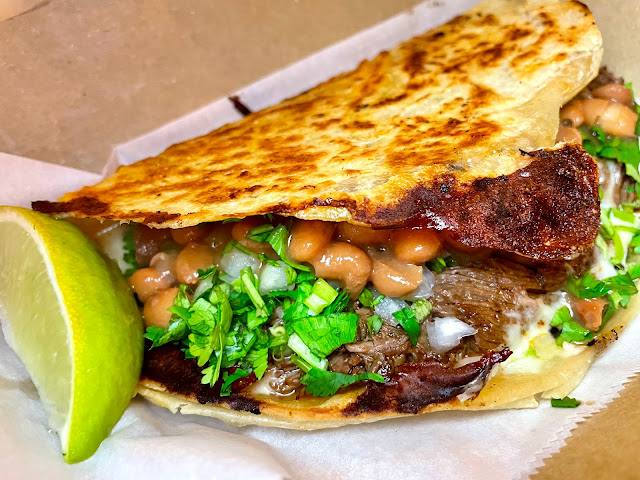


Birria quesadilla with beans

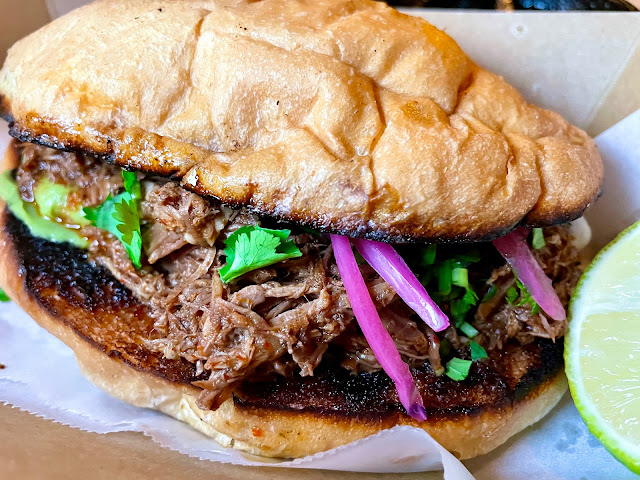
Birria Torta
 Birria taco with a side of bone marrow.

At some point last year, I decided to try making Birria de Res (beef) at home. I worked with a few different recipes I found online, but predominantly crossed this recipe from the NYT Cooking and this one from GimmeSomeOven.com to help me adjust things for prep in my Instant Pot. (I believe I used a combination of chuck roast and oxtail for the meat.) It turned out deliciously and yielded lots of leftovers, so I was able to store quite a bit in the freezer and doled out the goodness over a few months. 

In the process, I was also able to play around with serving it in different ways. In addition to eating it as a stew and in tacos etc., one day I brought home a bunch of tamales from a vendor at my local farmer’s market. I ended up marrying the two together, and now this might be my absolute favorite way to eat a tamale. 


Having lots of leftovers also gave me the chance to try the dish with different wines, and on two occasions, we paired the birria with Mexican wines. It was an easy match for both bottles, although each worked well in different ways. 


The Wines: Two Very Different Representatives

The two wines we’ll be looking at today represent different facets and extremes of what you might find. The first is from the Parras Valley from a historical winery and is made in the international style. The second is a natural wine from a young winery in Baja.


Casa Madero 3V Red Blend Parras Valley, Coahuila 2018 


Blend: Equal Parts Cabernet Sauvignon, Merlot, and Tempranillo |  ABV: 13.7% |  Average Price: $27 (Sample) | Find additional details here and here.

Casa Madero is the oldest winery in the Americas. Its history goes back to 1597 when King Felipe II of Spain awarded Don Lorenzo Garcia a land grant, along with the right to produce wine and brandy for the crown. The winery was born under the name Hacienda de San Lorenzo. It would then go on to change hands several times and was eventually purchased by Evaristo Madero in 1893, giving the winery its current name. 

It’s located in the Parras Valley in the Sierra Madre Mountains (as discussed above), and thanks to the high elevation of the vineyards at 5000 feet, the grapes enjoy warm days and cool nights. The winey has continued modernizing and moving forward. It was also the first Mexican winery to have organically certified vineyards and now has several certified sites. 
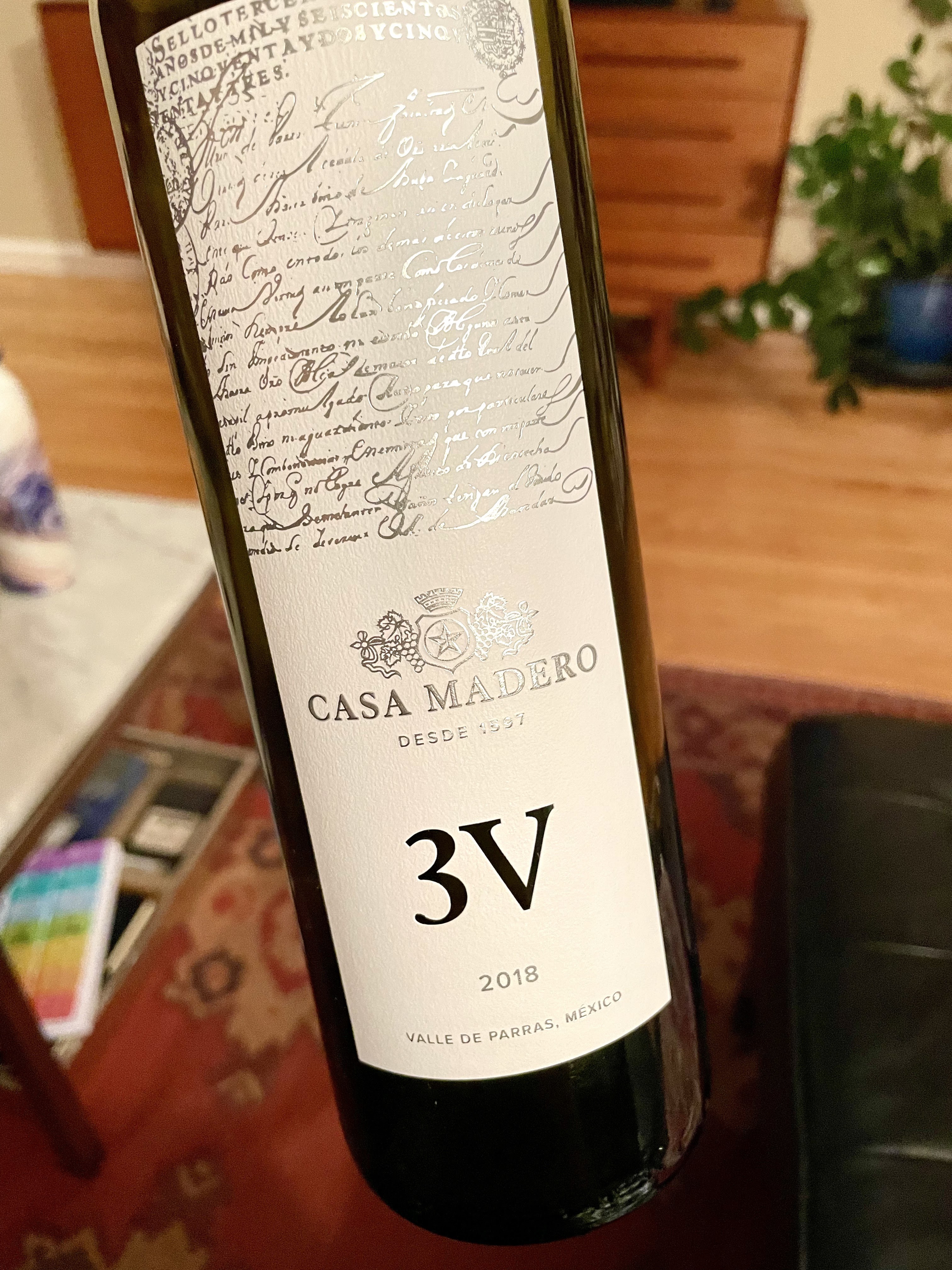

Tasting Notes: Warm, ripe fruit notes strawberry fruit leather, blackberry, black cherry, and red plum sauce. Dusty earth notes are mixed in, along with white pepper, pencil lead, hints of cocoa, and tobacco. The palate mixes Old World earthiness with the ripe fruit of the new world. The wine was medium+ to full-bodied with smooth but grippy tannins. I decanted this wine in advance. 

Pairing: It was excellent with birria tacos. The depth of the wine matched the depth of flavors in the food beautifully, and it became silkier alongside the food as the meatiness helped to further smooth out the tannins.

This wine was sent to me as part of a collaboration with Big Hammer Wines. They offer fine wines at discounted prices. While this particular bottle is sold out, you can find the 2019 bottling here. You can also find a curated list of my selections here. Use the discount code NICOLE15 for $15 off any purchase. (Limit to 1 use per customer.)


Bichi No Sapiens Baja California 2019


Blend: Unknown. Possibly Dolcetto, possibly Carrignan. | Average Price: $34 | Find additional details here.

Established in 2014, Bichi is at the much younger end of the spectrum. Nonetheless, they’ve made a splash in a very short period of time. This is a winery that gets natural wine fans very excited. Located in Tecate, the winery was started by Noel Téllez and his brother, chef Jair Téllez, who moved to Baja from neighboring Sonora. Noel, who left his job as a lawyer to work on the winery, is now the sole proprietor. The name Bichi means “naked” in the Sonoran Yaqui dialect and it reflects a hands-off approach to their winemaking. It’s also captured in the (literally) cheeky labels picturing luchadores and luchadoras wearing nothing but their birthday suits.


Bichi farms 10 hectares of their own Tecate vineyards biodynamically and they collaborate with organic farmers in Tecate and around San Antonio de las Minas in the Valle de Guadalupe. They seek out interesting vineyards to source from. In the case of the No Sapiens, the dry-farmed, own-rooted source vineyard is planted with a mysterious grape variety that remains unidentified. The farmer thinks it could possibly be Dolcetto from plantings brought over from Italy in the 1940s, while the Téllez family thinks it could be Carignan from Spain. In the winery, grapes are destemmed by hand and gently foot stomped, and fermentations are carried out by wild yeast. 

I first came in contact with Bichi’s wines several years ago, and I think the No Sapiens was the first one I tried. The first versions I tasted were at the "natty AF" end of the natural wines – too funky for my personal tastes. On top of that, I remember the necks of the bottles being clogged up with sediment. I don’t mind some sediment, but this was a bit much. I didn’t get the hype. But things have come a long way in just a few vintages,  as more recent tastings were much, much nicer. The wines were still a bit funky, but pleasantly so, and those elements blended in with the pretty fruit notes. 

Tasting Notes: Fruity and funky. Black cherries, pepper, licorice, flowers petals, and dusty barnyard notes on the nose. On the palate, it was bright, juicy, and generous up front, moving into more gamey notes towards the finish. There was a bit of brett, but it was integrated with the other flavors. The wine was medium to medium + in body, with fine tannins, and lots of freshness. I recommend decanting.

Pairing: This was another great pairing for the birria, although this wine brought out the gamier side of the stew. The wine’s gamey side blended into the food and became less pronounced in the combination. A delicious combo!

*****

Other Possibilities 

If you're looking for additional pairing suggestions to go with birria and can't your hands on a bottle of Mexican wine, have no fear. The bold, meaty flavors in birria should work happily with quite a few red wines, but since there is a mixture of spice and earthiness, look for a red that combines elements of rich, ripe fruit to balance the spice, and elements of earthiness or a meaty quality to further tie in with the flavors.

We also tried this Seven Hills Cabernet Sauvignon Columbia Valley 2015  from Washington state, which also worked well thanks to this combination of flavors. I tend to find that Washington wines generally have a good balance of fruit and earthy elements.


*****

More Mexican Wines

At the beginning of this post, I mentioned that one of my tasting groups dedicated a session to Mexican wines. I thought I'd drop the basic tasting notes I took at that session here to show some fo the range of wines. Starred wines were favorites. 


Casa Magoni Chardonnnay - Vermentino Valle de Guadalupe 2016

Blend: 80% Chardonnay, 20% Vermentino
Stainless steel, a little bit of neutral oak at the finish just to round it out .
Nose: Creamy nose, with a light herbal note.
Palate: Crispy apples and lemon lime, rounded out by herbal notes on the finish. 

Bodegas Henri Lurton Le Chenin Valle de Guadalupe 2016 *

Nose: Creamed apples and peaches, light tangerine, and touches of honeysuckle 
Palate: Similar notes continue on the palate, along with a little hay, a bit of dusty earth, nice freshness. 

Solar Fortun 'O Positivo' Valle de Guadalupe 2014 *

Blend: 50/50 Cabernet Sauvignon and Syrah 
Nose: Dusty smoke, singed cedar, and a dusting of cocoa.
Palate: Mixed Berries and cherries, ripe but bright (more acid than expected), a bit of dust, strawberry leather. 


Corona Del Valle Tempranillo Baja California 2015

12 month in oak, 30% new French
Nose: A little vanilla, cherry, strawberry candy, baking spice.
Palate: Definitely more oak here,baking spices, dusty strawberry, cherry, raspberry, vanilla
Would like to see it in about 3-5 years.


Infinito Cabernet Sauvignon Baja California 2013

30% new oak
Nose: Orange spice, cherry and red plum.
Palate: These continue on the palate along with red currant, light spice, and deep berries, black tea.

Corona del Valle Tempranillo - Nebbiolo Baja California 2015

Nose: A touch of a high-toned floral note, sweet spice, black cherry, red currant, red berries, sweet tobacco, cold stones
Palate: These notes continued on the palate along with black tea. The oaks still needs time to integrate. 
 

Bodegas Henri Lurton Le Nebbiolo Valle de Guadalupe2015

Nose: Dusty red raspberries, blackberries, cedar, sour cherry, tar, char.
Palate.  Inky and tarry, with lots ripe fruits and tooooooonnnnnnnnnnnnsssssss on tannins
Needs more time for the tannins to calm down a bit. Decant.


*****

The Wine Pairing Weekend (#WinePW) Blogging Group is exploring the wines of Mexico. Check out the rest of their posts:

  • Wendy from A Day in the Life on the Farm will share “Mexican Foods and Wines always provide for a Perfect Fiesta”
  • Susannah from Avvinare is “Discovering Mexican Wine”
  • Jen from Vino Travels is taking “A First Look at Mexican Wines Including Italian Grapes”
  • Carlos from Carlos’ Food & Wine is serving up “Mexican wines featuring sparkling wine risotto & grilled hanger steak with mushroom-red wine sauce”
  • Camilla from Culinary Adventures with Camilla is sharing "Outside the Pigeon-Hole: Pairing Mexican Wine with Thai Cuisine"
  • Gwendolyn from Wine Predator Gwendolyn Alley features Sparkling Wine from Mexico For #TacoTuesday”
  • Robin of Crushed Grape Chronicles shares “Mexican Wines – 2 wines from the central Mexican highlands of Querétaro #WinePW"
  • Linda from My Full Wine Glass is “Saying ‘hola’ to Mexican Tempranillo and sparkling wine”
  • Martin from ENOFLZ Wine Blog will share “Exploring Mexican Wine Beyond Baja”
  • Liz at What’s in that Bottle posted “Salud a Los Vinos de Mexico!”
  • Terri from Our Good Life pairs "Grassfed Ribeye with Steak Butter and Grilled Oyster Mushrooms Paired with Monte Xanic Cabernet Sauvignon"
  • Cooking Chat  paired “Roasted Beet Pesto Pasta with Mexican Merlot”

Additional Sources and Extra Reading:
  • Wine Enthusiast: Baja and Beyond: Everything You Need to Know About Mexican Wine
  • Wine Enthusiast: With Distinctive Terroir and Varied Microclimates, Mexico’s Baja California Aims to Preserve its Character
  • Wine-searcher.com
  • Winefolly.com: An Overview of Mexican Wine Country
  • Meet the New Visionary of Mexican Natural Wine


Isn’t it the BEST when something you’ve been really looking forward to actually manages to top your expectations?! I can’t say it happens all the often, but our visit to Bodegas Emilio Moro was definitely beyond expectation.

I’d become a big fan of Emilio Moro’s wines while I was working at Wine Spectator in New York and always relished the chance to get to taste their wines, particularly their top-tier wines like Malleolus de Valderramiro and Malleolus de Sanchomartín. These were out of my usual price point, but I always found seductively delicious with their deep dark fruit flavor, spices, and silky texture.

José Moro, the company’s president, happened to be pouring when I stopped by the winery’s table at Wine Spectator’s Wine Experience in 2013. (The Wine Experience is big tasting event where selected wineries from around the world are invited to pour for the public and partake in panel discussions.) I took the opportunity to mention how much I loved the wines and that I was planning to visit Spain later in the year. He was extremely kind, gave me his card, and went on to help me arrange a visit to the winery.

Fast forward a couple of months to the day Greg and I were passing through Ribera del Duero. We were in a rather dejected state when arrived at Bodegas Emilio Moro. I love the wines of Ribera del Duero, but we only had time to visit two wineries due to the extremely aggressive travel schedule we’d given ourselves. I’d chosen the wineries carefully, but our first stop of the day was TERRIBLE. Without delving too deeply into the details, I don’t mind telling you that said visit was at Bodegas Tinto Pesquera. It’s been many years now, and this still holds the title for the worst winery visit we’ve ever had by a wide margin. It's too bad as it's a historical winery in the region, and I’d previously been a fan of the wines, however, I have not bought a bottle since.

Younger versions of Greg and I during our visit to Emilio Moro. Note: Our visit was comped as I'm a member of the wine industry. As always, all opinions are my own.

By contrast, the warm hospitality we received at Emilio Moro was like a balm to our bruised spirits. The woman who greeted us and gave us a tour was so lovely and gracious. (I’ve sadly lost all my notes from this trip, so I no longer have her card with her name.) I’d met José Moro just the one time which was very brief, and yet we felt like we were treated like old friends from the reception we received on his behalf, as he was out of town on that day. In addition to the tour of the winery and tasting, we also had the chance to have a wonderful lunch at the winery’s restaurant. At the end of the visit, our spirits had been completely restored!

It’s was so typical of this trip to experience such highs and lows back to back. This visit at least was a definite high.

RIBERA DEL DUERO


Before I get into the winery’s history and our lunch there, let’s get to know Ribera del Duero a bit.

Map courtesy of WineFolly.com

This wine region is located on a barren plateau in Castilla y Leon in Northern Spain. The name translates to the riverbanks of the Duero, and it follows its namesake river for 70 miles between Valladolid and Aranda, and about two hours north of Madrid. 


Map courtesy of Ribera y Rueda

The growers of Ribera Del Duero have a tough climate to contend with. They’re fairly inland, so the climate is continental and swings between long, cold winters and short, intense summers. The altitude (600 m/2,000 ft) helps to cool things off at night in the summer, stretching out the ripening process, leading to grapes with intense color and flavor.


As is the case with a lot of Spain, Tempranillo is the star grape of the region – here it’s called Tinto Fino or Tinto del País – but the conditions and style here create wines with a very different profile than those of Rioja. (I think it’s really interesting to try these side by side.) Wines here tend to be much deeper, darker, more full-bodied, and more structured than those of Rioja. Historically they’ve also used more French oak, whereas Rioja used more American oak which added to the stylistic differences between the two regions, although nowadays you can find plenty of examples wines of wines using either in the latter.

The permitted blending grapes also vary a bit. Red wines must be made up of at least 75% Tempranillo, but you’re likely to find a little splash of Bordeaux Cabernet Sauvignon, Merlot, Malbec, as well as Garnacha included in the mix. (Albillo is the only permitted white grape.) One tends to think of the use of these international grapes as a modern thing, but the tradition here goes back a ways as Vega Sicilia, the region’s most iconic winery, has used Cabernet since 1864.

Infographic courtesy of Ribera y Rueda

The region’s winemaking history dates back to ancient times and it received its D.O. (Denominación de Origen) in 1982, although I’ve always felt that it deserves DOCa status (the top tier) along with Rioja and Priorat. It’s possible that I’m biased because it is the first Spanish red wine region I fell in love with. This might have something to do with the fact that, IMHO, the wines have a lot of crossover appeal for lovers of big California reds. If you love Cali Cabs, these wines have a similar ripe fruit character and structure, although typically with more earthy and minreally elements mixed in. If you’re a New World red drinker looking to dip a toe into Old World wines, I think these wines are a great place to start.


BODEGAS EMILIO MORO


The history of Bodegas Emilio Moro goes back three generations. The first two, both named Emilio, grew grapes and sold them on the bulk market. In 1988, José Moro, took a big gamble and invested the family’s savings into buying winery equipment and the modern company was born. Today he runs the winery in Pesquera del Duero along with his brother Javier.

The family owns 200 hectares of their own vineyards, and they also control another 200 hectares via agreements with other growers. You can find the names of the family’s best-known vineyards on their bottlings:

  • Resalso, which was planted the year the 2nd Emilio Moro was born (1932) and has deep, cool soil. This is also their youngest vineyard.
  • Valderramiro has the winery’s oldest bush vines and is the birthplace of their great single-estate wine Malleolus de Valderramiro.
  • Sancho Martin has excellent ripening conditions and produces wines with strong tannic structure and marked acidity. These tend to be particularly good for aging.


The winery’s philosophy is to try to main a balance between tradition, innovation, and social responsibility. They use sustainable farming methods and dry farm their vineyard, believing that irrigation changes the characteristics of the fruit and prefer to showcase the personality of each vintage.
 

The family has worked hard to preserve the particular clone of Tempranillo that is found in their vineyards. They have been working with the University of León to obtain a pure version of this clone that is free of viruses and pathogens. You can see tasting notes for a wine from this clone below.


In addition to Emilio Moro, the Moro family also owns the Cepa21 winery in Ribera del Duero and D & D in Portugal’s Douro region. (You might’ve already guessed, but Douro is the Portuguese name for the Duero, so same river.)

FEAST AT THE BODEGA

The lunch we enjoyed at the winery after the tour was not particularly elaborate or fancy. It focused on showcasing products local tothe area and everything was simply presented and prepared, however, everything was well executed and really delicious. Both Greg and I remember this as one of our favorite meals of the entire trip.

White asparagus is typical of the region. These had a lovely buttery texture unlike anything I've experienced from asparagus before. 
A charcuterie selection is always welcome in our book!

Roast lamb is a specialty of Ribera del Duero– in fact, they consider themselves the roast lamb capital of the world. It works out perfectly then that their wines pair so well with lamb. The picture doesn't do justice to how good this was.

Creamy flan with caramel sauce for dessert.


The winery still offers this experience with the same/similar menu. I highly recommend taking advantage if you find yourself in the area.

A fun detail to look for on Emilio Moro's bottles – they all features pictures from the family's history.
 

We enjoyed the Finca Resalso 2012, Emilio Moro 2010, and the Malleolus 2009 with our lunch that day, but as I mentioned, I lost my notes from this trip. However, I was able to unearth tasting notes for their wines for similar vintages.

These wines are all 100% Tempranillo. Click on the names for more info.

Clon de la Familia 2010
Average Price: $447    
Nose: Smoke and game, char, tobacco, dark licorice, sweet spice, blackberry, and plum.    
Palate: Blackberry, plum, black cherry, Dutch chocolate, espresso bean, smoke, tobacco, and baking spice. Brooding and complex.

Malleolus de Sanchomartin 2010
Average Price: $148
Nose: Blackberry, Black cherry, red plum, dark raspberry, red flowers, baking spice, moist tobacco, licorice, and cocoa.    
Palate: Silky blend of plush back and tart, dark red fruits, dipped in chocolate, with light hints of orange peel, red flowers, baking spice, licorice. Modern style.  

Malleolus 2010
Average Price: $47    
Nose: A little bacon, blackberry, tapenade, and coffee.    
Palate: Blackberry, and mocha flavors. Still a little young (at the time of tasting years ago) and tannins were little rough to start but opened up and smoothed out with air.

The winery also makes more affordable wines as well. The Finca Resalso usually runs right around $20. I recently opened a bottle that I bought for $18 at Whole Foods.

Finca Resalso 2019
Nose: Black cherries, red plums, and white pepper.
Palate: Similar fruit notes were joined by smoke, pencil lead, and a few flower petals. Simple but bright and rich. It does also benefit from getting a bit of air, so I recommend decanting if you can. Besides the pairing below, this would make a good burger wine.


Lamb and Camembert Pockets for Pi Day


I love Pi Day. When we lived in NY my girlfriends and I would sometimes have a Pi Day potluck with both savory and sweet pies. It was always a lot of fun!

Somehow, this year it would have completely got away from me if not for reminders from these ladies on our group text chain. I wavered between pie ambitions and laziness. As we were out of a lot of things, laziness won out. That said, I could not let the day go by without making something to celebrate the day.

I found I had puff pastry dough in the freezer and I decided to make use of it. I also had lots of lamb ragu leftover after making Instant Pot Lank Shanks and some leftover Camembert. These all came together to create very easy individual pies. It’s a great way to use up the leftovers of many saucy meat dishes. I’d recommend keeping the leftovers chilled as you’re forming to the pies so that it’s easier to work with and the meat will get saucy as the pies bake in the oven. Similarly, I’d also recommend cutting up the cheese into portions and then stick them in the freezer for 20 to 30 minutes so that it also melts more slowly in the oven. A non-recipe for the pies follows. 


For something so simple, they were sooooooooo good! It was hard to keep from eating them all. Seeing as how lamb work so well the wines of Ribera del Duero, I used this an excuse to open the Reslaso and the wine worked beautifully with the pies! This meal definitely punched above its weight class in every way given the minimal effort that went into putting it togehter. 


lamb, pies, savory pies, easy
non-recipe, leftover makeover
American, French
By: Nicole Ruiz Hudson
Lamb and Camembert Pockets

Lamb and Camembert Pockets

Prep Time: 30 MinCooking Time: 20 MinTotal Time: 50 Min
This is a tasty non-recipe (so no set quantities) to make when you have leftovers of a meaty ragu.

Ingredients

  • Store-bought puff pastry dough, thawed
  • Lamb Ragu (or meat sauce of your choosing), chilled
  • Camembert (Feel free to experiment with other cheeses – I think goat cheese would also be very good here.)
  • Any additional seasonings you desire – I added a bit of smoked paprika to the ragu I’d previously made.

Instructions

  1. Cut the Camembert into pieces and chill in the freezer for 20 to 30 minutes to firm up. (Note: If you’re experimenting with other cheeses, you might not need to worry about chilling firmer versions.)
  2. Preheat oven to 425°F.
  3. Unfold the pastry dough and cut into desired sizes. I found it easiest to simply cut along the creases where the dough had been folded to form 6 long strips.
  4. Spoon and spread chilled ragu on one half of the pastry strip, making sure to maintain about a ½ inch border from the edge. Layer pieces of cheese on top of the ragu.
  5. Fold the pastry over the filling so as to cover it. Use a fork to pinch the edges of the pockets together and seal them.
  6. Place the formed pockets on a baking sheet lined with parchment paper or a silicone baking mat.
  7. Bake the pockets in the oven until golden brown – about 10 to 15 minutes.
  8. Remove the pockets from the oven and allow them to set for a few minutes, then serve hot.
https://www.sommstable.com/2021/03/a-phenomenal-feast-at-emilio-moro.html
Did you make this recipe?
Tag @thesommstable on instagram and hashtag it #sommstable
Created using The Recipes Generator

*****
Explore other posts related to our Iberian Road Trip:
  • One Day in Haro 
  • On a Hilltop in Priorat  
  • Toasting Lucky Number 13 with Clos Mogador Nelin White Priorat 
  • Cooking to the Wine: Passagem Douro Reserva with Spiced Wine Braised Octopus 


The rest of the World Wine Travel group (#WorldWineTravel) will be exploring Castilla y Leon this month, co-hosted by Alison on AdVINEtures and Lynn of Savor the Harvest. You can read the invitation post on Lynn's blog.   

Be sure to check out the rest of the group's posts:  
 
  • Allison of AdVINEtures declares Ribera del Duero: Spain’s Rising Star.
  • Co-host Lynn of Savor the Harvest introduces us to Unconventional in Castilla y Leon – Ismael Gozalo and MicroBio Wines.
  • Camilla of Culinary Adventures with Camilla pairs Patatas a lo Pobre + Losada Bierzo 2017.
  • Steve of Children of the Grape explores Hemingway and the Plains of Spain.
  • Wendy of A Day in the Life on the Farm explains why Abadia Retuerta Seleccion Especial is indeed a Special Selection.
  • Terri at Our Good Life is Exploring Castilla y Leon Through Wine and Food.
  • David at Cooking Chat tempts us with his Steak Picado Recipe with Ribera del Duero Wine.
  • Jeff of Food Wine Click! reveals A Different Take on Castilla y Leon.
  • Martin of ENOFYLZ Wine Blog discusses Mesmerizing Mencia – The Star Grape of Bierzo; 2018 Raúl Pérez Ultreia St-Jacques.
  • Lisa The Wine Chef reveals Castilla y Leon, Home of Spain’s Best Kept Secret: Wine, Dine and Stay in an Luxe 12th Century Abbey Overlooking World-Class Vineyards.
  • Robin at Crushed Grape Chronicles shares Rueda and Verdejo Just Keep Rolling with the #1 White Wine in Spain!
  • Nicole at Somm's Table tells us about A Phenomenal Feast at Emilio Moro.
  • Linda at My Full Wine Glass discusses Rueda Verdejo – A Crisp White Alternative to Sauvignon Blanc.
  • Susannah at Avvinare is Exploring Rueda’s Signature Grape, Verdejo.
  • Lauren at The Swirling Dervish shares Dominio del Pidio Albillo: Tasting an Unusual Spanish White Wine in Miami.
  • Gwendolyn at Wine Predator posts Cristina Forner Leads Marques de Cacerés: Her Verdejo from Rueda with Barbacoa Tacos.
 
Additional reading and sources used for this post:
  • Ribera y Rueda 
  • Wine-searcher.com 
  • Sevenfifty Daily 
  • JancisRobinson.com 
  • Winefolly.com
  • Guildsomm.com 
  • Vineyards.com: Emilio Moro
  • Skurnik.com 
 
 
This post contains affiliate links, including these Amazon Associate links, from which I might receive a commission at no cost to you
Older Posts Home

INSTAGRAM

Sign up for my mailing list!

Subscribe

* indicates required


Somm's Table 2017