Somm's Table

Perfect pairings from the other side of the equation.

  • About
  • Front of the House
  • Back of the House
  • Contact Us
Powered by Blogger.

A bottle of Zind-Humbrecht Pinot Blanc from Alsace paired with a Leek and Bacon Tart straddles the line between decadence and simplicity. This is a delicious and classic pairing that will transport you to a French bistro.


The wine in this post was sent as a media samples. Note that no other compensation was received and all opinions are my own.


Time for a little summer decadence! Straddling the lines of wanting something a little bit indulgent, but that’s not too crazy heavy on a warm day can be a little tricky, but a cheesy Leek and Bacon Tart with a simple green salad strike all the right notes, and a Pinot Blanc from Alsace made the perfect accompaniment.

ALSACE

Alsace is my favorite French region for white wines, and we’ve covered it a few times before. I love the texture, minerality, and aromatics of their wines, as well as their food pairing versatility. The region is tucked up in  France’s northeastern corner, right up on the border with Germany. This is one of France’s sunniest and driest regions thanks to the Vosges Mountains that block rain and harsh weather from reaching the area. As a result, Alsace enjoys a rather mild climate.

Image provided by Teuwen Communications.


This wonderful climate gives the region a leg up when it comes to sustainability. Warm, sunny days and cool nights without a lot of rain create an environment that’s essentially paradise for grapes. They can ripen slowly and steadily to develop flavor while maintaining acidity. Without a ton of rain, there is not a lot of disease pressure on the vines either, so Alsace’s location gives it an excellent starting point for sustainable farming practices. One-third of Alsace’s vineyards are organic or in the process of conversion, numbers that are continuing to climb as that represents a 33% increase from 2019. Alsace also is the number two wine region in France for biodynamic certifications, with 4.5% of producers having been certified and climbing.  

For a deeper dive into the region, please see this post. 

PINOT BLANC . . . AND AUXERROIS TOO

Alsace has four “noble grapes”:  Riesling, Gewurztraminer, Muscat, and Pinot Gris. But today, I thought I’d take a look at one of its underdogs – Pinot Blanc. Poor Pinot Blanc is pretty much the underdog in every situation, always a hard worker, but never the star. While each of its more glamorous Pinot siblings gets its time to shine in turn, Pinot Blanc is the dutiful child that diligently does the chores at home with a pleasant attitude, but gets overlooked in the process. Alsace is its spiritual home (having been first noted in Burgundy), but as mentioned, here too it’s shown up by the region’s more aromatic residents.

We’ve previously explored Pinot Blanc from Trentino-Alto Adige in this post.

Pinot Blanc’s identity is also often mixed up. Throughout its history, Pinot Blanc has often been confused with other grapes like Chardonnay and Auxerrois, a grape that was born of Pinot and Gouais Blanc. In Alsace its identity is still wrapped up with Auxerrois’, so much so that in a bit of a peculiarity for European labeling laws, wines from Alsace that are labeled Pinot Blanc can be a 100% Pinot Blanc or a blend of Pinot Blanc and Auxerrois. (Today’s wine is an example of this.)

🤷🏻‍♀️ 

Pinot Blanc is a very friendly grape though and can be a great everyday wine since it’s often reasonably priced. It tends to have moderate acidity, although on average it has more than Pinot Gris. While it tends to be lighter in body, it also often has a rounded mouthfeel that can feel lightly creamy, giving it a bit of opulence, a factor that I often contend makes it a good alternative to Chardonnay for those who maintain the ABC (Anything But Chardonnay) credo. In general, you’ll find apple, stone fruit, and citrus notes, which can be accompanied by light minerality. In examples from Alsace, you might also find light notes of fresh white flowers accompanying those peach and apple notes. It opens up readily and has that balanced structure that makes it an easy match for many foods. It’s just a generally easygoing wine.

Pinot Blanc is pretty obliging in the vineyard and cellar as well. It’s more productive and easier to grow than its fussy, diva sibling Pinot Noir. Much like Chardonnay, it’s a bit of a “winemaker’s grape” that will take easily to many treatments and techniques, so you’ll find many different versions and styles, oaked and unoaked. In Alsace, it’s also often used in the region’s Cremants.

Pinot-blanc.jpg
Photo courtesy of Wikipedia.

It is blended in today’s bottle with Auxerrois. Besides having been often confused with each other, the two grapes do also complement each other well. Pinot Blanc is crisper, while Auxerrois tend to be a little fuller, adding body, and shows more complex aromatics. It shows a lot of citrus flavors, along with rich aromas that can become honeyed and nutty over time in good, aged versions. To add more confusion to Auxerrois’ identity, it should be noted that the name gets used in various forms for other grapes, most notably in Cahors where it is a synonym for Malbec.


THE WINE: ZIND-HUMBRECHT PINOT BLANC ALSACE

This wine was received as a sample, but as always, all opinions are my own. No other compensation was received.


Our Pinot Blanc today is by Domaine Zind-Humbrecht, one of Alsace’s most iconic wineries with a history dating back to 1620. (We’ve explored one of their wines before here.) It emerged in its current form when Leonard Humbrecht married Genevieve Zind, joining the families’ vineyards and wineries, which had previously operated under their separate names. 

Olivier Humbrecht manages the winery today. He’s one of the few winemakers in the world to achieve MW status. He’s also a major advocate for biodynamic farming and has served as President of the Syndicat International des Vignerons en Culture Bio-Dynamique/ Biodyvin (SIVCBD) since 2002.

Image borrowed from the Kobrand website.


Zind-Humbrecht has been certified organic since 1998, and certified biodynamic since 2002. As such, the Domaine practice low-impact farming with a holistic view of the vineyard, using natural treatments and homeopathic herbs to tend to any issues in the vineyard, instead of commercial fertilizer, weed killer, and pesticides. Animals are used to work the land instead of machinery, to avoid compacting the soil. Vines are tended by hand, organic compost is used in the vineyard, and the yields are restricted to maintain quality. In the winery, they use minimal sulfites and native yeast fermentations. (For more on Olivier Humbrecht's take on biodynamic, see here.)

The 2019 Pinot Blanc is a blend of Pinot Blanc and Auxerrois, and Auxerrois is dominant here with 65% of the blend. On the day we opened in I picked up lemon cream, gold apples, and few white flowers on the nose. These notes were joined on the palate with stone fruits and hints of nutmeg and ginger. The wine’s texture was silky and round with hints of minerality on the finish.


THE PAIRING

Pinot Blanc in general kind of gives me the impression of everyday luxury, like a cozy blanket you spend a little extra on because you know you’re going to curl up with it every day. It’s not a pricey or fancy wine, but that extra hint of texture brings in a touch of decadence to the mouthfeel. I’ve also had this wine in previous vintages, so had an idea of what to expect, and knew this is a version likely to be on the more elegant end of the spectrum for the grape(s).

I wanted to pair it with a dish that straddled similar lines as the wine, something familiar but with a bit of decadence to it, that was also appropriate for summertime. A classic leek tart topped with bacon and Gruyère seemed perfect, as I shared at the beginning. The combination seems to me just like something you might enjoy at a French bistro. 


It worked out beautifully. The cream tart filling and flaky pastry crust brought out the rounder side of the wine, with the stone fruit flavors emerging more in the pairing. The nutmeg in the dish brought out the same note in the wine. I also thought the weight of the food and wine matched each other nicely.

I definitely felt like I created a bistro at home for an evening!


OTHER POSSIBILITIES 

Pinot Blanc pairs easily with a lot of food, but it does particularly well with creamy textures so it’s ideal with cream sauces, soft cheeses, and egg dishes. I also think it’s a great pairing for roast chicken.

THE GEEKY DETAILS

Taken from the Zind-Humbrecht website which shares a lot of information on its wines, so see here for additional details. 

Alcohol:13% 
Blend: 35% inot-Blanc and 65% Auxerrois
Residual sugar: 2.7 g/l
Yield :75 hl/ha
Optimum drinking period: 2021-2029+
Average age of the vines: 44 years
Terroir: Oligocene calcareous and gravely soil

Vineyards: These grapes are grown on the Rotenberg vineyard in Wintzenheim and Herrenweg area in Turckheim. The earlier ripening gravelly soil of Herrenweg will bring power and aromatic intensity, while the cooler limestone in Rotenberg will bring structure and more aging capacity. The 2019 shows an ideal ripeness and balance and fermented dry.

Rotenberg vineyard. Photo courtesy of Zind-Humbrecht website. 


MONEY TALK 

The average price of this wine is $24, which I think is a Solide Value, particularly given the quality level of the house. However, I also often see it on sale, and then it’s very worth grabbing. This would also be an interesting wine to experience over time, buying a few bottles to see how it develops over several years. 


*****


tart, leeks, bacon
appetizer, tarts
French
Servings: Serves 6 to 8. Six light meal portions, or eight appetizer portions
By: Nicole Ruiz Hudson
Leek Tart with Bacon and Gruyère

Leek Tart with Bacon and Gruyère

Prep Time: 15 MinCooking Time: 60 MinTotal Time: 1 H & 15 M

Ingredients

  • 10½ store-bought pastry crust (thawed according to package instructions), or Pâte Brisée shell
  • 2 lbs young slim leeks, light green and white parts only, thinly sliced into rounds (Or about 2 cups previously sautéd sliced leeks.)
  • 4 slices of thick-cut bacon, sliced into ¼ inch pieces
  • 3 Tbsp butter
  • 3 Tbsp olive oil
  • 2 Tbsp all-purpose flour
  • 3 large eggs
  • ½ cup heavy cream of crème fraiche
  • ¼ cup whole-milk ricotta or fromage blanc
  • 1 ¼ tsp salt, or as needed
  • ½ tsp ground white pepper
  • ¼ tsp ground black pepper, or as needed
  • ¼ tsp ground nutmeg
  • ¼ to ½ cup shredded Gruyère cheese

Instructions

  1. Preheat oven to 400°F.
  2. Prepare the pastry crust in a pie dish or tart ring. Keep the dough cold in the fridge while you prepare the rest.
  3. Soak the leeks in cold water to remove the sand and grit. Drain well.
  4. Place the bacon on a large baking sheet or oven-safe pan and place it in the oven. Cook for 10 to 15 minutes in the oven until the pieces are lightly golden brown and starting to crisp, stirring occasionally. Remove from the oven, scoop the bacon pieces onto a plate lined with paper towels, and set aside.
  5. Cook the leeks while the bacon is in the oven. Combine the butter and olive oil in a large skillet and warm over low to medium-low heat until the butter melts. Stir in the leeks, season with a pinch of salt and pepper, cover, and continue to cook, stirring occasionally, until the leeks are tender – about 15 minutes. If the leeks begin to brown before they’re cooked through, add a bit of water to the pan to slow down the browning. Once tender, stir in the flour and stir well to combine. (You can also do this step a couple of days in advance, and stir in the flour when you’re ready to use.)
  6. Whisk together the eggs, heavy cream or crème fraîche, the ricotta or fromage blanc in a medium bowl until smooth. Stir in the salt, peppers, and nutmeg. Add in the leeks and mix well. Remove the prepared pastry crust from the fridge and pour the filling into the pastry shell. Sprinkle the bacon pieces over the top of the tart, pressing lightly into the filling, followed by the shredded Gruyère.
  7. Bake the tart in the oven for 35 to 40 minutes, or until the top of the tart is puffed and lightly golden browned, and lightly set, and the pastry is golden. Remove the tart from the oven and let it cool on a wire rack for 15 minutes before serving.

Notes:

Adapted from the recipe for Tarte aux Poireaux in French Tarts: 50 Savory and Sweet Recipes by Linda Dannenberg.


https://www.sommstable.com/2021/07/Zind-Humbrecht-Pinot-Blanc-with-Leek-Bacon-Tart.html
Did you make this recipe?
Tag @thesommstable on instagram and hashtag it #sommstable


*****


For more about Alsace, see these additional posts: 
  • French Wine 101 Cheat Sheet
  • Bo Ssäm and a Comparative Riesling Party!   
  • Alsace-A-Palooza Part 1: The Wines 
  • Alsace-A-Palooza Part 2: Flammekueche & Cheese  
  • Alsace-A-Palooza Part 3: Chicken with Riesling and Veggie Sides
*****

The rest of the French Winophiles (#Winophiles) blogging group is exploring the wines of Alsace this month, hosted by Rupal of Syrah Queen. Check out the rest of their posts here:

  • 3 Riesling from Alsace by Wine Predator...Gwendolyn Alley
  • All About the Wines of Alsace by Vino Travels
  • Alsace Wine and Cold Poached Salmon with Sauce Verte (Green Mayonnaise) by Our Good Life
  • Alsace Wines’ Heart and Soul - Land Sustainability, Family Tradition and Food Compatibility by Chinese Food and Wine Pairings
  • Alsace Wines Shine with Summer's Bounty Risotto by Food Wine Click!
  • Blending Innovation and Tradition with Wines of Alsace by L'Occasion
  • Butternut Squash Chickpea Curry with Wine from Alsace by Cooking Chat
  • Domaines Schlumberger 2018 Pinot Blanc: A Delectable Grape Mutation + Criques de Pommes de Terre by Culinary Adventures with Camilla
  • Five Winemaking Women of Alsace by My Full Wine Glass
  • Once Upon a Wine in Alsace by Wining With Mel
  • Shrimp Louis Sandwiches paired with an Alsace Pinot Blanc by A Day in the Life on the Farm
  • Summer Food Pairings with Alsace Wines by Always Ravenous
  • Wines of Alsace Bring the Wow Every Time by What's in that Bottle?
  • Women of Alsace – Conversations with 4 Women on their Family Wineries in Alsace by Crushed Grape Chronicles
  • Zind Humbrecht Pinot Blanc with a Leek & Bacon Tart by Somm's Table
  • And Alsace Rocks With Paul Blanck Rosenbourg Riesling and Summer Shrimp by Syrah Queen.

Additional sources and extra reading:
  • Vins d'Alsace
  • Kobrand
  • Wine-searcher
  • The Oxford Companion via Jancis Robinson
  • Decanter: Why is this Auxerrois wine labelled as Pinot Blanc?
  • Winefolly.com
  • Wine Grapes: A Complete Guide to 1,368 Vine Varieties, Including Their Origins and Flavours

This post contains Amazon Affiliate links, from which I might earn a commission at no cost to you.


Côtes du Rhônes are among my most regular everyday go-to’s. They’re kind of the quintessential bistro wine since they tend to not be expensive, are pretty food-friendly, and just generally easy-going. For the same reasons, they fall into a sweet spot for what I’m usually looking for in a weeknight wine. Similarly, if I’m having a party (when parties were a thing) and need to supply wine for lots of people, I’m bound to serve a few bottles of CdR because they tend to be crowd-pleasers, in addition to having those wallet-friendly prices. The Rhône also happens to be one of my very favorite wine regions, so I get to please my own palate as well.


Côtes du Rhône is actually quite a large AOP/AOC with 86,000 acres, and as is usually the case in large regions, there is a lot of variety and quite a bit more to know than one might expect. Here are the basics:

  • It covers the whole region. The Côtes du Rhône AOC was established in 1937 and covers the entire Rhône Valley, both north and south. That said, the grand majority of CdR comes from the Southern Rhône.
  • Most Rhône wine is Côtes du Rhône. This is the entry-level appellation for the region, and the majority of the wines released from the Rhône fall under it – over ⅔ according to GuildSomm.com, although I've seen figures of around 50% elsewhere.  
  • CdR’s come in Red, White, and Rosé. The overwhelming amount of wine is red as over 95% of the region’s vineyards are planted with red grapes, which of course can be used for rosé as well. However,  you will find white wines too. Today we’re going to look at an example of each color. 
  • It’s all about the blends. Generally, speaking most wines from the Southern Rhône are blends, and that’s also typically the case for CdR’s. Moreover, there are 21 permitted grape varieties to choose from. 
    • That said, Grenache, Syrah, and Mourvèdre (aka GSM) are the star players for the reds, with Grenache usually making up the base of the blend, as it is the most planted grape in Southern Rhône. Cinsault and Carignan also make frequent appearances. 
    • Marsanne, Roussane, Viognier, and Grenache Blanc are common players among the whites. 
  • There are levels. While Côtes du Rhône is the entry point and the base of the region’s quality pyramid, there are few more levels. With each rung you move up the ladder, the quality restrictions get tighter and there is  more regulation of how the wine is made.
    • In 1966 the Côtes du Rhône Villages AOC was added for villages deemed to be producing wines of consistently higher quality. 
    • Next up are the named Côtes du Rhône Villages. These communes get to attach their name on the label. Currently, there are 21, but more are occasionally added. 
    • The Crus sit at the top of the pyramid above all the CdR's. This tier includes all of the Rhône’s most famous appellations like Châteauneuf-du-Pape and Côte-Rôtie. There are 8 in the north and 9 in the south. I hope to eventually get to them all, but so far we’ve explored:
      • Crozes-Hermitage (Northern Rhône)
      • Gigondas (Southern Rhône)
      • Ventoux  (Southern Rhône)
      • Rasteau  (Southern Rhône)


Famille Perrin


I recently received a set of samples of Famille Perrin’s Côtes du Rhône wines and I thought this would be a great opportunity to explore the range of CdR colors together.

The Perrin stepped into the wine world in 1909, Pierre Traminer bought the famous Château de Beaucastel and then transferred it to his son-in-law Pierre Perrin, a scientist who further developed the property. His son, Jacques, then continued his father’s work and continued expanding the family’s holdings. His sons Jean-Pierre and François now head up the business with the fifth and 6th generations involved in the company as well. They now have a wide range of holdings and wines spanning the entire Rhône pyramid, as well as participation in ventures around the world.

The family is also a leading organic grape grower in the Southern Rhône. The began working with organic farming techniques in 1950, and later biodynamic farming in 1974. They are trying many different techniques at their properties, which now span much further than the
Southern Rhône. Initiatives include an innovative renovation at Château de Beaucastel, as described in the article by Jill Barth on Forbes.com, and Regenerative Farming at Tablas Creek here in California, as described in this post by Robin of Crushed Grape Chronicles. Their organically certified Nature Côtes du Rhône line, the red of which is described below, is another example.

THE WINES


For this post, I’m looking at three of their Côtes du Rhône, all of which are pretty classic examples of their respective CdR color and all very good values.
 
These wines were provided as media samples. Please note that no other compensation was received and all opinions are my own.
 

Côtes du Rhône Reserve Blanc 2019


Average Price: $12
Blend: Grenache Blanc, Marsanne, Roussanne, Viognier
Alc: 13%
Nose: White flowers, sweet honeysuckle, melon, white peach, and apples jump out of the glass.
Palate: All came back on the palate, and were joined by almonds, lemon cream, and stony minerals. It showed medium acid and medium body.
Find more details on the wine here.


Côtes du Rhône Reserve Rosé 2019


Average Price: $12
Blend: Cinsault, Grenache, Mourvèdre, Syrah
Alc: 13%
Nose: Cherry blossoms, tart cherries and strawberries.
Palate: The flowers and juicy red fruits were rounded out by a lightly creamy texture. Medium acidity and medium body.
Find more details on the wine here.


Côtes du Rhône Nature Rouge 2018


Average Price: $13
Blend: Grenache, Syrah
Alc: 14.1%
Nose:  A bouquet of herbs and flowers, with berries and rosehips.
Palate: Crushed berries, pepper, and pencil lead. It reminded me of brambly raspberry and blackberry bushes at the edge of a forest. Medium body, medium + acidity, and medium/medium + tannins.
The grapes for this wine are certified organic by Ecocert.
Find more details on the wine here.


THE PAIRINGS & HOW THEY WORKED


Our friends Dee and OWD visited the Rhône Valley last year, back when we could travel, although they focused on the Northern Rhône. 
 

I asked Dee to send me some pics of their adventures. These pics are of Cornas in Northern Rhône, where the landscape is more mountainous, and the weather and soils are bit different, but it still gives a bit of an idea of the rugged, rocky terrain.

Dee picked up this little recipe booklet for me put out by Inter-Rhône and I thought it would be fun to pick a couple of recipes to try and then see how each of the wines worked with them.


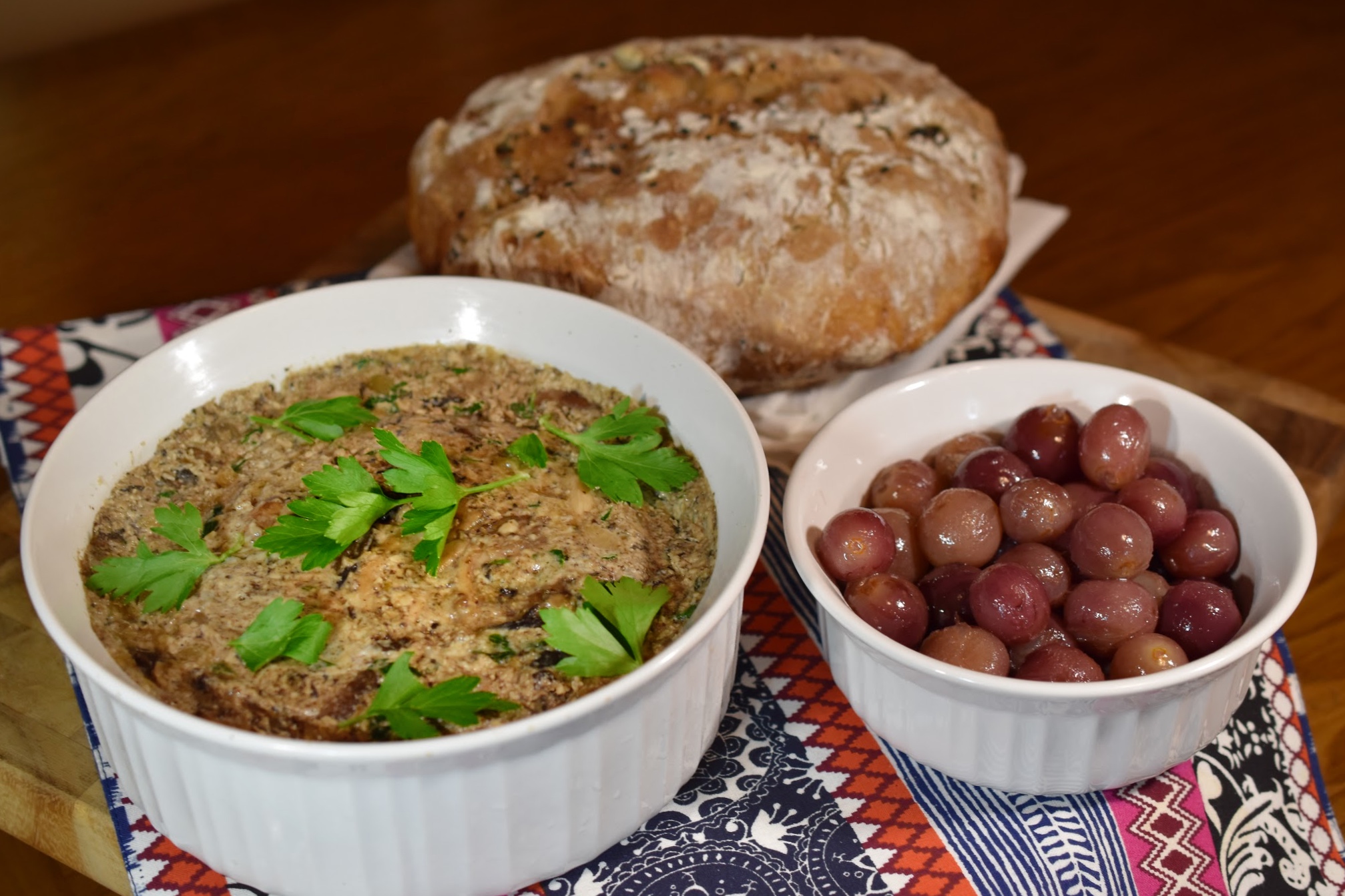
I chose a mushroom terrine with grape compote and a braised pork dish flavored with preserved lemon and rosemary. I made a meal out each and served the dishes with the wines over two nights, however, these were originally intended to be an appetizer and a main dish respectively. I’ve adapted each bit from the original. Here’s a little about each and how they worked with the wines.


Mushroom Terrine with Grape Compote and Cheese


While this is written as a terrine, which is certain to be the more elegant presentation, I kind of prefer the creamier texture of pâté, and you can easily go either way with this recipe. For the pâté-like texture (which is the direction I went), just use an immersion blender on the mushrooms, or run them through the blender. 
 
While the grape preparation is referred to as a compote, the grapes actually retained their shape fairly well, so they're more like glazed grapes. To turn this into a complete meal, I served it with a salad and sourdough bread I’d baked. I also had some Moses Sleeper cheese – a creamy, bloomy rind cheese that’s just a little funkier than a basic brie-style IMHO – so I included it in the spread.

  • Greg and I agreed that the rosé was the MVP in this spread. Regardless of the composition of the bite, it seemed to work quite well.
  • The red was the runner up. It worked with the mushrooms and wasn’t too bad with bites involving the cheese or even the compote, which could be tricky at times due to its sweetness.
  • The white version worked solidly well with bites that had mushrooms and cheese, as well as with the salad. It definitely did not work with the grape compote.


Braised Pork with Preserved Lemon, Rosemary, and Fennel


I love the flavor components in this dish, however, preserved lemon is an intense flavor and I shouldn’t have used as much as the recipe indicated. The way it was, it kind of took over, particularly in the leftovers after the flavors had sat together overnight. I’ve written it here the way I should’ve made it, with the quantity drastically reduced, as well as making a couple of other adjustments. My grocery store also didn't have pork loin, as requested by the recipe (and it would've been my preference), so I had to adjust for tenderloin. I give instructions for both below. I served it all with Israeli couscous and a salad.
  • The overall winner was the white CdR. It was refreshing with the pork and the food resonated well with the lemon and herb flavors in the wine.
  • Greg and I were split on the other two wines. I preferred the rosé, which I thought was refreshing, and matched the weight of the food. Greg felt it brought out a melon note in the wine that he didn’t care for.
  • He preferred the red as a close runner up, and the choice was particularly close for bites that were predominantly pork. I have to say that I was surprised – I didn’t expect the red to work with the flavors in the dish at all, and I had to agree that it wasn’t half bad.
To me, there is a floral note in fennel, and in turn, the dish brought out the floral notes in each of the wines. 
 

Mushroom Terrine with Grape Compote
Print

Mushroom Terrine with Grape Compote

By: Nicole Ruiz Hudson, Adapted from recipe by Inter-Rhône
Prep Time: 15 MinCooking Time: 45 Mininactive time: 8 HourTotal Time: 9 Hour

Ingredients:

For the Mushroom Terrine
  • 1.5 to 1.75 lbs of mixed mushrooms (The original recipe recommends porcini and a couple of different types of chanterelles. I used a mix of various kinds including a high percentage of cremini.)
  • ¼ cup olive oil
  • 3 shallots, finely diced
  • 3 to 4 garlic, finely diced
  • 1 bunch of parsley, chervil, or half a bunch of each, chopped
  • 5 sprigs tarragon (or substitute in 1 tsp dried), chopped
  • 1 cup cream
  • 1 packet of gelatin
  • Salt, to taste
  • Pepper, to taste
For the Grape Compote
  • 2 Tbsp butter
  • 1 Tbsp vinegar
  • 1 Tbsp sugar
  • 1 lb grapes, rinsed and dried (The original recipe recommends Muscat or Chasselas, but I used regular red table grapes here.)

Instructions:

For the Mushrooms
  1. Rinse mushrooms, trim off the woody ends of any mushrooms that have them, then slice up mushrooms.
  2. Sweat shallots in the olive oil in a large pan over medium/medium-high heat until beginning to turn translucent, then add in the garlic and continue to cook for about 30 seconds. Add in the mushrooms and season with salt and pepper. As the mushrooms begin to release cooking juices, spoon out about ¼ cup of the juices, and set aside. Cook the mushrooms until they’ve softened and the majority of the remaining liquid has been cooked off.
  3. Optional: For a terrine with a creamier, paté-like texture, blend the mushroom with an immersion blender (or regular blender).
  4. Sprinkle the gelatine in the reserved mushroom liquid and let stand for 1 minute. Add the mushroom-gelatine mix to a small saucepan along with the cream, whisking until the gelatin is fully dissolved, then reduce the liquid by about ⅓ over medium-high heat.
  5. Add the mushroom-cream sauce to the mushroom mixture, along with the chopped herbs. Taste and adjust seasoning. Pour the mixture into a terrine dish or small casserole dish. Weigh the terrine down with a board or a plate. Store in the fridge and allow to set for at least 8 hours.
For the Grape Compote
  1. Melt butter in a deep pan, then add in the vinegar, sugar, and grapes. Toss everything to dissolve the sugar and coat the grapes well. Cook for about 5 minutes, then set aside to cool.
  2. Serve the terrine and with the grape compote.
https://www.sommstable.com/2020/09/all-colors-of-cotes-du-rhone-with-famille-perrin.html
mushrooms, terrine, pate
appetizer
French
Did you make this recipe?
Tag @thesommstable on instagram and hashtag it #sommstable
Created using The Recipes Generator


pork, braise, fennel
dinner
French
Servings: 4 to 5
By: Nicole Ruiz Hudson, Adapted from recipe by Inter-Rhône
Print
Braised Pork with Preserved Lemon, Rosemary, and Fennel

Braised Pork with Preserved Lemon, Rosemary, and Fennel

Prep Time: 10 MinCooking Time: 60 MinTotal Time: 1 H & 10 M
Serve with a side of Israeli couscous as shown here, potatoes, or rice.

Ingredients:

  • 2 to 2.5 boned pork loin or tenderloin (however, note the two will require different cooking times)
  • 1 to 2 Tbsp butter
  • 2 Tbsp olive oil
  • Juice of 1 to 2 lemons
  • 4 garlic cloves, minced
  • 2 Tbsp honey
  • 6 sprigs rosemary
  • 6 bulbs fennel, quartered
  • 1 preserved lemons, sliced
  • Salt, to taste
  • Ground pepper, to taste

Instructions:

  1. Heat butter and oil in a large saucepan or Dutch oven over medium-high heat, add the pork and brown on all sides, then place on a separate plate and set aside.
  2. Reduce the heat in the pan to low, then add garlic and cook until it’s beginning to turn fragrant and lightly golden (1 to 2 minutes), then add in the honey, lemon juice, sprigs of rosemary, and 6 oz of water. Stir to combine, allow the mixture to come to a boil, then immediately reduce to a simmer. Add in the fennel and the preserved lemons, along with a generous pinch of salt and pepper.
  3. If you’re working with a pork loin, add it back to the pot now, cover, and cook over very gentle heat for 50 mintues to 1 hour 15 minutes (the final internal temperature should be between 145° F medium-rare) and 165°F for medium to medium well). If you’re working with pork tenderloin, the cooking time will be at the lower range of this, about 50 minutes.
  4. When the pork is cooked through to the desired temperature and the fennel is tender, remove from the pot. Taste and adjust seasoning. Allow the pork to rest for about 5 minutes, then slice and serve with the fennel and lemons and a little jus spooned on top.
https://www.sommstable.com/2020/09/all-colors-of-cotes-du-rhone-with-famille-perrin.html
Did you make this recipe?
Tag @thesommstable on instagram and hashtag it #sommstable
Created using The Recipes Generator


*****
Check out these previous posts and recipes related to the Rhône:
  •  A Simple Spring Lamb Feast with Maison Nicolas Perrin Crozes-Hermitage 
  • Cooking to the Wine: Les Vins de Vienne Gigondas with Gratinéed Shepherd's Pie  
  • Cooking to the Wine: Clos de Trias Ventoux with Bacon-Cheddar-Teriyaki Burgers  
  • 5 Nights of Rasteau  
  • 8 & $20: Braised Lamb Shanks and Lentil Stew  
  • 8 & $20: Ham Steaks with Peach-Tomato Succotash
  • A Wine & Cheese Night #MadeinFrance
  • French Wine 101 Cheat Sheet 
 And for a bonus pairing idea,  I've found that CdR Blancs tend to be quite good with Asian cuisines that aren't super spicy,  like this one from Guigal we had with Laotian take-out.

View this post on Instagram

#TakeoutTuesday: #ChampaGarden is one of our favorite local spots – the rice ball salad is always a go-to and I love the fried wrapped spring rolls! A bottle of @domaineguigal #cotesdurhoneblanc made a delicious pairing with recent dinner ordered in. . If you can, be sure to support your local restaurants during this difficult time.

A post shared by Nicole Ruiz Hudson, DipWSET (@nibblinggypsy) on Apr 21, 2020 at 12:49pm PDT


*****
 
The rest of the French Winophiles blogging group are exploring various aspects of Côtes du Rhône, hosted by Camilla of Culinary Adventures with Camilla. If you happen to see this post early enough, join our twitter chat at 8am Pacific Saturday 9/19/20 by following the hashtag #Winophiles.
  • A Côtes du Rhône from Franck Balthazar and A Deconstructed Pairing by Robin on Crushed Grape Chronicles
  • A Côtes du Rhône Tasting by Payal on Keep the Peas
  • All the Colors of Côtes du Rhône with Famille Perrin by Nicole on Somm's Table
  • A Trio of Côtes du Rhône Pairings by Cam on Culinary Adventures with Camilla
  • A Window Into Chateau-Neuf-Du-Pape Through Maison M. Chapoutier by Susannah on Avvinare
  • Back on the Rhône Again by Cristy.
  • Beef Tongue Stew with a Côtes du Rhône Gigondas by Wendy on A Day in the Life on the Farm
  • Côtes du Rhône and Clearwater Camping: Charcuterie in God’s Country by Terri on Our Good Life
  • Côtes du Rhône: Essential French Wines by Jill Barth on L’Occassion
  • Lamb Meatballs Paired with Côtes du Rhône by Jane Niemeyer on Always Ravenous
  • Leaning Savory with a 2016 Alain Jaume Côtes du Rhône by Linda Whipple on My Full Wine Glass
  • Rhone Roam #3: Crozes-Hermitage Is Syrah, Condrieu Equals Viognier Paired with Fall Fish #Winophiles by Gwendolyn Alley at Wine Predator
  • Rhône Wine with Brisket by David Crowley at Cooking Chat
  • Turkey Does the Côtes du Rhône by Andrea Lemiux at The Quirky Cork
  • What the Heck is Côtes du Rhône Villages? by Mel at Wining with Mel
 
Additional sources used for this post and further reading:
Wine Enthusiast: What is Côtes du Rhône?
WineFolly: The Guide to Côtes-du-Rhône Wine w/ Maps 
The Oxford Companion via JancisRobinson.com  
Wine-searcher.com 
Vino Vest: Cotes du Rhône (History, Top Wines, Prices, How to Buy) 
 
 
This post contains Amazon Affiliate links, from which I might earn a commission at no cost to you.
 

Older Posts Home

INSTAGRAM

Sign up for my mailing list!

Subscribe

* indicates required


Somm's Table 2017