Somm's Table

Perfect pairings from the other side of the equation.

  • About
  • Front of the House
  • Back of the House
  • Contact Us
Powered by Blogger.

A bottle of bubbly from Jansz Tasmania, pairs beautifully with a tartine topped with lobster, leeks, and mushrooms.


I’ve been taking a summer vacation from the blog for a few weeks, and as I’m reemerging this week, I think it’s only appropriate to toast with a bottle of bubbly. 

Today we’re going way, way, way Down Under. We’re picking up our exploration of Australian wine, and we’re going about as far south in the country as you can go to Tasmania. Australia’s Island State is known for its Devils, gorgeous scenery, and incredibly clean air. It’s also a pretty ideal place to make sparkling wine – so let’s go ahead and pop a bottle!

Cheers!


An Intro to Tassie Wine

Map borrowed from WineFolly.com


Tassie wines are still somewhat undiscovered gems. They represent less than 1% of Australia’s wine production, but they’re known for their quality, and as a result, this is one Australian winemaking region where demand outpaces supply. 

Despite the production numbers being small, winemaking history goes back to the early days of Australia’s European settlement. Its first vineyards were planted in 1823 – which gives it a potential claim over the Hunter Valley, which is generally cited as Australia’s oldest region. The issue is that after its early start, winemaking on the island pretty much dried up for about a century starting in the second half of the 1800s and then reemerged in the 1950s, so it hasn’t been continuous. 

Tasmania is way down south – located between the southern parallels of  40° and 44° latitude, about 150 miles (240 km) off the coast of Victoria. As you can probably imagine, things get can get chilly around these parts, so the grapes they focus on as pretty different from much of the rest of mainland Australia. Rather than Shiraz, Grenache, and Cabernet Sauvignon which like the heat, we see grapes that like the cool maritime climate take center stage here. Pinot Noir and Chardonnay take the top spots for plantings, and those are followed by Sauv Blanc, Pinot Gris, and Riesling. (We saw this in the Yarra Valley* in Victoria, and now we’re even farther south.) 

Pinot Noir and Chardonnay also happen to be the grapes most traditionally used for traditional method sparkling wines, and much like Champagne, cooler climates tend to be perfect for making bubbly as the grapes retain lots of crisp acidity. Lo and behold, Tasmania has developed a reputation for making some of the country’s best sparkling wines. Moreover, Australia’s first sparkling wine was made in Tasmania in 1826.

Tasmania’s landscape is dominated by dolerite-capped mountains which give the island its complex geography with many varying terroirs and micro-climates. Most notably, the mountains on the western side create a rain shadow that blocks the majority of rain from hitting the island’s seven major growing areas: North West, Tamar Valley, Pipers River, East Coast, Coal River Valley, Derwent Valley, Huon Valley / d'Entrecasteaux Channel. 


Thanks to the shifting and colliding of continents, plus volcanoes, and the movements of bodies of water, Tasmania’s soils are incredibly diverse. If you have a few minutes to geek out, check out this video for a mind-bending look at their geology.


The Wine: Jansz Premium Cuvée Brut Tasmania 


Alcohol: 12%  | Price: $19.99 (Purchased at K&L) 

Jansz Tasmania has been solely focused on sparkling winemaking since 1986. Champagne house Louis Roederer saw similarities between the climate in the Pipers River region, where the original vineyards are located, and that of Champagne, and they decided to partner with the owners of Heemskerk Wines to create Tasmania’s first premium, traditional method sparkling wine house. The Hill-Smith family purchased the property in 1998 and they’ve established it as one of the most highly regarded family-owned sparkling wine houses in Australia. 

The winery’s name pays homage to Tasmania’s namesake, the Dutch explorer Abel Janszoon Tasman who first sighted the island in 1642. When the vineyards were first established in 1975, they were named after Tasman’s ship, the Heemskerk. 

Image borrowed from Jansz's website.

The Pipers River region has a maritime climate but also gets a lot of sunshine hours, making it excellent for grape-growing. Cool winds from the Bass-Strait also helps to moderate temperatures in the vineyards from becoming too extreme both in the summer and winter, resulting in a long, cool, sunny growing season that allows the grapes to ripen slowly and develop their flavors.  The Janz vineyards here sit on a bed of free-draining red basalt soils, which also adds to the minerality of the wines. 

The wines are made in traditional method and they've put a little spin on the "Méthode Champenoise" and call their take "Méthode Tasmanoise":

Méthode Tasmanoise is the embodiment of every aspect of our unique place. It goes beyond terroir, beyond winemaking. Méthode Tasmanoise encapsulates our Tasmanian way of life and our respect for our environment, the natural wilderness, our clean air, fertile soils, pristine waters, the untamed oceans. It celebrates our unique crafts and the synergy between our wares and our surrounds. Most of all, Méthode Tasmanoise embraces the people that call our island state their home

The Hill-Smith family owns several wineries around Australia and they are all run sustainably. They lay out quite a few of the details of their practices here. The particular bottling we’re talking about today is certified sustainable and vegan friendly.

We opened the Jansz Premium Cuvée Brut Tasmania NV and were greeted with notes of lemon cream and apple blossom on the nose. On the palate, the wine was crisp and bright with a mixture of crunchy green and gold apples, lemon juice and curd, white peach, a hint of berry, a touch of toast and brown sugar, and lots of salinity.

For the price, this is a lovely bottle of bubbly.


Geeky Details

Blend: 66% Chardonnay and 34% Pinot Noir

Winemaking:  Hand-picking, gentle whole bunch pressing, cool fermentation, 100% malolactic fermentation, complex assemblage, and extended aging on lees after bottle fermentation, all combine to produce a stylish and complex wine. To maximize complexity in the final wine, batches are kept separate during winemaking. Released with a minimum three months of bottle age.

Winemaker: Jennifer Doyle
 
Details are taken from the tech sheet. Additional details can be found here and here. 


The Pairing: Lobster Tartines with Leeks and Mushrooms

In looking up what foods are commonly grown and produced in Tasmania, I discovered that it is one of the world’s leading suppliers of lobster and abalone. Pairing this bubbly with buttery lobster seemed like a perfect way to go! 


Lobster need not be fancy. In this case, I decided to serve it on grilled bread as a tartine, or open-faced sandwich, topped with sautéed leeks and mushrooms that I thought would bring out the wine’s more earthy notes and tease out hints of herbal flavors. In the end, the dish I came up with to pair with this wine is more about assembly rather than any elaborate cooking.

I ran into one tiny snag when I went to the grocery store – no lobster. No abalone either. I found my solution in the freezer section via Luke’s Lobster pre-packaged knuckle and claw meat. It proved quite tasty and very convenient. (I was addicted to Luke’s Lobster rolls when we lived in New York.) I simply thawed the meat and tossed it all in warm, melted butter and heated it gently, then sprinkled it with a bit of included seasoning. 


The only thing on this dish that required real preparation was the leeks and mushrooms, and that only requires only a few ingredients and little attention. Despite this, the combo becomes really saucy and flavorful. I use the same mix in many different ways including to top all kinds of proteins, mixed into a grain bowl, on a sandwich, or in an omelet or quiche. If you add more stock or water it becomes a fabulous base for a soup, and if you stir in a touch of cream when it comes off the heat, it's fabulously completely decadent. 

In this case, as I mentioned, I layered the leeks and mushrooms on slices of buttery grilled bread, along with arugula, and the buttery lobster meat. The pairing was just lovely and worked even better than I’d hoped. The wine would show different facets with each bite. With the buttery sweet lobster meat the plumper, riper fruits note would come out. The char on the bread at times brought out the wine’s toastiness. At other times, earthier and more minerally notes came out to play. Mostly, it was simply delicious and refreshing with the tartines. 

***** 


*****

The rest of the World Wine Travel blogging group (#WorldWineTravel) is exploring the wines from Tasmania, as well as other Aussie Sparklers and Stickies this month. Check out the rest of their posts:

  • Lori is tasting “Tasmanian Sparkling and Egg Rolls” at Exploring the Wine Glass
  • Camilla is showcasing “Tasmania + Hawaii: Celebrating with an Island Wine and Island Eats” at Culinary Adventures with Camilla 
  • Jeff shares how we can “Discover Rutherglen Stickies” at Food Wine Click!
  • Robin is pairing “Sparkling Wine from Jansz Tasmania and a Tassie-inspired seafood curry pie” at Crushed Grape Chronicles
  • Kat has a “Surprise! South Australia Pét-Nat is on the Rise” at The Corkscrew Concierge
  • Susannah is featuring “Tasmanian Chardonnay” at Avvinare
  • Deanna is popping an “Australian Sparkling Wine from Deviation Road” at Wineivore
  • Linda is having “Sparkling Aussie Shiraz as summer draws to a close” at My Full Wine Glass
Additional sources used for this post and extra reading: 
  • WineTasmania.com
  • Oxford Companion to Wine via JancisRobinson.com
  • Wine Searcher
  • How Stuff Works: Ultimate Guide to Tasmanian Wine Regions

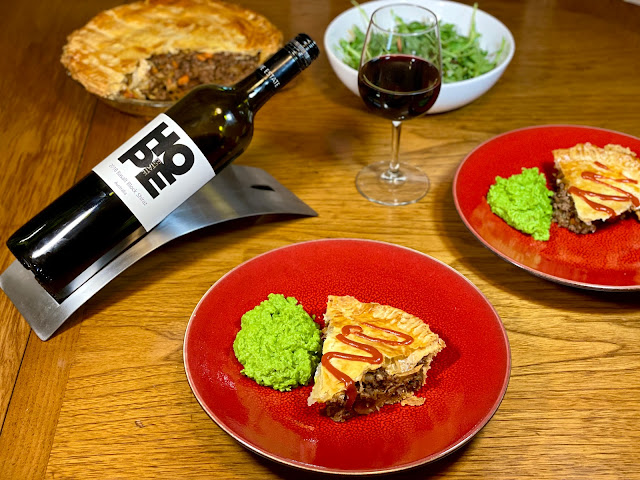
A bottle of Shiraz from Hope Estate and a meat pie bring back happy memories from time spent in Australia.


Once upon a time, in 2009, Greg and I spent four months in the land down under. Greg took advantage of a study abroad program while in business school and spent a semester at the University of New South Wales (UNSW) in Sydney. I quit my job and went with him. They were four of the best months of my life.


He arranged his schedule to give us plenty of time for exploring while we were in Sydney, and I’d spend the days he was in class wandering Sydney on my own. When the schedule allowed for more time, we’d rent a car and go road trips to branch out further. On top of that, the other students at the business school, the Australian Graduate School of Management (AGSM), were a very welcoming, interesting, and fun lot. They planned many events and excursions that we were able to join in on. Among these was a wine tasting tour of the Hunter Valley, which is only a couple of hours north of Sydney. 


On that particular excursion, one winery stood out from the rest – Hope Estate. It was definitely our favorite of the day. We were also distinctly aware that we’d been a bit tipsy by the time we got there, as it was the last stop in a long day, so it was possible that our preference had been set thanks to the extra good vibes we were feeling by that point in the day. However, we’d brought back several from the trip, and our favorite was borne out as we tried the wines again back at our flat over the next few weeks – this time with clearer heads. 


Hope Estate back in 2009


This was all before I’d dived into the wine life, but the name stuck with me – it is a fairly easy one to remember. I’ve recently seen an occasional bottle from the estate pop up at local wine stores and on Wine.com, which has been a fun blast from the past. 


A Brief History of the Hunter Valley 


Map borrowed from Winefolly.com


We’ll be talking about the Hunter Valley again soon, so I’m going to break up the discussion on the region into two parts. Today we’ll take a look at its history. 


The Hunter Valley is Australia’s oldest winemaking region. This makes sense, given the region’s proximity to Sydney, where the first Europen arrived and established the first penal colony. Prior to their arrival, the Wonnarua  ("people of the hills and plains") inhabited the upper Hunter region for at least 30,000 years. The Worimi held the northeastern shores, and the Awabakal were located around the southeastern shores. 


The Hunter River was first spotted by European settlers in 1797 by accident. Lieutenant John Shortland was on a search for escaped convicts when he spotted the river. The Hunter Valley went on to become a valuable source of timber and coal for steamships. A land route to the area wasn’t discovered until 1820. By 1823, there were already about 20 acres of vineyards planted along the Hunter River in what is now the Dalwood /Gresford area between the towns of Maitland and Singleton.  


James Busby, the 'godfather' of viticulture in both Australia and New Zealand, changed the game in the 1830s. He returned to New South Wales after an extensive tour studying European wine regions with around 500 (pre-phylloxera) vine cuttings. Busby’s brother-in-law William Kelman took up one of the first official land grants at Kirkton on the Hunter River using a replica set of these cuttings. By 1840 the Hunter Valley’s vineyard area had boomed to 500 acres (200 hectares) and its reputation as a wine-growing region had been established. 


The Pokolbin area, the region Hope Estate is in, had established itself as a quality zone by 1930. Sadly, war and economic turmoil slowed down further expansion. Things wouldn’t pick up again until the second half of the 20th century, but there are now over 150 wineries in the Hunter Valley.


Hope Estate Basalt Rock Shiraz


Hope Estate. Image borrowed from the Hope Estate website.


It would appear that Hope Estate has expanded quite a bit since we visited. In addition to wine, they have spirits, beer, and a 20,000-seat amphitheater that hosts major concerts. Maybe I didn’t see it or just didn’t notice because of my tipsy state, but there wasn’t anything so grand in my memories. 


Hope Estate was established in 1994 by Michae Hope, a former pharmacist who gave up his career to make wine. He and his wife Karen purchased their first vineyard at Broke in the Hunter consisting of 30 acres of vines on a 250-acre property. They then purchased a winery in 1996 and the first vintage of Hope Estate was released in 1997. Additional vineyards have been added since, including in Victoria and Western Australia, and a new winery followed in 2006. All of the wines are made from estate-grown grapes  in their Hunter Valley headquarters


I ordered a bottle of the Hope Estate Basalt  Rock Shiraz 2018 from Wine.com ($16.99) and I opened it the same it arrived. I was honestly a little worried about the wine because it arrived on a very hot day and it tasted a little off when we first opened it. (Wines can get “cooked” if they spend time in extreme heat.) Luckily, it improved quite a bit once we cooled the bottle down a little bit and allowed the wine to breathe. It’s a good reminder that serving temperature can make a big difference – the ideal range for big red wines is generally considered to be around 63°-68°. 


Once the wine had a chance to open up, it showed notes of blackberry, plum, bay leaf,  and charcoal on the nose. On the palate, the fruit was juicy with just a touch of jamminess. Savory touches of bay leaf, cedar, olives, and black pepper joined in on the mid-palate, softened by a touch of vanilla, and there was a hint of stony charcoal hint on the finish. It was reminiscent of Rhône Syrah in style, but with riper fruit notes. It was medium + in body with balanced acidity.


Geeky Details


Taken from the tech sheet. 


Alcohol: 14%     

Blacked: 100% Shiraz 

Winemaking:  Estate Grown – 100% Family Owned - The Basalt Block is located in the Hunter Valley among the hills of the Broken Back Mountain Range. The range was formed by volcanic activity leaving the red soil rich with basalt. This mineral-rich soil produces the finest quality, low-yielding grapes which Hope Estate winemakers use to make this single vineyard wine. Matured in new and old French hogsheads for 13 months. 


The Pairing: Aussie Meat Pies


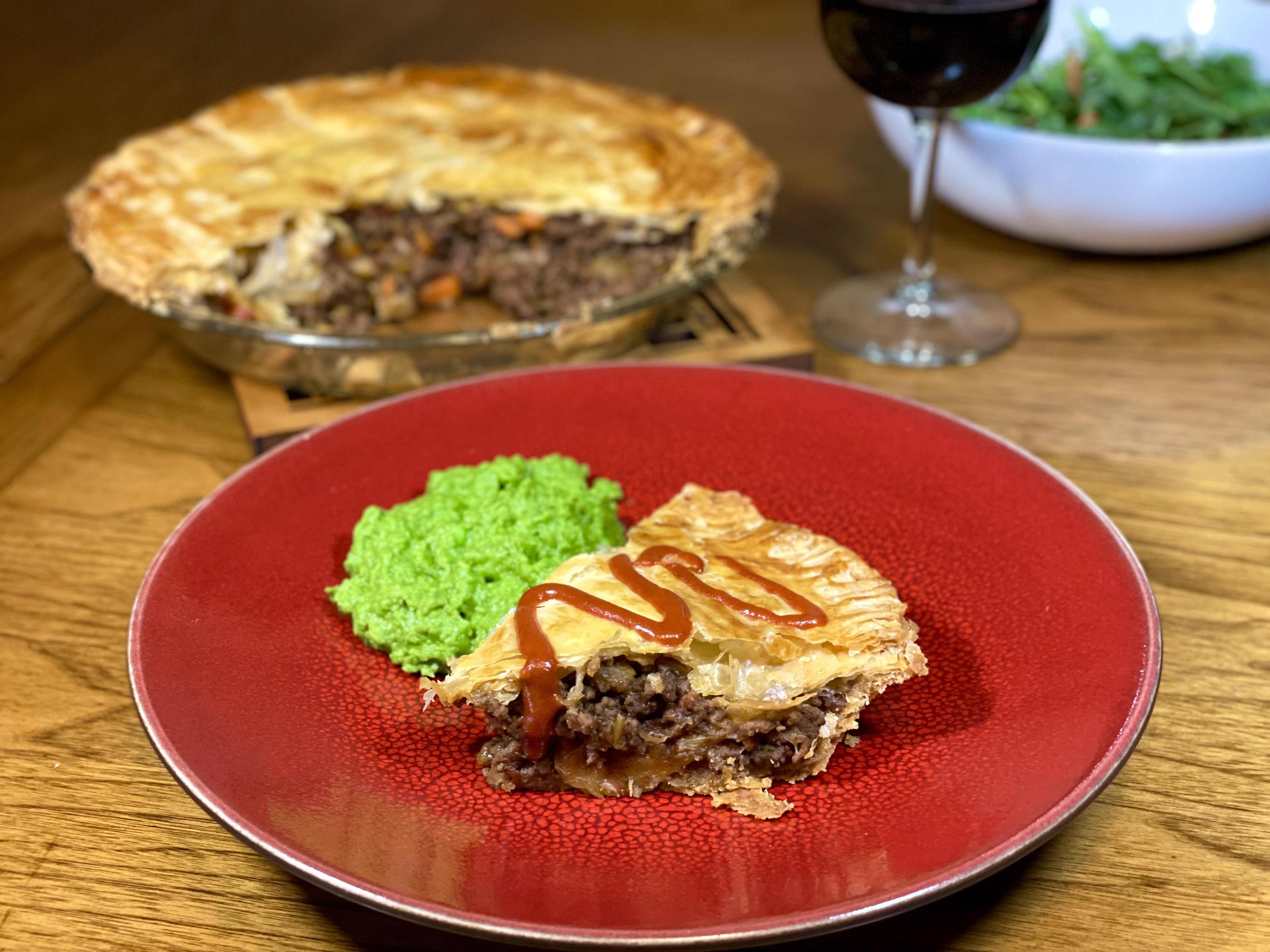
While in Oz, we developed a taste for the meat pies that are so ubiquitous there. They’re inexpensive, portable, and delicious – what’s not to love?! Food trucks, street carts, and food stalls everywhere sell these hand-held pies filled with beef in gravy. You might find different flavor variations and additions to the filling; for example, in addition to the classic, I often liked mushroom and curry flavors as well. The pies are often served topped with mushy peas, or you might drizzle on ketchup or hot sauce. 


Greg and our friends Marc and Dan eating meat pies in the CBD.


I thought I’d recreate the memory to pair with this wine. I’d originally intended to go all in and make individual hand-held pies, but it was crazy hot out on this particular day and it got to me, so I decided to cut myself a break and make a single large pie in the end. Hand-held pies will have to wait for another occasion.  


I looked at quite a few recipes for meat pies before creating my own. I noticed many recipes used a combination of short-crust for the bottom shell, and flaky puff pastry for the top and I decided to go this route, but other versions choose to just use one or the other. I made the short-crust but used store-bought puff pastry. (Making puff pastry is a headache I do not need, thank you very much!) Feel free to go with what appeals to you. 


I also made mushy peas to go with the pies. I often forget how easy it is to make this and how satisfying the results are. Heat a bag of thawed frozen peas in a pot, add a bit of flavoring, then mash them up using an immersion blender or food processor – that’s it! A little sriracha was the final topper to the ensemble.  


The wine paired nicely with the meat pies. To be honest, it worked best with the pie alone, without the hot sauce or the peas, but the combo is just too good to pass up. 


*****

The World Wine Travel (#WorldWineTravel) blogging group is exploring the wines of New South Wales this month. Be sure to check out their posts:

  • A Scruffy Shiraz with Urban Smoked Short Ribs by FoodWineClick!
  • Chili de Moira + Beelgara Winery Estate Shiraz 2017 by Culinary Adventures with Camilla
  • Yellow Tail Wine is from NSW, Who Knew?? by A Day in the Life on the Farm

Additional sources used for this post and extra reading:

  • Winecountry.com
  • Wine-searcher.com
  • Jancisrobinson.com
  • HunterValley.com
  • Sydney.com
  • Australia.com
  • HunterValley.com
  • HunterValleyTourSydney.com
  • Kazzit.com

A Mediterranean-style orzo salad gets a simple leftover makeover incorporating shrimp and bacon to match a Chardonnay from Australia's Yarra Valley.


Sometimes, there’s no need to reinvent the wheel in order to get a delightful pairing. 

I recently opened this bottle of Oakridge Henk Vineyard Chardonnay 2019 and tasted it in order to create a pairing, but quickly discovered that there was a good one already sitting in my fridge. I’d made an orzo salad for a dinner party a couple of days before and it occurred to me to have a bite while I was tasting the wine and quite liked the match – I particularly enjoyed the way the wine picked up the flavors of the Parmesan cheese. 


I decided to run with the match, but made some additions in order to both tie the wine and the food more closely together and to switch things up to and reinvigorate the leftovers. Roasted shrimp with bacon pieces made for an excellent leftover makeover that came together quickly and turned this side into a main dish. To grab every last bit of bacony flavor, I also quickly tossed a couple of large handfuls of greens in the rendered bacon fat and incorporated them into the salad as well.


Oakridge Henk Vineyard Chardonnay 2019

Established in 1978, Oakridge is located in Australia's Yarra Valley. I wish I could’ve found more on the history of the winery, but they farm sustainably making use of cover crops, compost teas,  and they have an insectarium, all of which help to minimize the use of synthetic inputs and improve the health and biodiversity of the vineyards. They have 10 hectares (about 25 acres) of vineyards and also source grapes from carefully selected sites.

The Henk Vineyard Chardonnay comes from a north-facing site comprised of the red volcanic soils in the town of Woori Yallock. The wine was made in a traditional style. Grapes were whole-bunch pressed directly into 500-liter French oak puncheons where it was naturally fermented and then spent 10 months maturing on the lees for texture. Find more information on the 2020 vintage of this wine here.


I found this to be a lively and classic Chardonnay at a reasonable price. (I purchased this bottle at K&L in SF for $25. ) Notes of lemon cream, baked apples, and stone greeted me on the nose. Similar notes returned on the palate, although the apples were leaner, crisper, and less baked,  with notes of green pears and light herbs joining in. The lees added creamy texture and body to the crisp fruit notes elevated by lots of acidity. 

As I mentioned up at the top, the wine loved the Parmesan cheese, and the combination of seafood and bacon each spoke to different aspects of the wine’s textures and flavors. I think it resonated particularly well with the bacon’s smoky notes. A white pepper note in the wine also came out when sipped alongside the food. Having a few extra lemon wedges on hand to squeeze on top of the food while eating is also not a bad idea. I added avocado to a third iteration of the salad using up the last bit of leftovers, and I also think this would’ve worked quite well with the wine. 


Yarra Valley

Map borrowed from WineFolly.com


The Yarra Valley is located about an hour northeast of Melbourne, making it a  convenient side trip if you’re ever visiting the city. It’s one of Australia’s oldest winemaking regions, with the first vineyards in the area having been planted in 1838. However, the wines go against the grain of the general image we might have of Australian wines. It’s generally cooler than most of Australia’s wine regions, so it’s better known for cool-climate-loving Pinot Noir and Chardonnay, and increasingly Riesling. However, the region features a lot of variation in terms of altitude, site exposures, and soils, which makes it conducive to different grapes and styles, so you will also find Shiraz and Cabernet Sauvignon grown there as well, but they’re often made in leaner, elegant style.


Other Pairing Possibilities

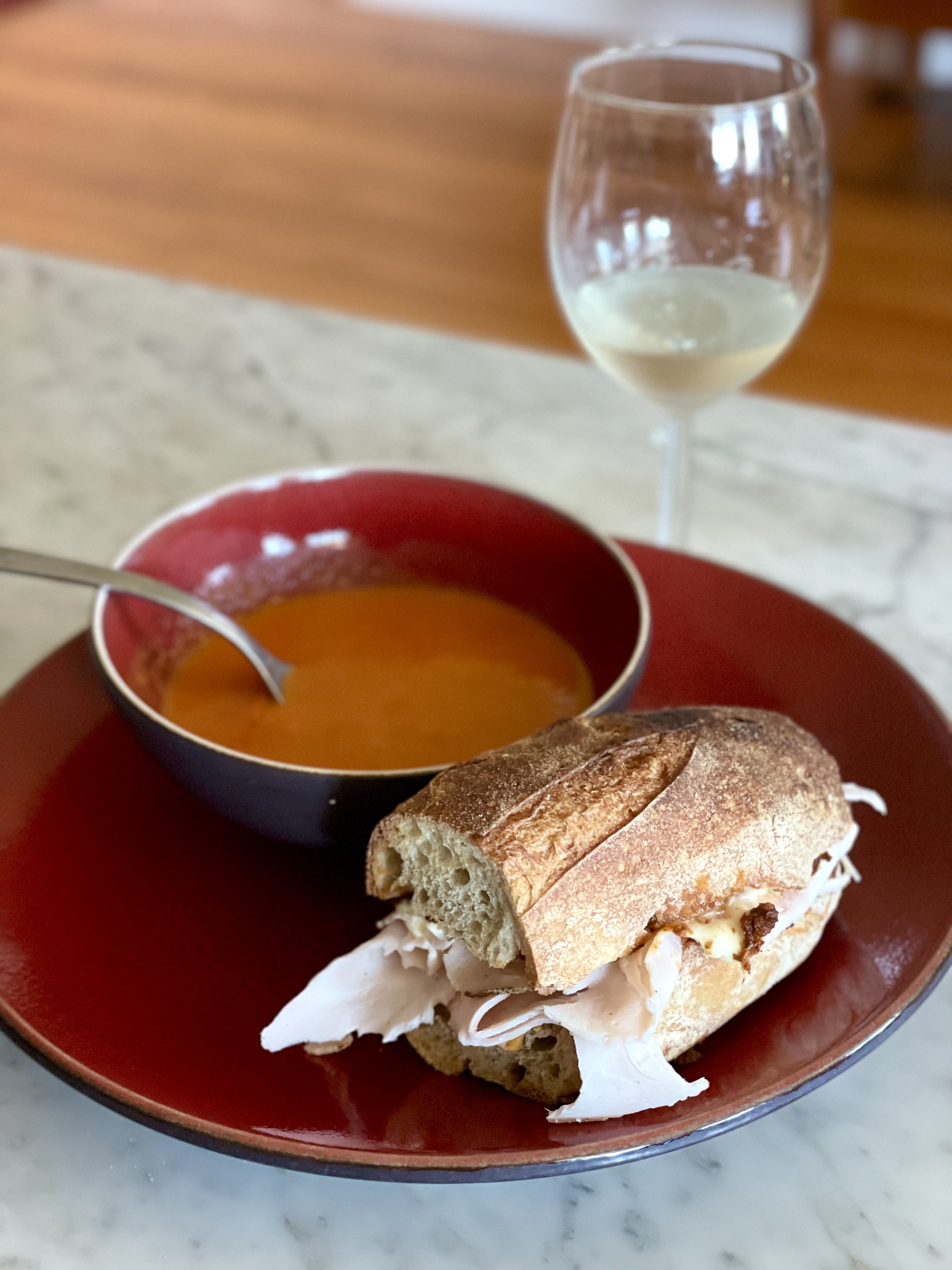
After I initially tasted the wine, I enjoyed the last remnants in my glass with a turkey sandwich with a red chermoula spread and tomato soup and that was a solid match too. 


I also tend to love Chardonnays that are lightly oaked and/or have lees contact with roasted chicken, and I think this would certainly be a good candidate. Seafood topped with butter should also be delicious. 

*****


*****


The rest of the World Wine Travel (#WorldWineTravel) blogging group is exploring white wines from Victoria this month. Be sure to check out the rest of their posts:

  • Wendy of A Day in the Life on the Farm paired Peach Chicken and a Chardonnay from Fowles Farm 
  • Cam of Culinary Adventures with Camilla shares Steamed Mussels with a Citrus Drizzle + Punt Road Pinot Gris 2019 
  • Terri of Our Good Life is enjoying Summertime Charcuterie with Whipped Feta + Butterfly Effect Rose Grenach
  • Jeff of Food Wine Click! serves up Frisk Prickly Riesling with Hoisin Pork
  • Deanna of Wineivore is talking about Mango + Tahblik Old Vine Marsanne
  • Gwendolyn of Wine Predator says "Say Hey to Summer with Victoria’s Fowles Wines “Ginger Prince” Sparkling Rosé Paired with Smoked Egg Salad "   


Additional sources used for this post and extra reading:
  • The Oxford Companion to Wine via JancisRobinson.com
  • Wine-searcher.com
  • Australianwine.com
  • Wineyarravalley.com
Older Posts Home

INSTAGRAM

Sign up for my mailing list!

Subscribe

* indicates required


Somm's Table 2017