Somm's Table

Perfect pairings from the other side of the equation.

  • About
  • Front of the House
  • Back of the House
  • Contact Us
Powered by Blogger.

Contratto Millesimato and Vitello Tonnato Sous Vide. Photo by Greg Hudson. Recipe by Nicole Ruiz Hudson


In my last post, I shared a virtual tour of Contratto, Italy’s oldest sparkling wine house, based on the visit Greg and I made there during our recent trip to Italy. While tasting through the wines, our guide Elisa mentioned that she really enjoyed the Contratto bubblies with the classic Piedmontese dish Vitello Tonnato. Her favorite version of this dish happens to be the one made by Giovanna Rivetti, Contratto and Spinetta’s vineyard manager and in-house chef. Giovanna is also the sister of owner and winemaker Giorgio Rivetti. I knew I’d have to try it!

Vitello Tonnato is really a kind of surf ‘n’ turf involving cold, thinly sliced veal with a creamy, mild tuna sauce. It’s served chilled or at room temperature as an appetizer or a light main dish. We had several versions of it while traveling around the northern part of the country, and it seemed to be one of those dishes that each cook put a slight spin on within a generally accepted parameters.


Vitello Tonnato served at Marchesi di Barolo. Photo by Nicole Ruiz Hudson
Vitello Tonnato served at Marchesi di Barolo. This style's more in keeping with Elisa's description of her preferred take on the dish. These slices were ethereally thin and light. Extremely delicate. This will be the goal next time.  
Vitello Tonnato at Al Morro in Rome. Photo by Nicole Ruiz Hudson
Vitello Tonnato served at Al Moro in Rome. Vitello Tonnato is a Piedmontes dish, so a Roman version is likely to be less traditional. However, since I was trying to make due with the ingredients I had available, my version this time was more reminiscent of this style.

I wrote Elisa (with whom we’d had such a lovely time) to see if she could send me Giovanna’s recipe and she very kindly obliged. Funny enough, I happened upon it by accident after the fact on La Spinetta’s website.  Nonetheless, the version Elisa sent me had some extra tips and tricks, so I’ve combined the two below.

I was eager to try this version, but sadly, the season was against me. I checked with several stores and butchers in the area to find the right cut of veal, but I think it’s late in the year to find many options. All I could find was thinly cut slices of leg meat as one would use for scallopini. I was disappointed to not try Giovanna’s version, but was determined to roll with the punches.

Since the slices I had available were thin and could potentially be overcooked, I thought this dish might be a good candidate to prepare sous vide, which allows you set your desired finished cooking temperature exactly. As the dish is served cold and doesn’t really require browning, I didn’t think would be necessary to sear them in a pan afterward, and so could essentially go straight to plate after cooling down post cooking in the circulator.

I way generally pleased with the outcome of my little experiment, and it wasn’t unlike some of the versions we had in Italy. The one downside to my sous vide version (as least when using the thin-cut veal slices) is that you lose the pretty, rosy color achieved by using Giovanna’s version. (It might be doable if you sous vide a larger cut of meat, but that’s for a future experiment.) The plus side is that my method here allows you to go from cooking to plate in just over an hour, where the classic version is typically made a day in advance.

Given that I’d be losing out on the rosy color, I tried to infuse a bit of extra flavor while cooking the meat, so I tossed some aromatic veggies and herbs in the cooking bag with the veal. I happened to have leeks on hand and I’m always looking for uses for the green portions, so used them here. You could just as easily use green onions, onion slices, or chives.

I made and chilled the sauce while the veal cooked. I based my quantities for the sauce on this recipe by Andrew Zimmerman on Food & Wine, as Elisa hadn’t been able to find quantities as they normally make it to taste. To be honest, you really don’t need them. You can just mix the ingredients bit by bit and adjust until you get a flavor you like. You’ll likely have some sauce leftover. This was not an issue for us and we loved this sauce! I found it lovely spread on toast with grilled tomato slices, and I also mixed some into a tuna salad for a little tuna on tuna action.


Contratto Millesimato and Vitello Tonnato Sous Vide. Photo by Greg Hudson. Recipe by Nicole Ruiz Hudson


I served it all with a very simple salad on top. To make this a full meal, I added simply roasted potatoes and thick slices of country bread grilled with butter on top. (This particular loaf came from Base Camp Bakery. If you happen to be in Oakland, their awesome bread is very worth searching out!)

I’m still hoping to the make Giovanna’s version, but I will have to wait until spring or summer and I will report back when I do.  
 

THE WINE PAIRING


On our visit to Contratto, Elisa had specified For England Rosé as her favorite match for this dish. Sadly, this one is a bit hard to find near me. Contratto’s Millesimato Pas Dosé 2012 is more easily available, and given that this is their “all-purpose” pairing wine, it seemed worth giving it a shot.


Contratto Millesimato and Vitello Tonnato Sous Vide. Photo by Greg Hudson. Recipe by Nicole Ruiz Hudson

Full disclosure, while not exactly a submitted sample, I ultimately got a bottle of the wine through my friend Julie who works with Skurnik, the importer. It was actually also on Julie’s recommendation that we found our way to Contratto on our trip. (Thanks on all fronts, lady!) All opinions, as always, are my own and no compensation was received.

This combo made a lovely match! The Millesimato was crisp and refreshing as expected, but also had enough body to match this light meat dish. We both thought the pairing worked particularly well when the buttery bread was included, as it spoke to the wine’s toasty and ripe pear notes. Yum!

For a full description of this and other Contratto wines, please see my last post.


OTHER POSSIBILITIES


On La Spinetta’s site, they recommend Chardonnay as a pairing for this dish, and I could absolutely see this making a good match. To be honest, I think a wide range of white wines could work quite well here. 

Elsewhere on our travels, we had Vitello Tonnato with Barbera, Langhe Nebbiolo, and other light red wines. If you’re looking for a red here, the key is keep it light! A big red is likely to quickly overpower the delicate flavors of this dish, and aggressive tannins would be way too much for the veal.

Bubblies are among the most versatile of food pairing wines, so I think you can try this wine with A LOT and come out happy. We discussed a few other options for this one last time.


MONEY TALK


The average price for this is $27, which I think is a very good price for a high quality traditional method sparkling wine, making it a very Solid Value and maybe even an Overachiever.


When you think of Italian sparkling wine, I’m going to guess that the first thing that comes to mind is Prosecco, or maybe Moscato. So it might be a surprise to find out that Italy’s oldest sparkling winery makes their wines in the traditional method (i.e. in the style of Champagne). ‘Oh, of course!’ some of you might say, ‘In Franciacorta!’ Nope. Contratto, Italy’s oldest operating sparkling winery happens to be in Piedmont–the same region that’s better known for burly reds like Barolo and Barbaresco, as well as Barbera and Nebbiolo.  

Internal courtyard at Contratto.

Contratto dates back to 1867 when Giuseppe Contratto moved to the town of Canelli in Piemonte and started building his winery. Conttrato had moved from Aosta, a tiny region that borders France, so it has always had a lot of French influence. It stands to reason that Contratto would have come across French wines there. In any case, he fell in love with Champagne, and he got it in his head to make wines in the Champagne-style in Italy. 150+ years later, the winery he started is still making bubbles. With so much history, the winery was named a UNESCO World Heritage Site in 2014. 

Antique wine press at Contratto.

(Technical clarification: There is some contention as to who has the title for oldest sparkling wine producer in Italy. I was told that it’s possible that there are other producers that have existed as an entity for longer, but have moved locations. Contratto has always been in the same location, so the winery itself is the oldest for the style in the country.)

Another antique press.

Greg and I had the chance to visit on our recent trip to Italy and tasted through several of the wines. We will definitely get to the wines and pairing suggestions in a bit. However, the tour itself was really fun and fascinating; so before we get to the wines I’d like to invite you on a little photo tour of the winery. I highly recommend going if you’re ever in the area!

Antique bottle of Contratto "Asti Champagne."

Canelli is in the province of Asti, which is known for making wine from Moscato grapes. Therefore, in the beginning, Contratto made its wines using Moscato grapes and called it “Asti Champagne.” The term was used until 1941, when the region of Champagne won the sole right to use the term “Champagne.” The winery continued to make traditional method Moscato regularly as part of their range until 2007, but now it’s only occasionally made in small batches.

You might be thinking, “Moscato? Isn’t that sweet?” Well yeah, usually; but at the time this was very much in keeping with the Champagne style since most Champagne at the time was sweet.

For a while, Contratto also experimented with using other typical Piemontese grapes like Barbera and Nebbiolo for their sparkling wines, but eventually moved into using the international sparkling grapes, Pinot Noir and Chardonnay.

Vintage Contratto wine labels.

Here we have a line up of old Contratto labels. Just as in Champagne, the English market drove the preference for drier styles of sparkling wine. For a long time, the British Empire was Contratto’s largest export market. In 1930, Contratto created a wine called "For England" to suit their tastes. (The winery says this wine was was less sweet than its Champagne counterparts at the time.)  Today, Contratto makes white and rosé “For England” cuvées.


Look at all those bottles! Our guide Elisa calls this her “favorite sea" and I can see why.
Here’s a shot with me in it for scale.


If you ever wonder why traditional method (or as it’s known here, Metodo Classico) tends to be so expensive, well . . . you’re about to see many reasons. One is that after the base wine is made, the second fermentation that makes the wine sparkle has to happen in bottle. Then you have to wait around while all the lees (or yeast cells) that perished creating all the bubbles, lend their yummy, toasty flavors to the wines. All those bottles take up A LOT of space.

The Contratto family ran out of room in the original winery space in 1898. They expanded by digging into the hills behind the winery. This turned out to be a great thing, because the underground caves keep temperatures nice and constant. 


This is what a traditional method wine looks like after all those yeasts have done their job. Not the pretty, clear bubbly you’re used to right? To get the wines nice and clear, the bottles are slowly turned, little by little, in a process called riddling (developed by the Veuve Clicquot) until all the lees are trapped in the neck of the bottle. 

Contratto bottles on riddling racks.

At Contratto, this is all done by hand, by one guy. His name is Mauro and he has been doing it for 40 years, since he was 16 years old. He can riddle 300 bottles per minute!
I was assured that Mauro has no issues with carpal tunnel.

One also has to wonder what will happen when Mauro retires.


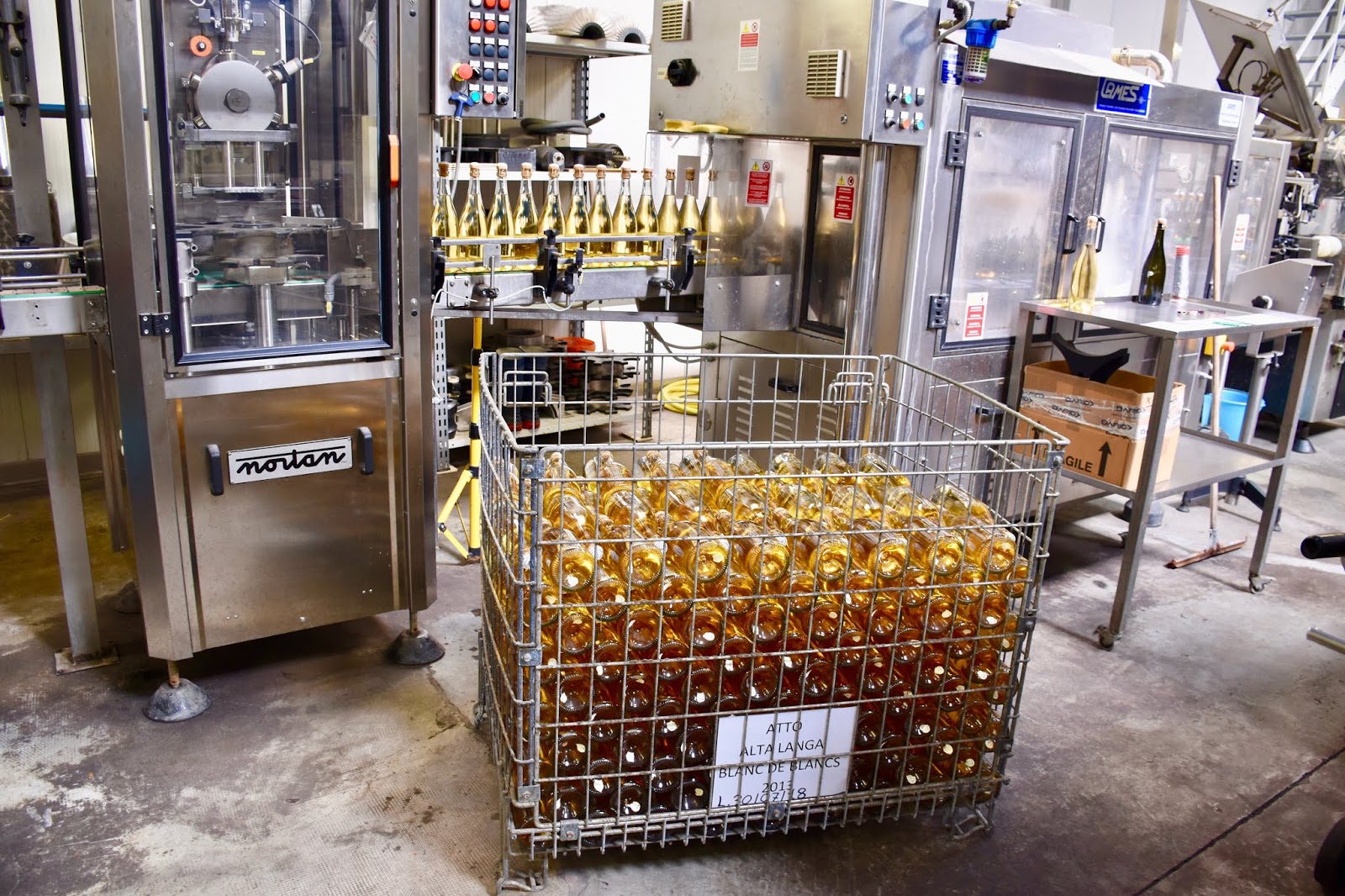
Once the lees are trapped in the neck of the bottle, you still have to get them out to get a clear wine. This process is called disgorgement. Nowadays, the neck of the bottle gets frozen (usually by dipping it in dry ice or some variation) to create a little “yeast-cicle,” as I like to call it, which then gets popped out. In old times, the disgorgement occurred in this contraption above. Nothing went to waste, though. The wine that shot out in the process was then collected and used to make Vermouth. More modern machinery is used for disgorging and corking the bottles these days.


Once the wine is disgorged, the bottle gets topped off with more wine prior to being corked. The wine is then ready to be shipped. However, Contratto feels that the light that can come in through their clear glass bottles that is used for some cuvées is not good for the wine. So before shipping them off, Angela here wraps the bottles to “give them sunglasses” for protection. 


Altogether, each bottle is touched no less than 30 times by human hands, and more in the case of certain cuvées.


This is the oldest part of the winery, which they call “the Cathedral.” The cellars were restored in 1993/1994.


Modern sparkling wine really couldn’t exist until the technology existed to make glass strong enough to contain all that pressure in the bottle. Before that, making bubbly was a dangerous proposition. Even today, explosions still occur.

Just a few more old-timey contraptions for making sparkling wine.

As you can see, a lot of care is taken in making these wines. In addition, they use sustainable farming practices for growing the grape, and natural yeasts are used for both first and second fermentations. You’ll also find the disgorgement date on the capsule of each bottle. Contratto says their wines can be drunk for 10+ years.


Now for the wines! We also discussed pairing suggestions with Elisa as we tasted through.

Millesimato Pas Dosé 2012


- 80% Pinot Noir, 20% Chardonnay
- Minimum 48 months on the lees.
- No dosage. Only wine is added in the final top off.  This is the case for all of today’s wines.
- Average price: $27

Tasting Notes: Ripe pears, biscuits, toast, a little tangerine, and a hint of salty lemon. It has a round body and finish coming from the Pinot Noir.

Pairing Suggestions: Great with fried chicken! This one is very all-purpose and complements anything with a fatty component.  It works really well with spicy foods. Of course, this being Italy, pizza is also recommended. It was lovely with the salami that was served alongside our tasting. This is also a great match for seafood, as would be the case for all of today’s wines.

Elisa recommends leaving this one in bottle for a bit. She noted that the wine is really beautiful immediately after disgorgement, but then needs a little time to come back together. 

For England Rosé Pas Dosé 2012


- 100% Pinot
- Only free run juice is used and the wine spends about an hour on the skins to achieve the pale salmon color.
- Minimum 32 months on the lees.
- Average Price: $29

Tasting Notes: Peaches, blood orange, gold and pink flowers, cherry, and brioche.

Pairing Suggestions: Elisa noted that this is awesome with salmon on a bagel with cream cheese and capers, so bust it out for brunch. Or try my salmon and goat cheese gougères.

It was delicious with the toasted hazelnuts on the table. It’s also a good match for carne crudo, as well as the traditional Piemontese appetizer, Vitello Tonnato. Stay tuned–this is coming up in my next post!

Riserva Special Cuvée Pas Dosé 2010


This is a new cuvée. Its first bottling was in 2009.
- 95% Pinot Noir/ 5% Chardonnay. All old vines.
- Only free run juice is used. The Chardonnay for this wine spends 7 months in French oak, while the Pinot matures in stainless steel. (In general, I believe most of their base wines are matured in stainless steel.)
- This wine spends 7 years on the lees.
- Price: I couldn’t find price info for this wine as it is probably still too new a cuvée. 

This wine nows falls under the Alta Langa DOCG, which is a new DOCG created in 2011 to focus on traditional method sparkling wines in Piedmont.

Tasting Notes: There’s a hint of gunpowder with lots of super toasty notes coming from all that extra time on the lees. Fruit notes of baked peaches, baked pears, and gold apples. Hints of toasted nuts, deep golden flowers, and salted butter.

Pairings: We’d been enjoying an aged Castelmagno cheese, an ancient style of Piemontese cheese. (The winery is actually a partner in producing one.) It worked with all of the wines, but it went to another level this aged bubbly.

Beyond that, this is this is a sparkling that can stand up to some meats as well. Crudo and carpaccio for sure, but possibly even a steak, or an Italian Bollito Misto.

De Miranda Moscato  Metodo Classico 2011


This was a very special treat. Remember I said that they still make limited quantities of the traditional method Moscato? We got to taste a bit from the very last bottle they had of the 2011.

- 100% old vine Moscato.
- Free run juice only.
- The first fermentation is halted at 5.5% ABV. It goes through a long second fermentation for 4-5 months until it reaches 7% ABV, making this a sweet cuvée. At that point the fermentation is halted again by a drastic chill down.
- The wine spends 4 years on the lees while held at very cold temperatures.
Price: N/A

Tasting Notes:  Orange blossoms and honey. It was surprisingly delicate with creamy, silky mouthfeel like satin. Lots of pastry notes and an array of dried tropical fruits, stone fruits, and candied citrus.

Pairing suggestions: This wine was also magical with the Castlemagno, but in a very different way from the Special Cuvée. I’m sure it would be just as amazing with other strong cheeses. Of course, this is also an ideal match for fruit dessert.


La Spinetta Barolo Vursu Vigneto Campe 2009


How’d that Barolo get in there?  Giorgio Rivetti, the owner of La Spinetta, bought Contratto in 2011 from Bocchino, Canelli’s distillery, after consulting for the winery since 2007. The Contratto family sold him the winery in 1993, but they remain connected as members of the family still live on the property.

- 100% Nebbiolo. Average age of vines is 50 to 55 years.
- Winemaking and aging: malolactic fermentation in oak. Aged in entirely in new, medium toasted French oak for 24 months. Transferred to stainless steel vats for 9 months before bottling. Aged in bottles for another 12 months
- Average Price: $124

Tasting Notes: Quite perfumed with red flowers, orange blossoms, rosemary, a little forrest floor, and tomato paste. On the palate, cherries surrounded by balsamic and cedar notes, a little eucalyptus, tobacco, and black tea. “Many leather bound books.”

Pairing Suggestions: Richer meat dishes like braised beef, osso buco, and game.

 
Contratto bottles on riddling racks in their caves. Photo by Greg Hudson. 
Photo credits on today's pics split between Greg Hudson and Nicole Ruiz Hudson.


We've been on a role with the bubblies lately. Check these posts out for lots of inspiration for the holiday season!

5 Champagne Toasts
The Big 10, Champagne, Burgundy, and #OTBN
Crémants for Going Out and Staying In (Psst! They're Your New All-Purpose Bubblies!) 
If you're in the mood for Prosecco instead, check out  Three Nights of Prosecco Holiday Fun: Carbonara, Sabering, Friends, with a Side of Pear Endive Spears 

And for more sparkling wine pairings, check out my 8 & 20’s for:
 8 & 20: Buffalo Chicken Meatball Sliders
 8 & 20: Saffron-Tomato Chicken Croquetas
4-Layer Caviar Dip with Potato Chips and Other Happy New Year's Appies!

*****

The rest of the Italian Food Wine Travel Group (#ItalianFWT) is exploring sparkling wines from Italy. The group meets on Twitter the first Saturday of every month. Feel free to join the chat simply by following the  #Italianfwt hashtag on Twitter this Saturday, December 1st at 11am ET/8am PT.
  • Lynn Gowdy of Savor the Harvest suggests Italian Sparkling Wines To Try #ItalianFWT
  • Jeff of foodwineclick want us to add some Sparkle Your Dessert with Moscato d’Asti #ItalianFWT
  • Jen of Vino Travels~An Italian Wine Blog will be sharing Spaghetti and Clams with a Flight of Adami Prosecco #ItalianFWT
  • Cam of Culinary Adventures with Camilla will be dishing up Italian Bubbles + Lasagna Bianca #ItalianFWT
  • Wendy of A Day In the Life on a Farm will be Celebrating Leftovers #ItalianFWT
  • Kat of Bacchus Travel and Tours show us how Italian Sparklers to Light Up Your Holidays #ItalianFWT
  • Lauren of the The Swirling Dervish gives us A Trio of Italian Sparkling Wines for Your Holiday Table #ItalianFWT
  • Gwendolyn of the Wine Predator serves up Bellavista! Shrimp Pasta with Italian Sparkling Wine From Franciacorta #ItalianFWT
  • Susannah of Avvinare extolls the virtures of Lambrusco in Lambrusco - Perfect for the Holidays #ItalianFWT
  • Katarina of Grapevine Adventures offers A Superior Sparkling Christmas With Bele Casel #ItalianFWT
  • Martin at ENOFYLZ Wine Blog is sharing A Distinctive Duo of Italian Sparkling Wines #ItalianFWT
Older Posts Home

INSTAGRAM

Sign up for my mailing list!

Subscribe

* indicates required


Somm's Table 2017