A trip to Allegrini's Villa della Torre in Valpolicella outside Verona leaves us feeling like Renaissance nobility while sipping Valpolicella, Amarone, and other Veronese wines.

Let’s step into a mansion with beautiful rooms, gardens, and a hidden grotto, all surrounded by vines. Well, of course, you’ll need some wine to sip during your visit. Welcome to Allegrini’s Villa della Torre.
Back in 2018, Greg and I took a magical road trip around central and northern Italy. We visited many wineries, and I’ve been slowly sharing those experiences here over time. Every single one of our visits was wonderful, but perhaps none with more majestic vibes than Villa della Torre in the Valpolicella region, not far outside of Verona. Stepping into this space, you can easily imagine yourself as a part of the Veronese nobility attending a glamorous party during the Renaissance. Sampling the wines doesn’t hurt one bit.
Note: Our visit was comped as I’m a member of the wine industry. No other compensation was received and all opinions are my own.
VALPOLICELLA CHEAT SHEET
Before jumping into details on our visit, let’s take a quick look at the region. It’s one of Italy’s most famous regions, and wine has been made here since the time of the ancient Greeks. Today wines span a wide gamut in styles and prices. Amarone is its most celebrated style today, but interestingly, the region was historically best known for sweet wines.
 |
| Map borrowed from Winefolly.com |
Location: Valpolicella is a red wine region in Veneto, in northeastern Italy. As mentioned, it’s an easy drive from Verona, which makes a great base point from which to explore the area. The region then stretches westwards towards Bardolino and Lake Garda.
 |
| Sunset in Verona. |
This is a generally hilly region, with vines growing in a series of valleys descending from the pre-alpine Lissini Mountains north of Verona and into the plains further south. As is often the case, the best wines tend to come from the hillier sections. Three valleys – Fumane, Marano, and Negrare – form the historical center of the region and make up the Classico zone. You’ll find this designated on labels as Valpolicella Classico DOC.
Grapes: Valpolicella’s wines are traditionally blends. Here are 5 grapes to know, although a few others are permitted:
- Corvina - This is the region’s star player and is regarded as both the finest and the most traditional. It must make up 45-95%. It’s known for its sour cherry flavor and light, smooth tannins. The name comes from the word corvo for “blackbird” or “crow.”
- Corvinone - It was previously thought to be a clone of Corvina, but as implied by the name, the bunches and the grape are bigger. In 1993, genetic testing proved that it was in fact a distinct variety. It can replace up to 50% of the Corvina requirement.
- Rondinella - This grape is invited to the party because it’s reliable and prolific. It’s fairly resistant to diseases in the vineyard, so it can be useful, but it’s not particularly well-regarded for its quality. (Our guide at Allergrini, Elisa, mentioned that they’d phase it out if they could.) It must make up 5% to 30% of the blend. It can bring herbal and floral aromas to the blend. The name of the grape comes from the word for “swallow”.
- Molinara - This grape has a fairly non-descript flavor profile, and while it’s still allowed, it’s no longer mandatory and it has fallen out of fashion. It does tend to have a lot of freshness and acidity, which can be useful, but the grape doesn’t have much structure otherwise, and it has a tendency to oxidize easily. The name comes from an old word for “flour mill.”
- Oseleta - This is an indigenous grape that is starting to make a resurgence. It has lots of structure and tannins thanks to its very small, compact, thick-skinned berries. Continuing the theme of most of these grapes, the name means “little bird.” We were told that they used to be planted for birds to eat.

4 Key Styles: This is where things get interesting. One of the distinguishing features of the Valpolicella region is the wide range of styles made with the grapes, which range from light and easy drinking, to very deep and brooding. Let’s take them in ascending order of intensity:
- Valpolicella DOC (Plus Classico and Superiore)- These tend to be light to medium-bodied with light tannins and the characteristic sour cherry flavor. They can be made in nouveau style, like Beaujolais, which will be similarly light and fruity, and can even take a light chill. In general, Valpolicellas tend to not be expensive, and they’re incredibly versatile for food pairing purposes. Without knowing anything else about a producer, look for wines from the "Classico" zone for your best bet on quality. The term “Superiore” requires that wines be aged for a minimum of one year in wood and that they reach a minimum alcohol level of 12%.
- Valpolicella Ripasso DOC - These are sometimes referred to as “baby Amarones” because they sit in between Valpolicella and Amarone in weight and style. This style came into being in the late 20th century, so it really hasn’t been around all that long. It’s made by taking the pomace (grape skins and seeds) left over from a fermentation of recioto or Amarone and adding it to a baa tch of Valpolicella wines to macerate together. This helps to beef up the structure, complexity, flavor, and color of the wines by boosting the alcohol level, glycerine, tannins, and other phenolic compounds. It also takes on some the flavor characteristics of the dried grapes used in Amarone and recioto. Ripasso essentially means “re-pass,” for that second pass over those grape skins.
- Amarone della Valpolicella DOCG – Grapes used for Amarone are first dried out for weeks of even months via the appassimento method, concentrating and intensifying the flavors of the juice. Most passito wines you find in Italy and elsewhere are dessert wines, but Amarone wines are vinified dry. These wines are deep, dark, intense, and complex. They can also be pricey – not surprising given the amount of work that goes into them. Given that these are the region’s most famous wine, it’s somewhat surprising that they didn’t emerge as a commercial style until the late 20th century. For a more in-depth look at the style and its history, check out this post.
- Recioto della Valpolicella DOCG – These wines are made in the exact same way as Amarone, but they’re generally sweet instead of dry. Winemakers halt the fermentation before all of the sugars are converted into alcohol. The wines have flavors of raisin, figs, dried cherry, and lots spices, but they can develop savory flavors over time. Similar to Amarone, they can age for a looong time. Interestingly, while there isn't a lot of recioto made these days, it is the style the region was historically best known for.
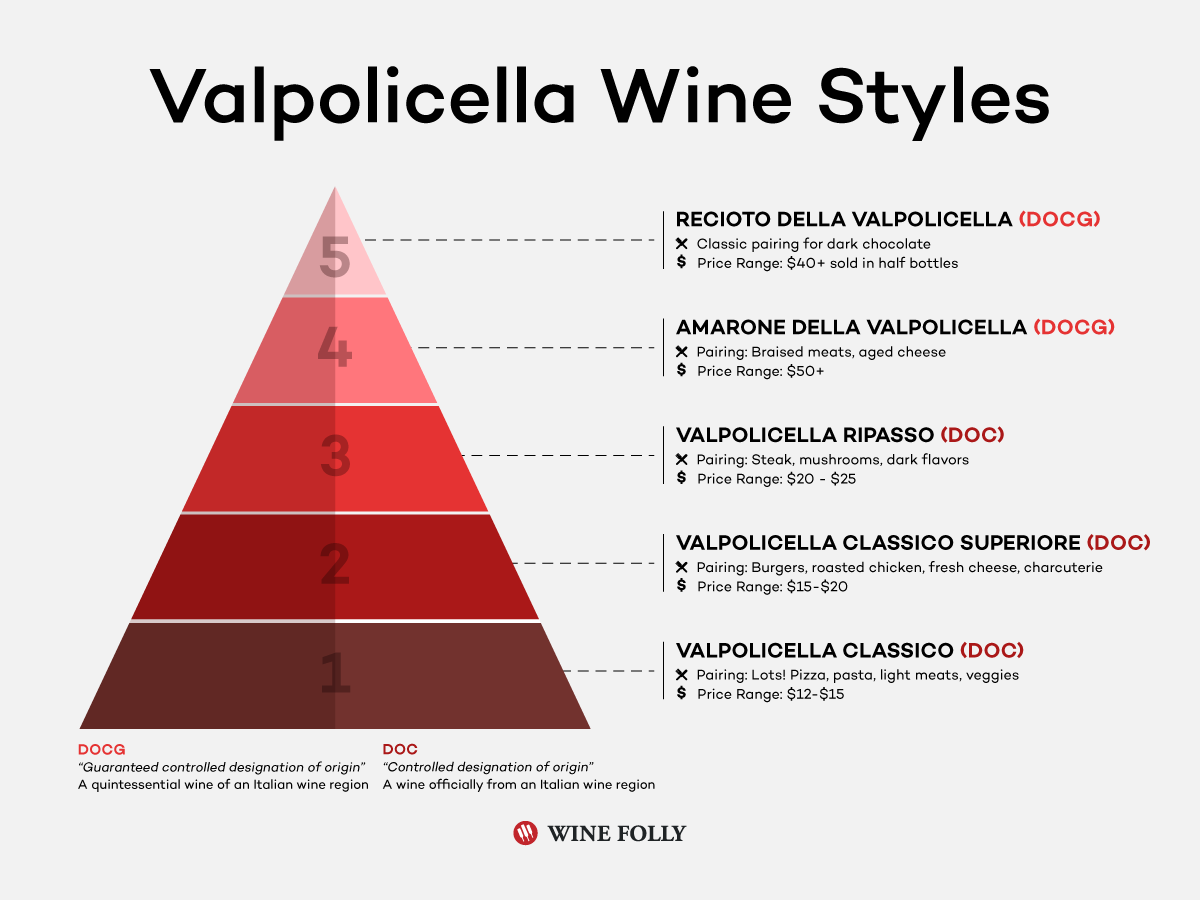 |
| Infographic borrowed from Winefolly.com |
Wines that fall outside these regulations, fall under the appellation of Veronese IGT.
It should be noted that white wines are also made in the area, but these fall under the various Soave appellations.
A VISIT TO ALLEGRINI’S VILLA DELLA TORRE

The Allegrini family has been active in Fumane and Valpolicella Classica since the sixteenth century. The company as it is today is the legacy of Giovanni Allegrini, who has since passed it on to his son and daughter, Franco and Marilisa, along with Silvia, the daughter of his late son, Walter. It continues to be family-run today.
Allegrini's winemaking style blends together modern innovation and traditional methods. They were among the first to limit yields in their vineyards, and they do not use chemicals.


They’ve built modern facilities in which to dry their grapes in a controlled environment. They also experiment with styles and techniques in their winemaking, and make quite a few wines that fall outside the prescribed DOC/G regulations, such as making single-varietal wines.
 |
Allegrini built a modern facility in which to dry their grapes for Amarone so as to preserve freshness and avoid botrytis and other molds. Corridors between the stacks allow for ideal ventilation, and the crates are designed to do the same. |
Like the family, the house has a long history and is an excellent example of Italian Renaissance architecture. The house was commissioned by Giulio della Torre, an intellectual and humanist, and a member of a rich and powerful Venetian family. Construction began in 1490.


Nowadays, it is the base for Allgrini’s hospitality programs. Giovanni Allegrini purchased vineyards nearby starting in 1967, and Marilisa purchased the villa a little over a decade ago for its current use. This make complete sense, as in addition to being intriguing and beautiful, it is conveniently located near both their vineyards and winemaking facilities. They host parties and events at the villa, as well as cooking classes, and there are even bedrooms that have been restored and are available for overnight stays.

We arrived at the villa on a beautiful morning, before setting off with Elisa, our guide, to see the rest of the operation including their estate vineyards and some of their winemaking facilities. Afterward, we sat down to taste some of their wines accompanied by a selection of bites to sample alongside them. Once we’d wined and dined, we had the chance to explore the house and the grounds.
 |
| The fireplaces at Villa della Torre are key features that helped make the house famous. The gigantic sculptures are carved from individual, single blocks of stone. |

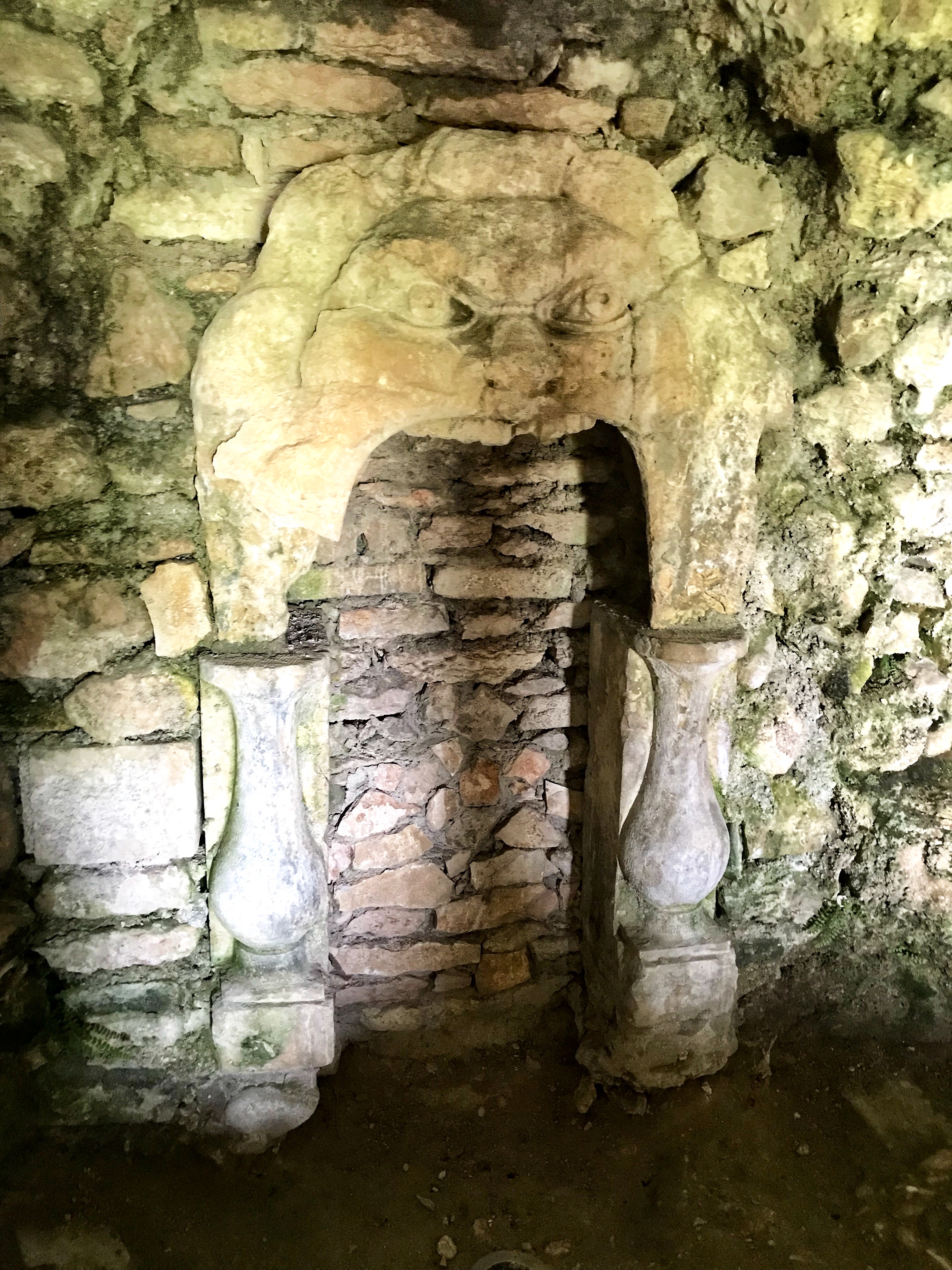
For a more in depth, virtual tour of the villa, check out this article.
THE WINES
 |
| Tasting line-up at Allegrini |
Valpolicella Classico 2017
Blend: 70% Corvina, 30% Rodinella | Average Price: $15
Winemaking: The grapes undergo soft pressing, then fermentation in stainless steel tanks at a controlled temperature. Aging is carried out in steel, then wines spend 2 months in the bottle.
Find additional details here. (Note that the wine has a different label in the US)
Tasting Notes: This wine showed aromas of bright sour cherry with light flowers and a hint of spice on the nose. Candied strawberries and raspberries joined on the palate. It was light, fresh and bright with very light tannins
Pairings: Drink as an apperitiff, pair with white meat, pasta with fresh tomatoes and basil, soup with vegetables, and even fish.
Palazzo della Torre Veronese 2017
Blend: Corvina 40%, Corvinone 30%, Rondinella 25%, Sangiovese 5% | Average Price: $18
Winemaking: This wine is basically their answer to a ripasso wine, but it uses a variation of the apassimemto technique. The wine is produced via the technique of double fermentation: most of the grapes are vinified at harvest, while the remaining part is left to partially dry (appassimento). In January the wine produced, blended with the crushed grapes, begins a second fermentation. It then ages in second use French oak barriques for 15 months, in large barrels for 2 months and is fine-tuned for 7 months in the bottle. It can evolve for 10 to 12 years in bottle
Find additional details here.
Tasting Notes: The wine showed notes of licorice, hints of bitter herbs, bramble, and black cherry. It was quite velvety on the palate, with hints of vanilla and spice, dark cherries, red plums, and white pepper.
Pairings: Pasta with ragu, carbonara, or all'amatriciana. Roast beef. Medium-aged cheeses. Sweet and sour flavors, mushrooms, pumpkin and Amarone risotto.
La Grola Veronese 2015
Blend: 90% Corvina, 10% Osiletta | Average Price: $33
Winemaking: Meant to demonstrate how a modern wine with depth and structure can be made in the regions without the appassimento techniques. Can age a very long time. Fermentation takes place in steel tanks with periodic daily pumping over. The wine ages in second use French oak barrels for 16 months and in large Slavonian barrels for 2 months, followed by ageing in the bottle for 10 months
Find additional details here.
Tasting Notes: Pomegranate, sour cherry, juniper, fennel, red licorice, a hint of smoke, moist tobacco hit on the nose. All of these come back on the palate, but there is a mix of fresh and baked fruit notes, balsamic herbs, and a little spice. This is a more rustic style than the previous wines.
Pairings: Medium-aged cheeses, duck, pheasant, game, and mushrooms.
La Poja Corvina Veronese 2012
Blend: 100% Corvina | Average Price: $116
The name of the wine means “the falcon.”
Winemaking: This wine come from grapes planted at the top of the La Grola vineyard, from a limestone plot, overlooking Lake Garda a few kilometers away. The grapes are picked in the last phase of the harvest. After maceration on the skins for about 25 days, the wine ages in new barriques for 20 months and for 8 months in large Slavonian barrels, followed by bottle ageing for 10 months.
Find additional details here.
Tasting Notes: Plush fruits, plum, juniper, cedar, a hint of mint, and spice rose from the glass on the nose. Rich pomegranates, red plums, raspberry sauce, hints of herbs, spice, and dusty cocoa joined on the palate. This wine had a lot of finesse and elegance.
Pairings: Gamey meats, aged cheeses, or as an after-dinner drink with a cigar.
La Poja Corvina Veronese 2010
Blend: 100% Corvina | Average Price: $98
Tasting Notes: This vintage showed lots of juniper, mint, and tobacco, as well as black cherry, dark plum, and spice on the nose. Cherry sauce, raspberry, licorice, chocolate, and balsamic herbs joined in on the palate. Luxurious and could still age longer.
Pairings: In addition to those shared for the 2012, lamb, and could even work with mint jelly thanks to those aromas on the nose.
Amarone Classico 2014
Blend: Corvina 45%, Corvinone 45%, Rondinella 5%, Oseleta 5% | Average Price: $80
Winemaking: The best grapes, harvested in the upper hillsides, are left to dry in the drying facility for about 4 months. After a soft pressing, the wine ferments in steel tanks and ages in new barriques for 18 months, in large barrels for 7 months, and in the bottle for about 14 months.
Find additional details here.
Tasting Notes: Complex aromas of tobacco, kirsch, currants, dried mint, and black licorice draw you in on the nose. These flavors are joined by dark chocolate, spices, and medicinal herbs on the palate. Very velvety.
Pairings: Really good with aged cheeses, braised meats, polenta, bollito mixto with pearà sauce (see below), a typical Veronese sauce made with bone marrow, pepper, and broth.
 |
| Snacks accompanying our tasting at Allegrini. |
Allegrini also has additional lines, as well as properties in Tuscany. We tasted some of their Poggio al Tesoro wines from Bolgheri, which were also very good, but I’m going to limit myself to the wines from Valpolicella here so that we’re not here all day.
MORE VALPOLICELLA PAIRINGS
Much like Pinot Noir or Gamay, Valpolicella is a good wine to grab when you have to pair one wine with lots of different foods at once or when you don’t what you’ll be having. Its light to moderate tannins and medium body allow it to work with everything from fish to meat.
For these very reasons, we ordered several bottles while we were in Verona with dinners that had multiple components or courses. It also never hurts that these wines tend to be reasonably priced.
 |
| We enjoyed a bottle of Zenato Valpolicella Classico Superiore 2016 with Risotto all'Amarone and other delicious dishes at Antica Bottega del Vino. This is a MUST stop in Verona for winelovers. This spot's history dates back to the XVI century. The wine list is a giant tome and quite amazing to look through. |
 |
| We had an incredible dinner at Locanda di Castelvecchio. We went here on Elisa's recommendation to enjoy bollito misto and roasted meats. Bollito misto is a feast of boiled meats that's typical of northern Italy. The meats are served with a selection of sauces alongside the meats. In Verona, pearà sauce is a key accompaniment to the dish and we fell in love with the stuff. It's made with bread crumbs, bone marrow, stock, olive oil and black pepper. We enjoyed it with Tenuta Chiccheri Valpolicella Superiore 2011, which worked easily with all of the different cuts and styles of meat. |
Valpolicella is also one of my favorite wines to have with pizza and it’s a great pick to go with meatballs and burgers too.
 |
| Sausage pizza with Zenato Valpolicella Superiore 2017 |
 |
| This Allegrini Valpolicella 2020 paired deliciously with a meatball sandwich on ciabatta with tomato sauce and mozzarella. |
Also check out this 8 & $20 recipe for Lamb Chops with Mint Gremolata and Minty Mashed Peas I created a while back for Wine Spectator that pairs with Allegrini's Valpolicella. You can also find a few more details here.

For more posts related to our Italian road trip check out:
- Exploring Castello di Brolio & On Location Pairings From the Home of Chianti Classico
- Cooking to the Wine: Barone Ricasoli Brolio-Bettino Chianti Classico & an Italian Twist on Pulled Pork
- Classically Contratto: Beautiful Wines from Italy's Oldest Sparkling Wine House
- Contratto Millesimato and Vitello Tonnato Two Ways
- One Afternoon in Lugana at Podere Selva Capuzza
- The History of Amarone at Cantina Valpolicella Negrar, and Domìni Veneti Amarone Classico with Decadent, Braised Lamb Shanks
- The Sweet Side of ILatium Morini: Sette Dame Recioto di Soave Classico with an Old-Fashioned Strawberry Cake
- Cooking to the Wine: Pezzuoli Lambrusco Grasparossa di Castelvetro with Antipasto Pizza
- Brunello, a Book, and a Boston Butt: Frescobaldi CastelGiocondo Brunello di Montalcino with Italian Braised Pork
- An Afternoon at CastelGiocondo
- Lunching and Tasting at Fattoria dei Barbi
- Touring & Dining at Marchesi di Barolo
*****
The rest of the Italian Food, Wine, and Travel (#ItalianFWT) blogging group is exploring the wines of Valpolicella this month. Check out the rest of their posts:
- Cam of Culinary Adventures with Camilla is serving up Fagioli all’Uccelletto + Allegrini's 2019 Valpolicella
- Cindy of Grape Experiences is Romancing the Menu: Valpolicella, Classic Lasagna and “Letters to Juliet”
- Jennifer of Vino Travels shares Cooperatives In Valpolicella with Cantina di Soave
- Nicole of Somm's Table adds Allegrini: Feeling Posh in Valpolicella at Villa della Torre.
- Gwendolyn of Wine Predator...Gwendolyn Alley posts Wine Media Conference 2022: A Family Reunion in Italy with Ca’ dei Frati 2016 “Pietro dal Cero” Amarone della Valpolicella.
- Wendy of A Day in the Life on the Farm writes Le Calendre Valpolicella; Romance is not just for special occasions.
Additional sources used for this post and extra reading:


