Somm's Table

Perfect pairings from the other side of the equation.

  • About
  • Front of the House
  • Back of the House
  • Contact Us
Powered by Blogger.

A steak dinner and a comparative tasting of four bottles of Nebbiolo – yes, please!

Please note, that some of the wines in this post were provided as media samples. No other compensation was received and all opinions are my own.


One of the great things about tasting with a group of friends is that you can open and taste a lot more bottles simultaneously without worrying that the wine will go to waste. If those friends are willing to go along with you on a wide-geeky ride, it’s also a perfect chance to do some comparative tastings. I admit that I often force friends to join me in conducting these types of experiments. Luckily, when we head off to the Culinary Cabin, only the lightest arm twisting is required. 

The Culinary Cabin is the loving name we’ve bestowed on our friends’ family vacation house in Tahoe, and the weekends we spend there tend to be all about food and wine experimentation. During our most recent trip, I “forced” my friends into a comparative tasting of four Nebbiolo-based wines “for science.” The guys in the group prepared a steak dinner to accompany the wines. Everyone was very upset.


NEBBIOLO 


Nebbiolo is Piedmont’s superstar red grape. It’s the grape behind this northern Italian region’s blockbuster wines, Barolo and Barbaresco. The grape’s trademark aromatic signature is notes of “tar and roses.” That tells you something about the combination of delicate and rustic elements this grape tends to bring together.  Tart cherries, leather, anise or licorice, earth, mushrooms, leather, and herbs are all also common flavor elements in Nebbiolo wines. I personally also often get a little orange peel in the mix. 

In addition, the grape tends the show super racy acidity and grippy tannins. While the wines tend to be deeply flavored and highly structured, the body of the wines is often sleek and can be anywhere from medium-bodied and translucent in a way that belies the punch the wines can pack in, to deep and full-bodied, depending on how it’s made and where it’s from. 

The wines often show orange color even when they’re young, but thanks to the mix of high acidity, alcohol, and tannin, the wines can easily age for decades in the bottle. In many cases, particularly in the case of Barolo and Barbaresco, the wines really need that time to chillax and can taste super tight otherwise. They’re kind of like a person that’s super anxious and wound-up in their youth, but learns to unwind and relax with age. If you don’t have the time to wait for your Barolos and Barbarescos to age in a cellar, you’ll at least want to decant them with plenty of lead time before dinner. I’ll often decant them hours in advance when I manage to think of it. The high levels of tannins and acidity also mean, in my mind anyway, that these wines are best served with a meal as these elements smooth out when enjoyed with a hearty meal. Enjoy these wines with foods that are meaty or have some fat, like creams or cheese, as these will help to calm the tannins.

We’ve taken a look at this grape several times before. Check out this post for more on the grape and this one for more on the history of Barolo. 

Nebbiolo can be a fussy grape to grow, a fact that contributes to the high prices some Nebbiolo- based wines tend to command. Nebbiolo is thought to take its name from the Italian nebbia (or nebia in Piedmontese), meaning "fog," and it really seems to relish the foggy conditions of its home region as it doesn’t seem to express itself with quite the same complexity anywhere else. (The name might also be a reference to the bloom that appears on ripe Nebbiolo berries.)

However, while it likes that fog, it also needs a good balance of sunshine as well to ripen fully, so it’s typically given the prime spots on hillsides that get the most sun exposure. It’s a diva. 

Map borrowed from Winefolly.com.

Barolo and Barbaresco might be the celebrity icons of Piedmont, however, they’re not the only show in town. It’s grown across Piedmont, as well as in Valle d’Aosta and Lombardy. While Barolo and Barbaresco tend to be pricey, thankfully, there are other Piemontese appellations making Nebbiolos that are both easier on the wallet and are approachable at a much earlier stage. Here are three: 

  • Roero DOCG – This region is just across the Tanaro river from Barolo and has sandier soil. It’s known for making high-quality Nebbiolos that tend to be lighter and a bit fruitier in style with less intense tannins.
  • Nebbiolo d’Alba DOC – This zone covers much of the territory of Roero but then extends further, crossing the Tanaro south of Alba to Diana d'Alba. It has similar characteristics to Roero.
  • Langhe Nebbiolo DOC – Langhe is the hilly subregion of Piedmont where Barolo and Barbaresco are located.  ("Langhe" is the plural form of langa, a local word for a long, low-lying hill.) Grapes that go into Langhe Nebbiolo might come from areas just outside the borders of Barolo and Barbaresco. The wines might also be made from grapes from younger vines or from less favored plots that lie within the two famed appellations. Wines not adhering to all of the requirements of the two prestige appellations might also fall into this classification. As such, these wines are sometimes thought of as “baby” Barolos and Barbarescos. Given this, prices on Langhe Nebbiolo can vary quite a bit.

Since we’re going to look at a bottle of Langhe Nebbiolo further down, we’re going to go a little deeper here. Production rules are meant to give winemakers more flexibility than they have in making Barolo and Barbaresco, so there are no minimum aging requirements and the wines will tend to spend less time in oak than in the other two. (Basic Barolo must be aged for at least three years with 18 months in oak, and basic  Barbaresco is aged for a minimum of two years with at least 9 months in oak.) Winemakers might also leave the juice less time macerating on the grapes than in the case of the other two, making a less extracted, easier-drinking style. Sometimes, winemakers use the Langhe Nebbiolo appellation simply to make declassified  Barbaresco and Barolo wines, allowing them to sell more wine without compromising their elite labels. Production rules also allow for up to 15 percent of other indigenous grape varieties, like  Barbera and Dolcetto, but most are also made entirely from Nebbiolo.


THE FOOD: A RIBEYE CAP STEAK DINNER

The guys did most of the cooking on this particular trip. One of our hosts, Northern Drew, was the head chef, Greg and Southern Drew were the sous chef. (Each Drew is so-called dependent on where in the state of California they live.) 


On this particular evening, they made a feast centered around Northern Drew’s favorite cut of beef: ribeye cap. This is the outer muscle of the ribeye roll, which is the source of ribeye. It’s richly marbled and also super tender, so it’s kind of like a ribeye crossed with a filet mignon. (For more on this cut, read J. Kenji LĂłpez-Alt’s ode in its honor.)  The guys prepared it sous vide and finished it on the grill, seasoned with salt and pepper. 

In addition, they made a slew of veggie sides including grilled asparagus, roasted cauliflower topped with gremolata,  sautĂ©ed cabbage, and  roasted sweet potatoes. We also had horseradish sauce to enjoy with the beef.


It doesn’t directly relate, but there might’ve also been a Basque cheesecake prepared by my friend Dee for dessert. 


This meal did not suck. 


THE WINES


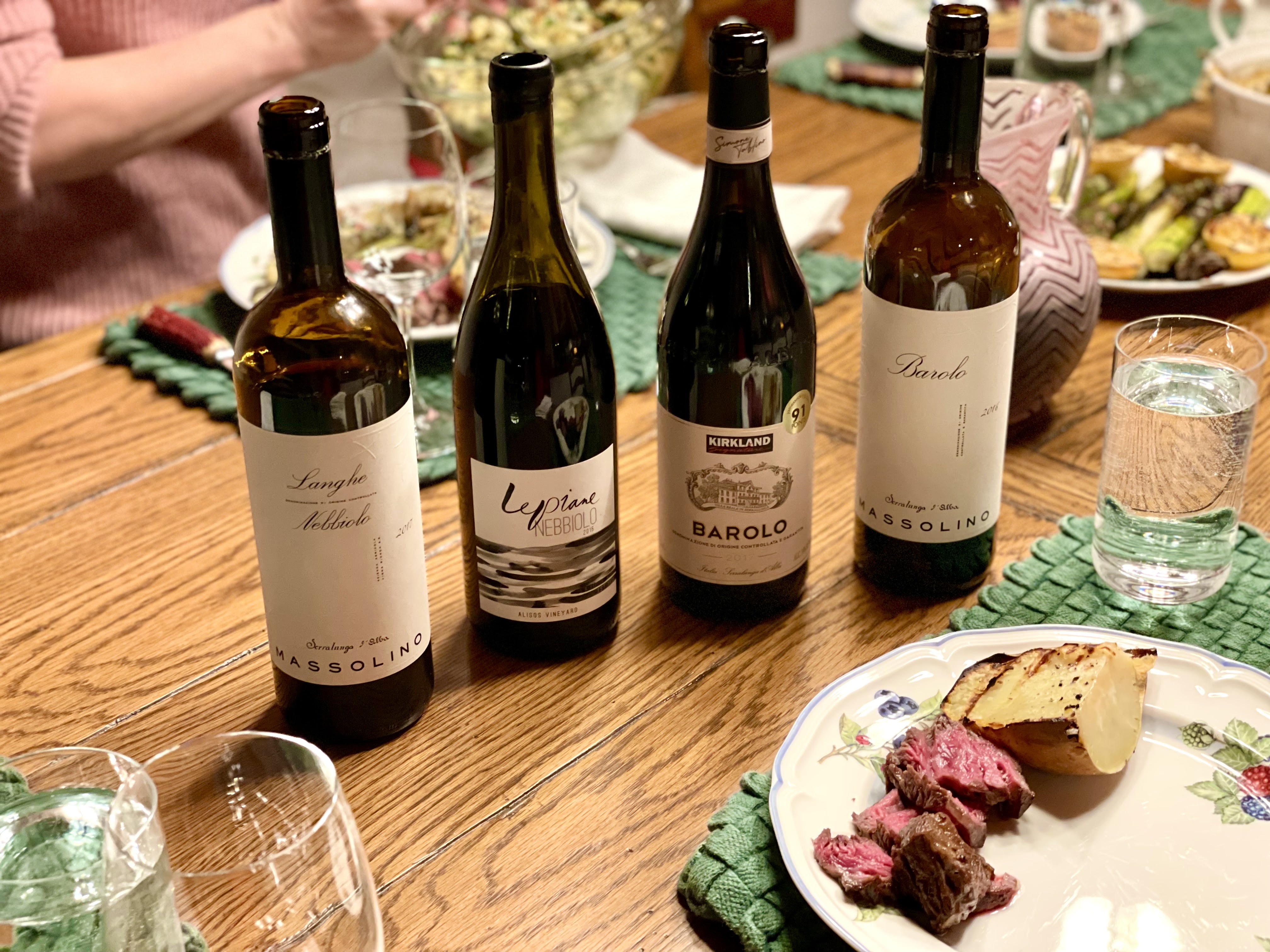
We had two Barolos (both were decanted), one Langhe Nebbiolo, and a bottle from California with this fabulous steak dinner. Here’s what was in the line-up. 


Massolino Barolo 2016
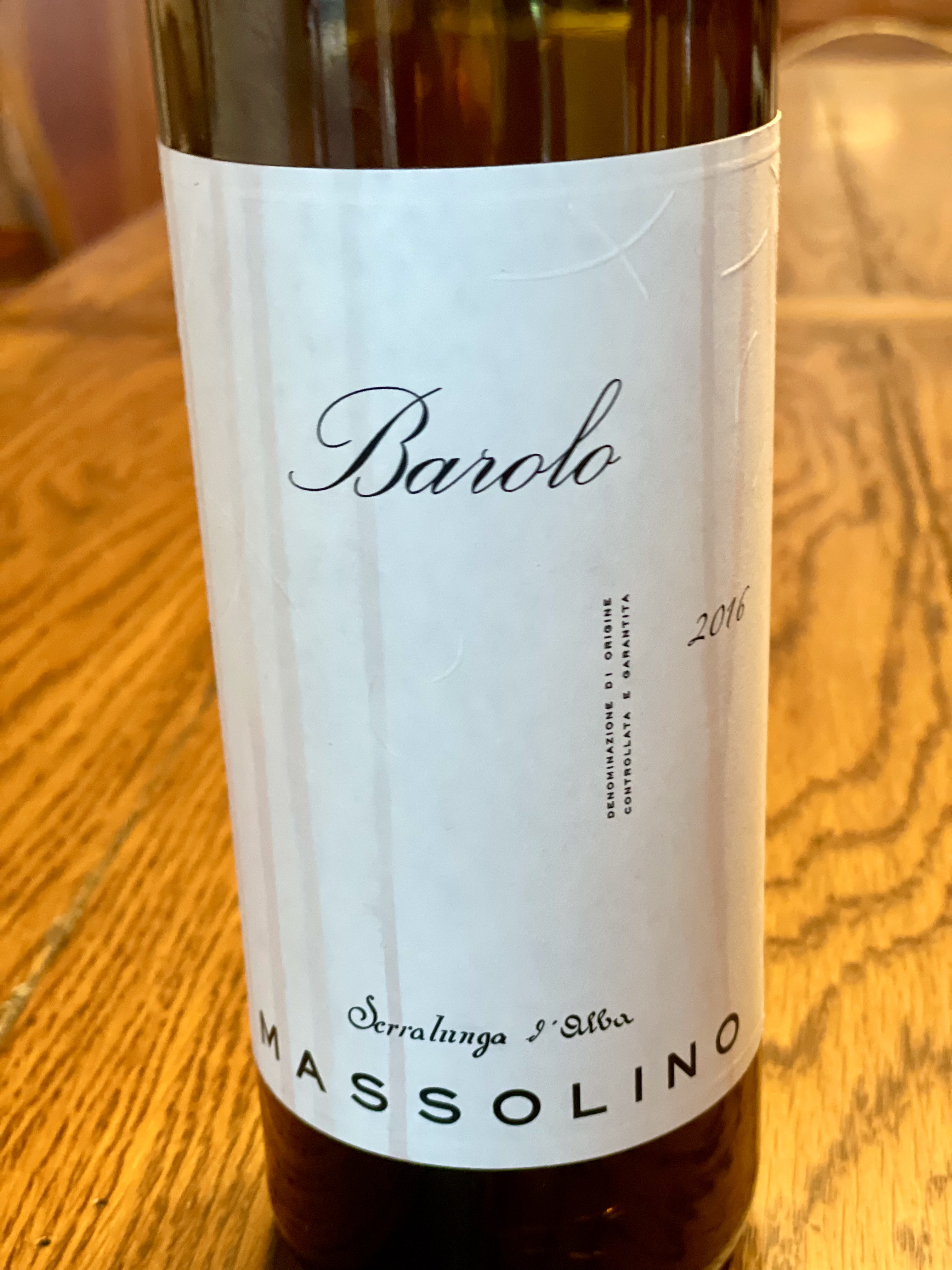

Average Price: $55 (sample)  | ABV: 14.%

The Massolino family’s history in the commune of Serralunga d’Alba dates back to 1896 when Giovanni Massolino founded the estate. Giovanni was the very first person to bring electricity to the village. His son, Giuseppe,  built their wine cellar, and he along with his sister Angela, extended the estate. Giuseppe was also one of the founders of the Consortium for the Defence of Barolo and Barbaresco in 1934. Giuseppe had six children and three of them – Giovanni, Camilla, and Renato – followed their father into the family business. They continued the estate’s expansion and purchased three of their cru vineyards: Margheria, Parafada, and Vigna Rionda. Franco, Roberto (both oenologists), and Paola represent the current generation. Their vineyards are farmed sustainably. 

Winemaking: Their Barolo DOCG represents a blend of their vineyards, each bringing different characteristics offered by each terroir. There is a blend of soils with a tendency toward limestone. This is traditional Barolo with long fermentation and maceration in oak fermenters (“tini”) at temperatures around 30°C; the wine is aged in large Slavonian oak casks for up to 30 months before being left to mature in bottle. Additional details can be found in the tech sheet here or here.

Tasting Notes: This is a classic Barolo showing the characteristic “tar and roses,” along with cherries, white pepper, and licorice. This wine showed an elegant and pretty side of Nebbiolo, showing a pleasant bright, tangy quality to the fruit, accompanied by the structure grippy tannins. One of the Drews noted that it tasted like his mental image of what he wants Barolo to taste like.  In comparison to Langhe Nebbiolo that we’ll see further down, the fruit quality was deeper, rounder, and plusher.

Pairings: This wine was generally friendly to the food on our table. No surprise, it was stellar with the steak, but it was also surprisingly ok with the asparagus, which is not a wine-friendly vegetable. 

The winery also offers the following recommendations: “It achieves its best expression when served with red meats, particularly game, and with dishes dressed with truffle. It is also excellent with fresh egg pasta and meat sauce, and with risotto, as well as medium-mature cow’s milk and goat’s milk cheeses.”


Kirkland Barolo 2017 


Price: $20 | ABV: 14%

Since Costco doesn’t share the details of the winery behind the wines, there’s no background info to share. However, as has been my general experience with their wines, this was a very solid representation of the style at a price point that can’t be beaten. The fact that it says “Kirkland” on the bottle might rule it out as an option to take to most dinner parties, but it should definitely not keep it from showing up on your dinner table. The price makes Barolo a possibility for a weeknight dinner. This is also a great option if you’d like to get an idea of what Barolo is all about without breaking the bank. 

Tasting Notes: This wine displayed the earthier side of Nebbiolo. It was the earthiest of the bunch. I picked up a little bit of brett when I first opened it up, but this quickly blew off, and then the nose became a bit shy. It showed notes of cherry, bay leaf, mushrooms, and thyme on both the nose and palate, all lifted by bright acidity. Unsurprisingly, this wine didn’t show the finesse of the Massolino Barolo, but it definitely delivers good value at $20. 

Pairings: Of course, this wine liked the steak, as they all did. However, I failed to take notes on how it went with the various veggies. This wine should also go with anything involving mushrooms.


Massolino Langhe Nebbiolo 2017


Average Price: $29 (sample) | ABV 14.5% 

The grapes for this wine come from several municipalities. As you might guess, it’s made for earlier consumption. 

Winemaking: The wine undergoes a medium period of fermentation and maceration (approximately 15 days). It ages in large Slavonian oak barrels for over a year. Additional details can be found in the tech sheet here and here.

Tasting Notes: A good representation of the fresher side of Nebbiolo. It showed notes of bright strawberries, cherries, and even a hint of cranberry on the nose and palate, along with floral notes and freshly tilled earth and stony minerality. While this was certainly a lighter expression in comparison to the Massolino Barolo, Nebbiolo’s structure wasn’t lacking and the wine still showed good density and grip.  

Pairings: Good with the steak of course, but this one paired quite well with bites involving horseradish as well. It was also quite good with many of the veggies. The wine became lighter and brighter alongside the roasted cauliflower with gremolata. 

Here are additional pairing recommendations from the winery: “Ideal throughout a meal but at its best when served with rich, tasty dishes, ranging from fresh-egg pasta with meat or vegetable sauces to grilled or roasted red meats. It is also excellent with soft and delicate blue cheeses.”


Lepiane Nebbiolo Alisos Vineyard 2015


Price: $49 (sample) 

I’ve shared a couple of wines from Alison Thomas’s Lepiane line in the past, so I’ll refer you here and here for more details on this one-woman operation in Santa Barbara, California. To be honest with you, I’m not typically the biggest fan of California Nebbiolos, but I thought it would be fun to have one in the line-up and this is usually one of the better examples, IMHO. Sadly, the wine wasn’t showing so well on this particular day, but I don’t really think it was its fault. I’d Coravin’d this bottle to AGES before and I think the gas cartridge had been running low because the fruit in the wine was a little flat, it was a touch oxidized, and overall, it lacked the vibrancy I’d previously experienced with it. 

Winemaking: Elevage occurred in a 600L neutral barrel for 33 months before being bottled without any fining or filtration. An additional 20 months of bottle aging allows this wine to show its beautifully complex nature. Organically farmed. Additional details here.

Tasting Notes: Since the wine wasn’t showing so well this evening, my tasting note is from my previous tasting of the wine. The wine reminds me of fall with notes of dried flowers, orange zest, and cranberries on the nose. The fruit is bright on the palate and joined by notes of black pepper, herbs, and the characteristic “tar and roses.”  

Pairings: It was good with the steak, of course. It was also good with the sweet potatoes, but it did not like the cauliflower. 


Go forth and explore the many sides of Nebbiolo!

*****

For more posts related to Nebbiolo, check out these posts:

  • Italian Wine 101 Cheat Sheet
  • Cooking to the Wine: Fontanafredda Barolo and Braised Short Ribs with Mushrooms
  • Touring & Dining at Marchesi di Barolo
  • An Anniversary Celebration with La Spinetta VĂĽrsĂą Gallina Barbaresco and Braised Spatchcocked Duck
  • Cozy Date Night In with Gnocchi with Easy Pork RagĂą


*****


The writers of the Italian Food, Wine, and Travel (#ItalianFWT) blogging group have been exploring the wines of Langhe this month. Check out their posts here:

  • Wendy Klik highlights Beef and Pork Ravioli, A Book Review and a Nebbiolo from Langhe on A Day in the Life on the Farm 
  • Camilla Mann pairs Spicy Mussels Chorizo + 2017 Villadoria Bricco Magno Langhe Nebbiolo at Culinary Adventures with Camilla 
  • Linda Whipple entices with Of Nebbiolo, Salami and a Langhe Farmer’s Dream at My Full Wine Glass
  •  Jen Martin gives us a glimpse with an Overview of the Langhe Wines at Vino Travels
  • Gwendolyn Alley introduces us to the “Queens of Langhe: Mother Daughter Duo Anna and Valentina Abbona of Marchesi di Barolo” on Wine Predator.
  • Host Cindy Rynning entices us to Explore a New-to-You Wine – Nas-CĂ«tta from the Langhe in Piemonte” at Grape Experiences.

Additional sources used for this post and extra reading: 

  • JancisRobinson.com
  • Wine-searcher.com
  • Winefolly.com - Nebbiolo: The Grape of Barolo and So Much More
  • NY Times.com - Your Next Lesson: Langhe Nebbiolo
  • Winefolly.com: Nebbiolo
  • Forbes.com: The Serralunga Style Guide - Barolo Power (Part One)
  • WineScholarGuild.org: Barolo Communes


Join me for a year-long exploration of the wines of L'Ecole No. 41.


Please note, that while the wines were provided as samples as part of this collaboration, no other compensation was received and all opinions are my own. This post also contains Amazon Affiliate links, from which I might earn a commission at no cost to you.

It’s rare that one gets the chance to really get to know a winery’s (or really any company’s) product line thoughtfully and over time. Last year, I had the unique opportunity to get to better know the wines of L’Ecole No. 41 through an ambassadorship program. Each month, I’d receive a wine, or sometimes, more, and would then join in a zoom call with the other participants and the team at L’Ecole to learn more about that month’s topic. I, along with the rest of the participants would then share a post about the wine(s) on social media. For my part, I shared my pairings on my @nibblinggypsy Instagram feed. Via this process, I not only got to taste a wide range of their offerings but also got to know a few members of their team and learned about their operations. 

I was already fairly familiar with L’Ecole going into this. I believe I first tried one of their wines years ago while taking my first sommelier course where they were presented as an example of Washington’s wines. I’ve also had the chance to try their wines over the years as part of #MerlotMe month, but this experience certainly widened my appreciation.

I became a bigger fan with each wine I tasted. I’m happy to say there wasn’t a bad wine in the whole year’s worth of wine. Of course, I had my favorites, but every single one was well-made, and they tended to be elegant and balanced with lots of freshness. They were also very fairly priced. Pretty much every time the price of a wine was shared, there’d be rumblings of amazement and approval throughout the group of participating wine bloggers and influencers. They make wines at a range of price points, but the wines always seemed to be a great value for whatever the price point was – usually they over-delivered. I got the sense that this was a point of pride. They want to make delicious wines at good prices.

I’m sure many of us want to feel that we’re supporting good, conscientious companies with the dollars we spend. This is another area in which L’Ecole wins points thanks to their commitment to sustainability, which we will look at more closely in a moment. 

In addition, their wines are fairly easy to find. Since I often focus on small wineries, I know that’s not always the case, but that shouldn’t be a problem with L’Ecole’s wines, at least within the US. They’re a medium-sized producer and they have good distribution. I can also often find their wines on Wine.com, and of course, you also find them via their website. 

Today, I thought I’d share my experience with L’Ecole No. 41 via a month-by-month look at the wines I tasted along with their pairings. 


A Brief  Intro to L’Ecole No. 41 

L’Ecole has been a pioneering winery in Washington State from the start. It was the third winery in Walla Walla and the 20th in the state. Their first vintage was released in 1983. It’s owned by Marty and Megan Clubb, and was founded by Megan’s parents, Jean and Baker Ferguson. The winery gets its name from the historic Frenchtown School building in which the winery is located. 

Here are a few more quick facts to introduce them:

  • I mentioned that they’re a medium-sized operation – they make between 40 and 46k cases per year – and they like it that way. They find they’re in a sweet spot that allows them the control of a smaller winery but are also able to have good distribution and reach. 
  • L'Ecole 41 has long made being earth-friendly a big priority and they are certified sustainable as well as Salmon-Safe. They've also recently revamped the part of their website that explains all of their sustainability practices, which you can find here. 
  • Black Label vs. White Label: 
    • Wines with the black label are their “heritage line” and they're their regional wines representing Columbia Valley.
    • Wines with a white label are from their estate vineyards in Walla Walla. 

Now let’s get to the wines and pairings. Where possible, I’ve included extra tidbits and extra pairings recommended by their team members. I occasionally joined the calls from the road or other places where I wasn’t able to take notes, so the level of detail varies.


Cab and Steak for the Holidays X 2

Before the collaboration had officially begun, I was sent a couple of sample bottles as a sort of invitation to the program. We enjoyed one of those bottles, the Cabernet Sauvignon Walla Walla Valley 2017 ($41, current vintage), with Greg’s parents over the holidays in December of 2020.  Since the program didn't officially start until February, will count this as an early start.


We had a simple steak night with roasted cauliflower seasoned with harissa and smoked paprika. The steak was prepared sous vide then seared. The wine was fresh and bright, but also had lots of dark fruit notes. It made for an easy and delicious dinner.

Tasting Notes: Blackberry and black cherry on the nose, along with cocoa and a light sprinkling of herbs. There was a nice balance of fruit and structure on the palate (I generally found that to be the case with their wines), with bright acidity and tannin that were firm but not overpowering. Warm spice notes and white pepper joined the fruit on the palate, along with stony notes on the finish. 


Skip ahead to Valentine’s Day 2021. I went in a similar direction with their Cabernet Sauvignon Columbia Valley 2017 ($30, current vintage) and prepared a London Broil and topped it with a smoky mushroom sauce with hasselback potatoes on the side. I shared that recipe on NibblingGypsy.com here.  

I’m not going to lie, if you give me a big red, my tendency is to put it with meat of some kind. Very often it’s a steak as we’ll see several times here. 

Tasting Notes: There were enticing notes of black cherry, plums, chocolate, and spice on the nose. These all continued on the palate, but the chocolate was dark and mixed with espresso. It was an elegant wine with lots of brightness and smooth tannins. 

This wine is built for aging, and Marcus Rafanelli, their winemaker, recommended decanting this wine for 20 to 30 minutes in advance of drinking, and I would agree, although it was already starting to show nicely within a few minutes of opening.

Additional Pairings: Other pairing suggestions from the team included osso bucco, braised meats, pot roast, and lentils. 


March: Cabernet Franc - Merlot Walla Walla Valley 2018 with Sausage Mac and Cheese


I brought a bottle of their Estate Grown Cabernet Franc - Merlot Walla Walla 2018 ($39) with us on one of our trips to the Culinary Cabin in Tahoe. It was cold and snowy outside, so comfort food was needed and it's hard to imagine any food more comforting than mac and cheese! This was a baked, casserole-style version flavored with sausage and topped with crunchy bacon on top. 

The wine was fruity enough to handle the light spice from the sausages and had a lush silky texture that matched the creaminess of the cheesy pasta. Super yummy!


April: Syrah Estate Seven Hills Vineyard Walla Walla Valley 2018 with Carne Asada Stuffed Arepas 


Greg and I headed to the Santa Cruz Mountains for a hiking weekend getaway. Our original plan had been to camp, but then we found a cabin via AirBnB. Since camping had been the original intent, the cabin was pretty no-frills. It had a small kitchen, but I tried to make life easy on myself by buying things to cook that had done some of the work for me and didn’t require too many ingredients, like Trader Joe’s pre-seasoned carne asada. I also roasted some bell pepper and onion strips in olive oil, salt, and pepper. All of these goodies were used to stuff arepas, which only requires adding water and salt to the Harina PAN (cornmeal) to make the dough. You’d be surprised at how easy arepas are to make! One of Trader Joe’s pre-packaged salad kits completed the meal. 

This paired sooo well with the Syrah Esate Seven Hills Vineyard 2018 ($39, current vintage). The meat had a lot of citrus in the flavoring which matched perfectly with the wine's super bright acidity. At the same time, char on the meat and on the arepas sang with smoky notes in the wine. The combo was even better than I'd expected and I couldn't get enough of the two together. It was one of my favorite combos of the year! 

Tasting Notes: Raspberry, black cherry, white pepper, dried herbs, black tea, and roses on their stems all showed on the nose. The fruit was luscious on the palate, with a mix of red and black fruits, smoke, espresso, cedar, and tapenade made from a mixture of green and black olives. It improved with air, so decant if you can. 

Additional Pairings: Marcus recommended this wine with grilled meats and mushroom risotto made with beef stock. Other recs from their team included bean stew, goat, grilled oyster mushroom tacos, and lasagna.

Behind the scenes details: 2018 was a particularly good vintage with perfect timing throughout the growing season, so the grapes ripened evenly and got good hang time. The wine saw 20% stem inclusion to add structure and tannins, and 20% whole cluster. The average age of the vines is 25 years.


May: Chenin Blanc Old Vines Yakima Valley 2020 with Coconut Shrimp


We all get the urge for crispy fried things from time to time, right?! I got the urge for some coconut shrimp and brought some home from Whole Food’s freezer section. While the shrimp heated up, I roasted some zucchini and tossed it in a sweet and sour chili sauce. The whole dinner came together in about 30 minutes. 

I chose to pair these sweet and crispy shrimp with L’Ecole’s Chenin Blanc Old Vines Yakima Valley 2020 ($18, current vintage), a delightful wine with a mix of tart and ripe fruit notes. It made for a solid pairing with the shrimp, but I think a little rice would've made it even better by balancing out the sweetness in the sauce. As was, the sweetness of the sauce overpowered the wine a little bit. It’s ok though because we’ll see the Chenin again later in the year for another shot at pairing. 

Tasting Notes:  Aromas of green melon, white peach, honeysuckle, and tangerine skin on the nose. These all came back on the palate, along with ginger and green apple. This was bright with a rounded beeswax texture on the mid-palate.

For more on Yakima, see this post. 


June: Grenache Rosé Alder Ridge Vineyard, Horse Heaven Hills 2020 and Turkey Chili


Greg got a hankering to make some chili and I was all for it!  It was a turkey chili, but other than that, I wouldn’t be able to tell you what went into it as he tends to riff when he cooks, throwing in a little of this, and a little of that. 

We paired it with the Grenache RosĂ© Alder Ridge Vineyard 2020 ($21, current vintage). I really loved this rosĂ© and it made for a yummy and refreshing pairing with the chili. It had enough fruit to balance out the heat while being refreshing and it perked up our palates in between bites of the lightly spiced bites of chili. It was also substantial enough to stand up to the bold flavors.

Tasting Notes: The wine showed a beautiful purity of fruit with lots of peaches, raspberries, and strawberries along with a few flower petals and a hint of orange zest on both the nose and palate.. It's super bright and tangy with a zesty finish.


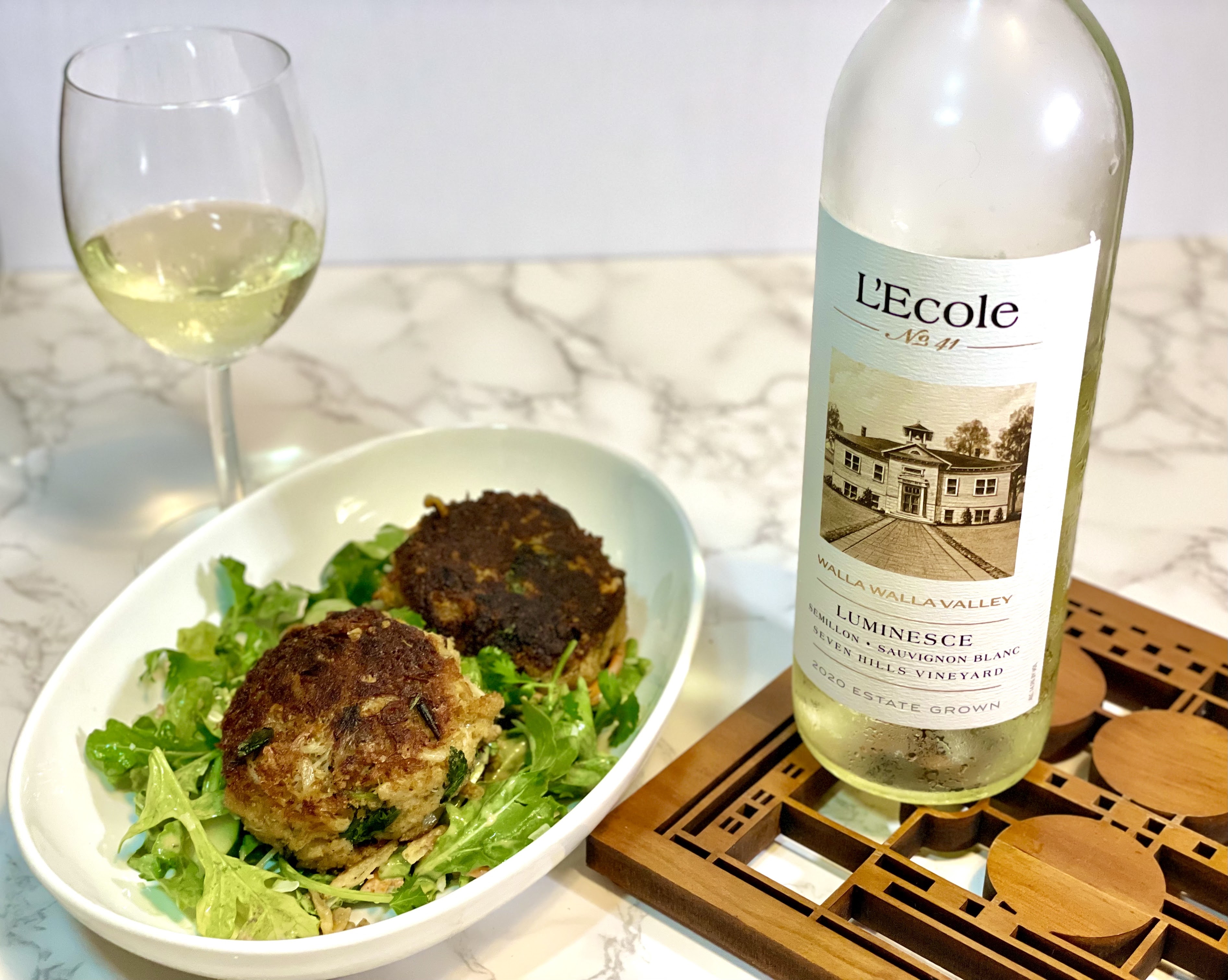
July: Luminesce Semillon - Sauvignon Blanc Seven Hills Vineyard, Walla Walla Valley 2020 and Crab Cakes


Blend:  62% Semillon and 38% Sauvignon Blanc 

Here’s an excellent pairing for sunshiny days. Luminesce ($22) is L’Ecole 41’s take on a classic Bordeaux Blanc blend with SĂ©millon, which brings texture, and Sauv Blanc, which adds brightness. This combination of attributes made it a perfect match for crab cakes, with their mixture of creamy and crispy textures. I used this recipe from Delish magazine for this round, then served them with a sauce made with Kewpie Mayonnaise and wasabi sauce (not pictured), and a salad. The wine’s balance of texture, citrus, and hints of herbal notes was a PERFECT match with the crab cakes –  a lip-smacking pair! Another of my favorite matches of the year. 

Tasting Notes:  The showed notes of key lime pie, lemon, white flowers, and a touch of minerality on the nose. Grassy green herbs joined in on the palate, along with notes of blanched almonds. It was rounded on the mid-palate moving into a crisp finish.


August:  Syrah Columbia Valley 2018 and Tri-Tip


I’m always jealous of people’s grills in the summertime. We live in an apartment, so I have to improvise the best I can. In this case, I once again used my sous vide circulator to cook up some seasoned Trip Tip and then seared the meat to finish it. I then served it with a side of mixed zucchini, sautĂ©ed mushrooms, onions, and potatoes. 

You’ll notice that I almost always prepare small and medium cuts of meat sous vide. I think this is hands down the easiest way to cook steak cuts as it takes all of the guesswork out of the process. (Cuts that you want to be fall-apart tender are best prepared via other methods like braising.) Below you’ll find a simple non-recipe for this tri-tip preparation. 

This round of meatiness was paired with the  Syrah Columbia Valley 2018. It made a beautiful match, although I suspect that this wine will be even better in a few years.  

Tasting Notes: There were notes of blackberry, smoke, and hints of vanilla on the nose. Tart blackberries continued on the palate along with black cherries, plums, touches of black pepper, herbs, licorice, craggy stones, and espresso granules, with a few flower petals mixed in. 

Trip Tip Sous Vide Non-Recipe: 

I rubbed the meat with garlic powder, shiitake powder, and black pepper, doused it with soy sauce, and added garlic to the cooking bag. I cooked it at 129.5 °F for 2 hours, then removed it from the cooking bag, patted it dry, and seared it in a large pan. I sliced up the tri-tip and served it topped with the leftover cooking juices. 


September: Frenchtown Columbia Valley Red Blend 2019 with Pork Chile Verde and Pizza


Blend:  45% Merlot, 17% Syrah, 18% Cabernet Sauvignon, 4% Grenache, 10% Malbec, 6% Petit Verdot 

The Frenchtown Columbia Valley Red Blend ($22) is such a happy, friendly wine. It’s very easygoing and bound to match decently well with a ton of different things. I got this impression after tasting it and decided to test the theory with a pairing gamble. Back in San Diego once again, my mother-in-law made chile verde with pork one night. I would normally gravitate towards a full white wine to pair with all of the green notes and spices in this dish. I decided to experiment with the Frenchtown Red instead and was very pleasantly surprised with how well it worked. 

This is a medium-bodied red with smooth easy tannins, both attributes which helped it to work with a lighter meat like pork. It is also pretty plush, fruit-forward, and a bit juicy which helped it to pair with the hits of spice.

Later on, we had another bottle with a pepperoni pizza, which also made for a very happy pairing!


Tasting Notes: Thanks to all of those different grapes, there was a whole host of fruit notes in here, with a mix of red, black, and blue fruits that were ripe but bright. There were lots of red cherries on the nose, with red licorice, and a mix of white and black pepper Roasted red plums joined in on the palate, with hints of herbs, lavender, and spice mixed in. I already mentioned that it was medium-bodied with smooth tannins. I thought it offered a lot of bang for the buck.

Behind the scenes details: The Frenchtown Red is an entry-level red and is always a blend of grapes, but might be different each year – it's kind of a snapshot of a particular vintage. The 2019 was a blend of Bordeaux and RhĂ´ne grapes including Merlot, Cab, Malbec, Petit Verdot, Syrah, and Grenache. Frenchtown is the name of the district where L’Ecole’s historical schoolhouse is located. It used to be called the “Recess Red” and many people still ask for it by that name. 


October: Merlot Me Month


October is Merlot Me Month and L’Ecole No. 41 made two appearances last year, so I’ll just go ahead and direct you to this post for more on the Estate Merlot Walla Walla Valley 2018 and this post for more on the Merlot Columbia Valley 2018, but it was fun to see the different expressions of the grape side by side. The Columbia Valley showed more plush fruit notes, whereas the Walla Walla, which is grown in a vineyard sitting on basaltic rock, showed more dusty minerality, smoke, and structure. You can see a similar comparison between the 2014 bottlings in this post.


I also got to enjoy the Estate Merlot Walla Walla Valley 2018 with a burger and it was pretty great.


As I mentioned earlier, L’Ecole has made several Merlot Me appearances in the past. Check out these posts for more pairing ideas:

  • Many Merlots Make Marvelous Mediterranean Meal
  • 5 #MerlotMe Nights
  • Experiments with Salmon and Merlot
  • What's Good?: Pasta Alla Norma & Merlot


November:  Perigee Vintage Comparison with Shawarma Chicken and Flank Steak 


Blend 2018: 50% Cabernet Sauvignon, 16% Merlot, 16% Cabernet Franc, 9% Petit Verdot, 9% Malbec.                                  
Blend 2015: 56% Cabernet Sauvignon, 16% Merlot, 14% Cabernet Franc, 7% Petit Verdot, 7% Malbec.

In November, we did a vintage comparison between the 2015 and 2018 ($56, current vintage) vintages of L’Ecole 41’s flagship Perigee Estate Seven Hills Vineyard, Walla Walla Valley, a Bordeaux blend of all estate-grown fruit from their Seven Hills Vineyard. Again, comparisons are always fun! In this case, looking at two different vintages as it gives you a chance to see how different conditions affect a wine and also gives you a glimpse of where a younger wine might go. 2018 was a cooler vintage and the wine showed more red fruits and brighter acidity. By contrast, 2015 was a warmer vintage and displayed deeper, darker fruit notes with more robust tannins. The two tasting notes are next to each other below for a more detailed comparison.

I paired the lighter, and brighter 2018 with a Shawarma-spiced chicken loosely based on this recipe from Olive Magazine along with butternut squash that I roasted alongside, as well as baba ghanoush and homemade pita bread. The wine paired particularly well with the smoky spices in the chicken and the weight of the wine and the food matched nicely. It wasn’t half bad with the herbed butternut squash as well. I put a lot of lemon in this batch of baba ghanoush, which probably kept it from matching as well as it might have normally, but I think it would go well with a more typical, smokier style of the dip.

The 2015 was in a good place and just opening up after 6 years, but still seemed like it has quite a few more years to go. I couldn’t help but myself but to return to steak with this one. This time it was flank steak topped with mushrooms and served with a side salad. I find mushrooms to generally be a good idea when pairing with wines with a bit of age on them.


2018 Tasting Notes: Predominantly red fruits showed on the nose – bright cherries and raspberries – along with dried herbs and a little menthol.

2015 Tasting Notes: Black cherry with brambly herbs, tobacco, black tea, esspresso showed on the nose, with notes of roses and lilacas coming out as the wine opened. It was rich but bright on the palate, with blackberries, blueberries, and black plum skin on the palate, along with mocha, cigar box, chocolate, licorice, and cassis. Lots of espresso. The wine showed grippy tannins and brawny structure. Decanting is definitely recommended 

Later on, I also got to participate in a tasting looking at the component varieties that go into Perigee, and I kind of wish some of those were sold bottled on their own as well!


December: Wine & Chocolates and Shrimp Stir Fry


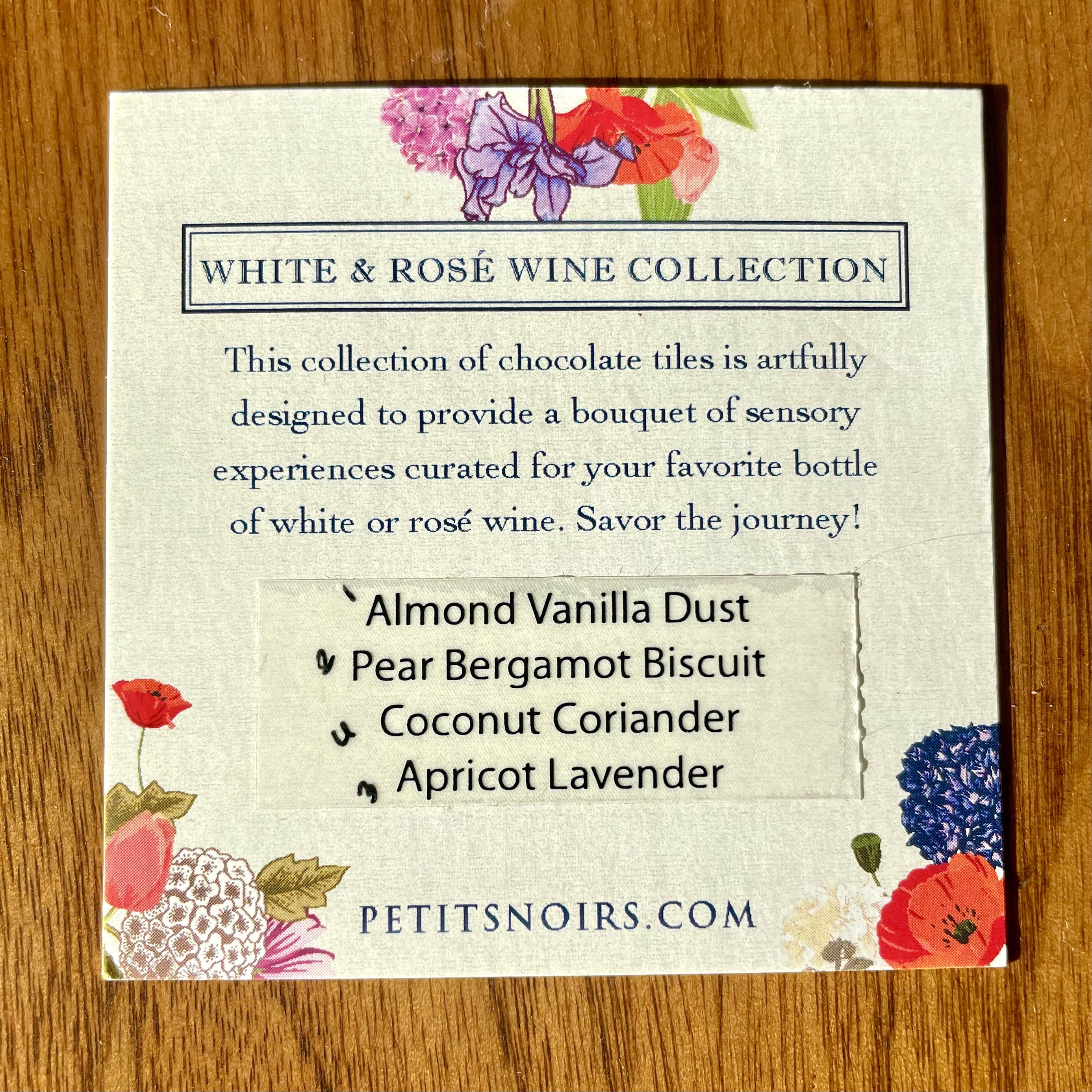
In December, I had a chance to try one of the lovely gift sets they’d put together for the holiday season. I received the wine and chocolate gift set, which included bottles of the Old Vine Chenin and the Syrah Walla Walla Valley with chocolates from Petits Noirs, also made in Walla Walla, selected to match. 


I’m a little picky about pairing wine and chocolate together – I personally don’t think they go that well together because most chocolate is too sweet to go with most dry wines. IMHO, pairings work best when the chocolate is dark and not that sweet, and the wine is fruit-forward. I find white wines to be particularly tricky, but I was still interested to try the flavor blends with the Chenin Blanc. 

I can't find the specific notes I took on the pairings, but I did wrank my preferences on the accompanying card.

This also gave me a chance to try the Chenin Blanc in another savory pairing. This time I paired it with a shrimp stir-fry with lots of veggies. This time, the sauce was less sweet than the one I served with the coconut shrimp back in May, and it worked much better. 


I still haven’t tried the Syrah with its corresponding chocolates, but I expect those to work well and will update this when I do. 


That wraps up my excellent year of exploring L'Ecole's wines, although I still have a few bottles left to play with and will share those experiments in the future.


Aged Bordeaux can be quite reasonable if you know where to look. Here we take a look at a bottle of Saint-Émilion Grand Cru paired with an extremely simple and delicious skirt steak preparation with leeks and mushrooms.

Today’s wine was provided as a sample by Big Hammer Wines, with whom I have an affiliate relationship. No compensation was received for this article, but this post does contain affiliate links, from which I might receive a commission at no cost to you. All opinions are my own.


I’ve long held that Bordeaux needs to be taken down a peg. By that I don’t mean that we should all start insulting the region, but just that it’s often seen as pretty highfalutin because of the fame of its top-tier Chateaux. The history of these houses is pretty amazing, but their prices are imposing, to say the least. The problem is that despite the fact that these uber-famous wines make up less than 5% of the total production, they overshadow all the wonderful wines that you can find at really great prices –– people kind of forget they exist! 

I’ve already shared a couple of posts on this theme, including a post entitled Faux Fancy Bordeaux that I wrote earlier this year, in which I shared the opinion that BDX is a particularly good choice if you like aged wines. There are really great options out there for aged Bordeaux if you know where to look. Today, I have another bottle for you and it’s paired with a super simple recipe

We covered the basics on Bordeaux here and here, so if the region is completely new to you, I invite you to check out those posts.


Saint-Émilion

Welcome to the Right Bank! Merlot is the star of the blend here, often with Cab Franc in the supporting role, in contrast to the Left Bank, where Cabernet Sauvignon tends to get the top spot in the blend. This is due to the fact that the climate and soils (which we'll take a look at in a moment) are different. The Right Bank is cooler since it's further inland and the moderating effects of the ocean, and Cab just doesn't ripen quite as well in most places here as a result.

Interestingly, while the Left Bank, with its grand Chateau enshrined by the 1855 classification, is more famous today, the Right Bank is far older. There have been vineyards on the Right Bank since Roman times, whereas most of the Left Bank had to wait for Dutch engineers to come and drain their swampy land in the 17th century and make it farmable. Today, this is an excellent area to look for wine values. 

Map borrowed from WineFolly.com .

Saint-Émilion, with its Romanesque architecture and many ruins, is often described as the prettiest town on the Right Bank. It was also part of the route to Santiago de Compostella, so many travelers have passed through here over time. The town’s long history and cultural importance led it and its vineyards to be named as a UNESCO World Heritage Site in 1999. 

A panoramic view of the town of Saint-Émilion, France.

Image borrowed from Wikipedia.

This is also an area of small farms, as opposed to the large grand estates of the Médoc on the Left Bank. The town lies just a few miles north of the Dordogne, near the point where the river spills into the Gironde estuary, after completing its journey from the hills of the Massif Central.

There are three main vineyard areas, geologically speaking, as laid out here by Wine Searcher:

The most significant is the limestone plateau on which Saint-Émilion town is located, and the slopes around it. Most of the very top vineyards and châteaux are located here, within a mile of the town (Cheval Blanc and Figeac again provide two notable exceptions to the rule).

Immediately south of the limestone plateau is the alluvial, sandy plain which slopes gently down to the banks of the Dordogne. Few wines of any note are produced here, and none of the Grand Cru Classe properties are located here.

In the northwestern corner of the Saint-Émilion area is an ancient alluvial terrace, formed by glacial activity at the very beginning of the Quaternary period roughly 2 million years ago. This boasts the same free-draining 'gunzian' gravels as are found in the best properties of the Graves and MĂ©doc, which explains why the two most famous châteaux here (Cheval Blanc and Figeac) are able to grow and ripen both Cabernet Franc and Cabernet Sauvignon. This terrace – known as the Graves de Saint-Émilion – continues westwards into neighboring Pomerol, and underpins the vineyards of such revered estates as Le Pin and Petrus.

Saint-Émilion also has a Grand Cru appellation (today’s wine is an example), under which wines are produced under slightly tighter regulations than regular Saint-Émilion wines. However, this has been the subject of a lot much controversy since its inception as the rules are widely regarded as being way too loosey-goosey to really be indicative of any major quality shift. As a result, there’s twice as much Saint-Émilion Grand Cru wine is made each year than regular Saint-Émilion. Somewhat confusingly, there is also a classification system, Saint-Émilion Grand Cru ClassĂ©; which confers grand cru classĂ© and premier grand cru classĂ© status on the top-tier wines from Saint-Émilion. 

For a more in-depth description of the Sanit-Emilion's quality tiers and classification system, please check out this post by Jeff at FoodWineClick.


Château Roc de Candale

Image borrowed from VOS Selections.

Magali and Thibaut Decoster are the owners of Château Roc de Candale, along with three other estates, Clos des Jacobins and Château La Commanderie. They purchased Château de Candale in 2017, which is located in a desirable area east of the Saint-Emilion’s limestone plateau.

Each of the properties has a different character. Roc de Candale sits on silty limestone clay soils which helps to make the wine more approachable in its youth. The wine is always predominantly Merlot with a splash of Cabernet Franc, although the exact amount might vary a bit (5 to 10%). The land is farmed sustainably with no herbicides or pesticides, although copper and sulfur treatments are used. 

ABV: 13.5% | Average Price: $28 |  Find additional details here and here.


The Wine and Pairing

On the day we opened the Château Roc de Candale Saint-Émilion Grand Cru 2010 it showed a nose of notes of black cherry, blackberry, licorice, and cedar. These notes were joined on the palate by tobacco, lots of herbs, and a dusting of cocoa and black pepper. It had smooth, fine tannins, medium acidity, medium body.

It was a pretty classic Bordeaux. I always get an interesting mix of herbs and spice, and since it had a few years on it, the notes of tobacco and earth were elevated. I wanted the accompanying dish to complement all of that, but not to overwhelm. I came up with an incredibly simple dish to accomplish it all.

I had splurged and purchased some Wagyu skirt steak from a very good butcher here in Oakland, Clove and Hoof.  It was a lovely piece of meat and I wanted to let it shine simply. I just rubbed it with some herbs, shiitake powder, and salt and pepper, and then broiled it for a few minutes on each side. I served it with a slick of butter and a sprinkling of flaky fleur de sel on roasted leeks and mushrooms. I always think mushrooms work wonderfully with an aged wine and their earthiness matches that in the wine and then somehow helps to bring out more of the fruit. Meanwhile, leeks mirrored the herbal components in the dish. The meat just completely melted in our mouths and wine and the food danced together beautifully.

I decanted this wine in advance to separate it from any sediment and to give it a chance to open up, which helped quite a bit. Even though this wine is intended for earlyish drinking and has a few years on it already, I still think it could go a few more. 


Partnerships 

This wine was sent to me as part of a collaboration with Big Hammer Wines. They offer fine wines at discounted prices. Find more details here. While this particular bottle is sold out, you will find other bottles of Bordeaux, including many aged options, at very reasonable prices.

You also find a curated list of my selections here. Use the discount code NICOLE15 for $15 off any purchase. (Limit to 1 use per customer.)

The glasses in the photo are also the result of a collaboration. These are Dragon Glassware’s Aura Wine Glasses. Click here to see their selection and use the code NICOLE10 for 10% off. 


Steak, Skirt Steak, Mushrooms, Leeks. Easy Dinner
Dinner
Servings: 3 to 4
By: Nicole Ruiz Hudson
Skirt Steak with Roasted Leeks and Mushrooms

Skirt Steak with Roasted Leeks and Mushrooms

Prep Time: 10 MinCooking Time: 5 MinInactive time: 37 MinTotal Time: 52 Min

Ingredients

For the Skirt Steak
  • 1 ½ lbs skirt steak
  • 1 tsp shiitake mushroom powder
  • 1 tsp dried rosemary
  • 1 tsp salt
  • Pepper, to taste
  • Olive oil
  • Butter, to serve (optional)
  • Flaky fleur de sel or Maldon sea salt, to serve (optional)
  • For the leeks and mushrooms
For the Leeks and Mushrooms
  • 1 lb mushroom (oyster mushrooms used here)
  • 4 leeks, whites and light green parts only, thoroughly cleaned and thinly sliced
  • Salt, to taste
  • Pepper, to taste
  • Olive oil

Instructions

  1. Preheat oven to 400°F.
  2. Mix together the shiitake mushroom powder, rosemary, salt, and a generous pinch of pepper. Rub the mixture on the steak. Set aside while the vegetables cook. Note: You can also place the rub on steak several hours in advance or overnight and keep it in the fridge. Remove the steak about 30 minutes before you plan to cook it to allow it to come up to room temperature.
  3. Toss together the leeks and mushroom in a thin layer in a baking dish. Drizzle with 1 to 2 tablespoons of olive oil and season generously with salt and pepper.
  4. Place the baking dish or roasting pan in the oven and roast for 20 to 30 minutes, or until the leeks have started to soften, tossing halfway through the cooking time.
  5. If your roasting pan has a rack inset, add it to the pan, or if not use a separate pan or baking sheet. Place the steak on the rack Switch the oven to the broil setting and place the pan near the broiler. (If you’re using separate pans, place the one with the steak near the broiler, and keep the vegetables further down in the oven.) Broil the steak for about 4 to 5 minutes per side for medium-rare to medium (130–135°F).
  6. Remove the pan from the oven. Allow the steak to rest for about 10 minutes. While the steak rests, taste and adjust seasoning on the vegetables. Finish the steak with a light dab of butter and sprinkling of flaky sea salt. Slice the skirt steak against the grain and serve with the mushrooms and leeks.
https://www.sommstable.com/2021/11/chateau-roc-de-candale-saint-emilion-and-skirt-steak.html
Did you make this recipe?
Tag @thesommstable on instagram and hashtag it #sommstable


*****

And if you're looking for more on BDX, check out these posts:

  • Faux Fancy Bordeaux
  • 2 oz Pours: Five Nights of BDX 
  • Many Merlots Make Marvelous Mediterranean Meal #MerlotMe
  • Château Loupiac Gaudiet with Cinnamon Apple Crème BrĂ»lĂ©e 
  • French Wine 101 Cheat Sheet 


*****

The rest of the French Winophiles (#Winophiles) will be exploring Affordable Bordeaux for the holiday season. Check out their posts here:

  • Sparkling Wine Secrets: Cremant from Bordeaux Paired with Bisque, Gourmet Grilled Cheese from Gwendolyn at Wine Predator
  • How to Balance Quality vs. Price in Bordeaux Starting with Saint Émilion from Jeff at foodwineclick
  • Cru Bourgeois: Welcoming Wines for Experts and Novices Alike from Susannah at avvinare 
  • Château Roc de Candale Saint-Émilion with Skirt Steak and Roasted Leeks from Nicole at Somm's Table 
  • Chateau Haut Guillebot with Mini Cheeseball Truffles for Thanksgiving from Terri at Our Good Life 
  • Bay Scallop Chowder and a White Bordeaux Wine from Wendy at A Day in the Life on the Farm 
  • Spiced Pork Tenderloin with a Cherry Sauce with an Affordable Bottle of Bordeaux: Chateau des Mille Anges 2016 from Camilla at Culinary Adventures with Camilla 
  • Getting Good Bang for Your Bordeaux Buck from Cathie at Side Hustle Wino 
  • Bargain-hunting for a CĂ´tes de Bordeaux celebration wine from our host Linda at My Full Wine Glass


Additional Sources and Extra Reading:

  • Bordeaux.com
  • Vins-saint-emilion.com
  • The Oxford Companion to Wine via Jancisrobinson.com

Older Posts Home

INSTAGRAM

Sign up for my mailing list!

Subscribe

* indicates required


Somm's Table 2017